
Sep 17, 2026
BlogWhat Is DLP for AI and Why do Businesses need t?
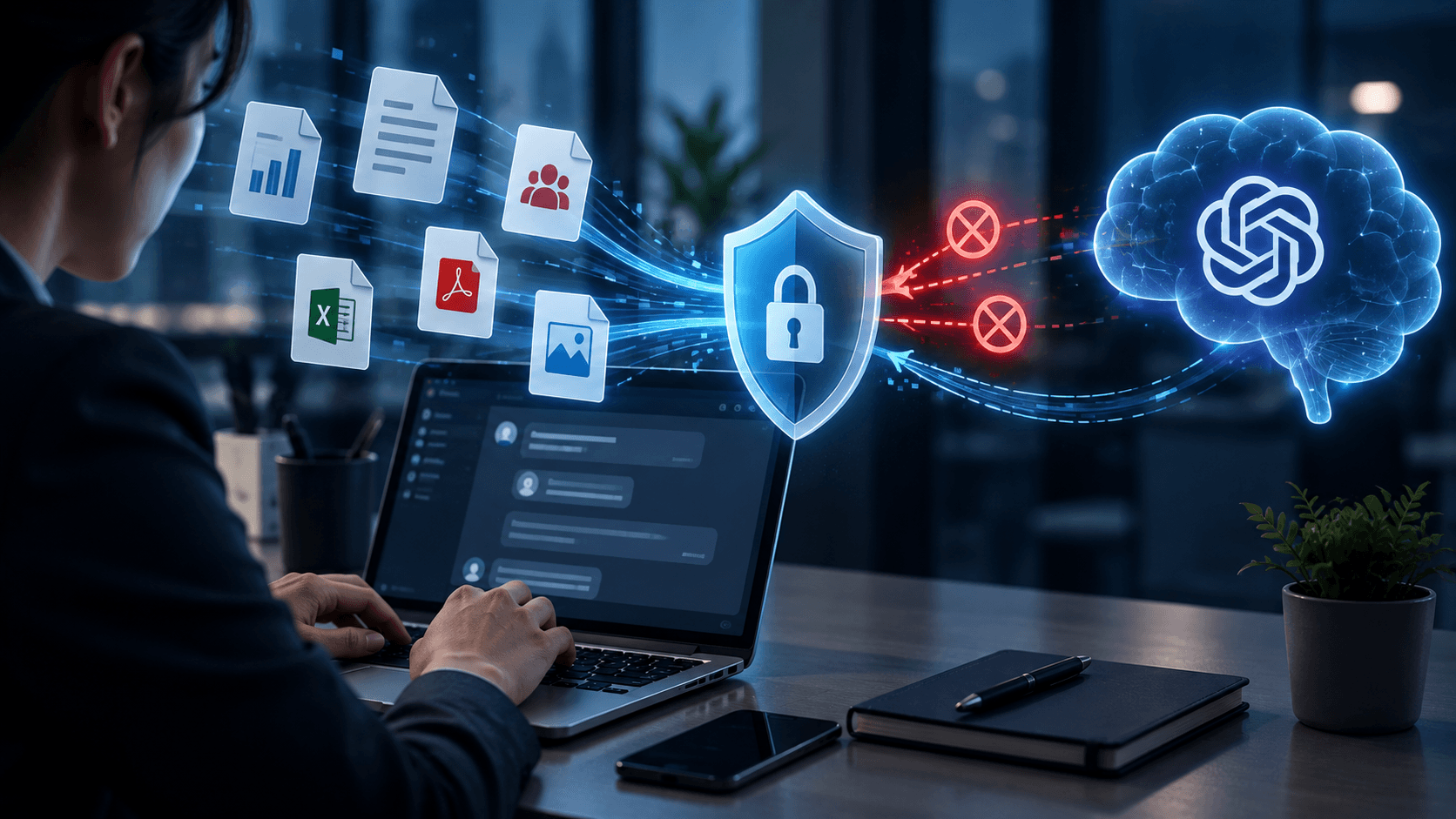
An employee needs to summarize a long customer document.
They open an AI tool, paste the document, and ask:
“Can you summarize this for me?”
It takes seconds.
But the document contains customer names, internal pricing, contract details, and other confidential information.
The employee did not intend to leak company data. They were simply trying to work faster.
This is one of the new challenges businesses face as generative AI becomes part of everyday work.
DLP for AI helps businesses prevent sensitive information from being accidentally shared with AI tools.
The goal is not necessarily to stop employees from using AI.
It is to help them use AI without losing control of business data.
Quick Answer: What Is DLP for AI?
DLP for AI, or Data Loss Prevention for AI, is a security approach that helps identify and prevent sensitive information from being shared with AI applications when it should not be.
For example, it can help protect:
Customer information
Employee information
Financial data
Passwords and credentials
Confidential documents
Contracts
Source code
Internal business information
Intellectual property
Instead of simply asking businesses to “tell employees not to paste confidential information into AI,” DLP adds a protection layer that can identify risky data sharing as it happens.
Why Has AI Created a New Data Security Problem?
Before generative AI became common, employees mainly worked with company data through familiar systems:
Email. Cloud storage. Business applications. Internal tools.
Now there is another destination:
AI.
Employees may copy information from a business system and paste it directly into an AI assistant to:
Summarize a document
Rewrite an email
Analyze a spreadsheet
Review a contract
Fix code
Translate content
Create a report
Analyze customer feedback
These actions can improve productivity.
The problem is that employees may also send information that should not leave the company's controlled environment.
And it can happen with a simple copy and paste.
What Does an AI Data Leak Look Like?
An AI data leak does not always look like a cyberattack.
There may be no hacker.
There may be no malware.
There may be no suspicious email.
An employee can accidentally create the risk while performing normal work.
Here are some simple examples.
Sales
A salesperson copies a customer list into an AI tool and asks:
“Which customers should I prioritize this month?”
The list contains names, email addresses, phone numbers, and sales information.
HR
An HR employee uploads employee records and asks:
“Summarize the performance feedback for these employees.”
The document contains personal employee information.
Finance
A finance employee uploads a financial spreadsheet:
“Find anything unusual in these numbers.”
The file contains confidential revenue, cost, or forecast information.
Legal
An employee uploads a contract:
“Summarize the key risks in this agreement.”
The contract contains confidential commercial terms.
Development
A developer pastes company source code:
“Can you find the bug in this code?”
The code may contain intellectual property or other sensitive information.
In all of these cases, the employee may have a legitimate reason for using AI.
The risk comes from the data being shared.
Why Is Employee Training Alone Not Enough?
Businesses should educate employees about safe AI use.
But policies and training have limitations.
Imagine a company tells employees:
“Never put confidential information into public AI tools.”
That sounds simple.
In practice, an employee working quickly may not realize that a document contains sensitive information.
Or they may think:
“I'm only asking AI to summarize it. What's the problem?”
Other employees may not clearly understand what the organization considers confidential.
DLP for AI adds a technical protection layer on top of policies and training.
Instead of relying entirely on every employee making the right decision every time, businesses can detect risky sharing closer to the moment it happens.
How Does DLP for AI Work?
The exact capabilities depend on the solution, but the basic idea is simple.
Step 1: An Employee Uses an AI Tool
For example, an employee opens a generative AI application and prepares to submit information.
Step 2: The Data Is Checked
The security layer evaluates whether the information may contain sensitive business data.
This might include things such as:
Personal information
Financial information
Credentials
Customer records
Confidential business information
Source code
Step 3: Risky Sharing Is Identified
If the information matches the organization's protection rules, the activity can be identified as risky.
Step 4: The Employee Is Protected Before Data Is Exposed
Depending on the company's policy and the security solution, the action may be:
Blocked
Warned
Logged for review
Handled according to company policy
The key difference is timing.
Protection happens when the employee is about to share the information, rather than after the business discovers a data leak.
What Information Should Businesses Protect From AI Tools?
Every organization is different, but several categories deserve particular attention.
Customer Data
Names, contact details, account information, transaction information, support records, and other customer-related data.
Employee Data
Personal information, salaries, performance reviews, identification documents, health-related records, and internal HR information.
Financial Information
Revenue figures, budgets, forecasts, bank information, pricing, margins, and financial reports.
Credentials and Access Information
Passwords, API keys, access tokens, private keys, and other information that could provide access to company systems.
Intellectual Property
Source code, product designs, research, formulas, internal processes, and other proprietary information.
Confidential Business Information
Contracts, acquisition plans, strategic documents, customer proposals, internal reports, and unreleased product information.
What Is the Difference Between Traditional DLP and DLP for AI?
Traditional Data Loss Prevention focuses on preventing sensitive information from leaving the organization through channels such as email, file transfers, cloud storage, or removable devices.
Generative AI introduces another important data-sharing path.
An employee can copy confidential information and send it to an AI application in seconds.
DLP for AI therefore focuses specifically on understanding and controlling how employees interact with AI tools.
The business question changes from:
“How do we stop sensitive files from leaving?”
to:
“How do we prevent sensitive information from being shared with AI while still allowing employees to use AI productively?”
Should Businesses Simply Block AI?
For some organizations or types of data, restricting particular tools may be appropriate.
But completely blocking AI is not always the most practical long-term approach.
Employees are using AI because it can help them work faster.
The more useful question is:
How can employees use AI safely?
A balanced approach can combine:
Visibility – Understand which AI applications are being used.
Policy – Define what information employees can and cannot share.
Education – Help employees understand the risks.
Protection – Detect or prevent sensitive information from being submitted where it should not be.
The objective is not simply:
“No AI.”
It is:
“Use AI without losing control of company data.”
Why Do SMEs Need DLP for AI?
AI data protection is not only an enterprise problem.
Small and mid-sized businesses may have fewer security resources while employees are adopting the same AI tools as larger organizations.
A single employee could accidentally paste:
A customer database
A contract
Financial information
Source code
Employee records
into an AI service.
The organization may have no dedicated security team watching for it.
For SMEs, DLP for AI can therefore help solve a simple but important problem:
How do we let employees benefit from AI while reducing the chance that confidential business information is shared in the wrong place?
DLP for AI and ShieldNet 360
ShieldNet 360 is designed to help businesses protect employee activity and company data without requiring employees to become cybersecurity experts.
As AI becomes part of everyday work, protection also needs to cover how employees interact with AI applications.
With DLP for AI, ShieldNet 360 can help businesses identify when sensitive information is about to be shared with AI tools and apply protection according to company policies.
This extends protection beyond traditional threats such as malware and phishing to a newer business risk:
Sensitive information leaving the organization through everyday AI use.
From Blocking Threats to Preventing Data Loss
Traditional endpoint security often focuses on what comes into an employee's device:
Malware → Phishing → Suspicious files → Attacks
AI introduces another question:
What is leaving the business?
An employee may not be under attack at all.
They may simply be copying the wrong information into the wrong AI tool.
This is why DLP for AI complements the broader protection provided by ShieldNet 360.
The objective is to protect employees from external threats while also helping prevent confidential company information from being shared unintentionally.
A Simple AI Security Checklist for Businesses
Before allowing broad AI use at work, businesses should answer a few basic questions:
Do we know which AI tools employees are using?
Have we defined what information employees should never share?
Can we detect when sensitive information is being submitted to AI?
What happens when an employee tries to share protected information?
Do employees know what to do when they are unsure?
If the answer to several of these questions is “we don't know,” the business may have an AI data visibility gap.
Key Takeaways
Generative AI is making everyday work faster, but it also creates a new path for business information to leave the organization.
Most employees who paste confidential information into AI are not trying to cause a data breach.
They are trying to get their work done.
That is why businesses need more than a policy telling people to “be careful with AI.”
DLP for AI provides another layer of protection by helping identify sensitive information when employees interact with AI applications.
The goal is straightforward:
Let employees use AI. Keep confidential business data protected.
Frequently Asked Questions
What does DLP for AI mean?
DLP for AI means Data Loss Prevention for AI. It helps businesses identify and prevent sensitive information from being shared with AI applications when that sharing violates company policy.
Can employees paste confidential information into ChatGPT or other AI tools?
Technically, employees may be able to do so depending on the tool and company controls. Whether they should depends on the organization's policies, the type of information, and the terms and data-handling practices of the AI service being used.
What types of data should not be shared with AI?
Businesses should define their own policies, but common protected categories include customer data, employee information, passwords and credentials, financial information, confidential contracts, source code, and intellectual property.
Is blocking AI the same as DLP for AI?
No. Blocking prevents access to an AI service entirely. DLP for AI is intended to provide more granular control over what information can be shared and how risky activity is handled.
Why do SMEs need AI data protection?
SMEs use many of the same AI applications as larger companies but often have smaller security teams. DLP for AI can help reduce accidental data exposure without relying entirely on employees to recognize every sensitive piece of information themselves.
Related Articles

Sep 16, 2026
What is Payroll Phishing and How does it target HR?
Learn how payroll phishing targets HR teams, how fake salary and bank account requests work, the warning signs, and how employees can verify requests safely.

Sep 10, 2026
Can a phishing email come from a real email address?
Yes, phishing emails can come from real email accounts. Learn how attackers hijack trusted accounts, what warning signs to check, and how to verify emails safely.
Sep 9, 2026
How to verify a suspicious email without clicking anything
Learn how to verify a suspicious email safely without clicking links, opening attachments, scanning QR codes, or replying to the sender.

Protect your business with ShieldNet 360
Get started and learn how ShieldNet 360 can support your business.