
Mar 16, 2026
BlogWhat Is Access Management? A Complete Guide for SMEs
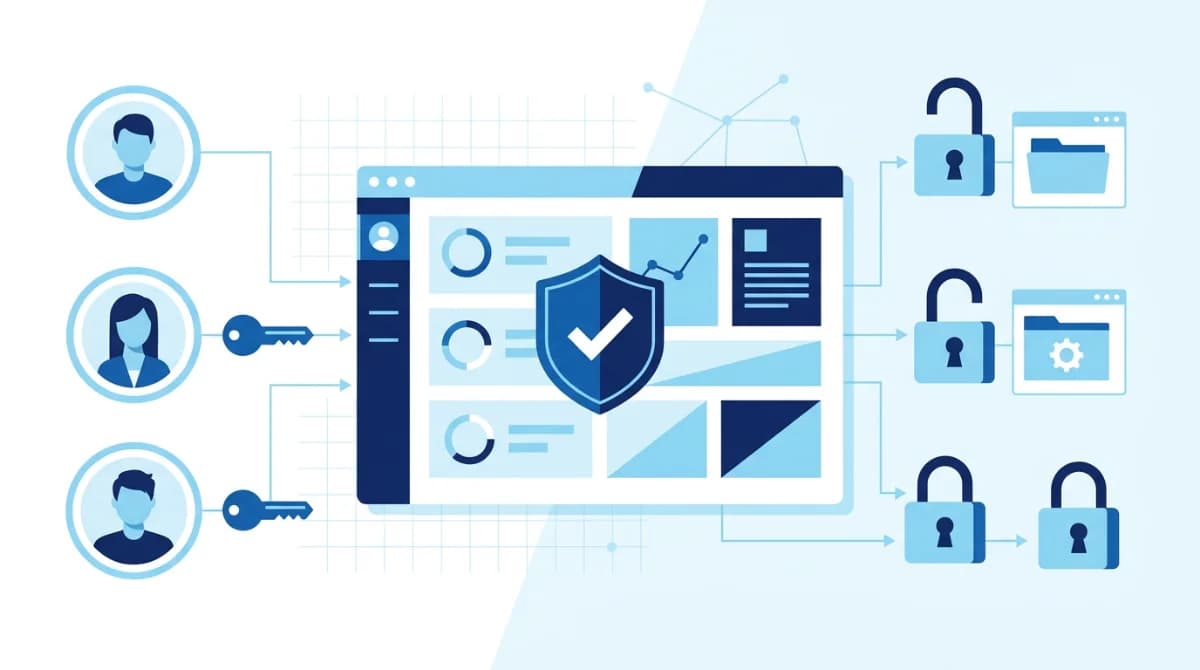
Every day, ex-employees, over-privileged contractors, and forgotten admin accounts sit silently inside SME systems – waiting to become your next breach.
Access management is the process of controlling who can access your business systems, data, and applications – and when. For SMEs, it means defining access control entries (rules that grant or deny permissions to specific users), enforcing least-privilege policies, and maintaining an auditable record of every login and action. Done right, it is your most effective compliance control.
This guide breaks down access management in plain business terms – what it means, why it matters for compliance, and how modern SMEs can implement it without technical overhead or enterprise-level complexity.
What Is an Access Control Entry – and Why Should SMEs Care?
An access control entry (ACE) is the individual rule inside an access control list (ACL) that says: this user can do this action on this resource. Think of an ACL as your building's visitor log and an ACE as one line in it: "Contractor Ahmed – Level 2 only – 9am to 5pm."
In a business context, every system your team uses – Microsoft 365, Google Workspace, cloud servers, internal dashboards – operates on ACEs. The problem for most SMEs is that these rules accumulate silently over time, with no one reviewing them.
Common access control problems SMEs face include:
- Ghost access: Former employees still have active logins months after leaving
- Permission creep: Employees accumulate more access than their current role needs
- Shared credentials: Multiple users logging in under one account with no individual accountability
- No offboarding process: New hires get access; departing employees take time to be removed
- Audit blindness: No log of who accessed what, making compliance reviews a scramble
Understanding access control entries is the first step. Acting on them is where compliance – and security – actually happens.
Why Does Access Management Matter for SME Compliance?
Auditors for ISO 27001, PCI DSS, and GDPR don't just ask if you have security tools. They ask: can you prove who had access to what, and when? Access management is the mechanism that generates that proof.
Credential abuse remains the top initial access vector in data breaches year after year, with 88% of attacks against basic web applications involving stolen credentials, according to the 2025 Verizon Data Breach Investigations Report. For compliance officers, that's a direct line from poor access governance to audit failure.
Here's what access management directly supports across major frameworks:
Framework | Access Control Requirement |
|---|---|
ISO 27001 (A.9) | Formal access control policy, user registration, privilege management |
PCI DSS (Req. 7) | Restrict access to system components on a need-to-know basis |
GDPR (Art. 25/32) | Data minimization and access restriction by design and default |
Third-party involvement in breaches doubled year-over-year in the 2025 DBIR, jumping from 15% to 30% – driven in part by credential exposures from partners and misconfigured environments. For SMEs working with contractors, freelancers, or SaaS vendors, this is a direct risk that access management controls.
The bottom line: compliance bodies aren't testing your tools – they're testing your governance. Access logs, session records, and role-based access reviews are the evidence that passes an audit.
How Should SMEs Implement Access Management Without Complexity?
Most access management failures in SMEs aren't technical – they're operational. There's no defined process, no ownership, and no visibility. Here's a practical framework:
Step 1 – Map your access landscape List every system, app, and cloud service your team uses. For each, identify who has access and at what level. You'll almost always find access that shouldn't exist.
Step 2 – Apply least-privilege access Every user – employee, contractor, or partner – should access only what they need for their specific role. Not more. This is the foundation of every access control framework, including NIST SP 800-207 Zero Trust Architecture.
Step 3 – Enforce continuous identity verification Static passwords and shared credentials are no longer sufficient. Modern access management verifies identity at every connection attempt – not just at login. This is the core principle behind Zero Trust Network Access (ZTNA).
Step 4 – Automate onboarding and offboarding The highest-risk moments in access management are when employees join or leave. Automating these processes – so access is provisioned on Day 1 and revoked on Day Last – eliminates the ghost access problem.
Step 5 – Generate audit-ready logs Every access event should be logged with user identity, timestamp, device, and action. This is what auditors pull during ISO 27001 or PCI DSS reviews.
Traditional VPN vs Identity-Based Access: What's the Real Difference?
Most SMEs still rely on VPNs or manual access management inherited from their earliest IT setup. Here's how that compares to a modern, identity-based approach:
Feature | Traditional VPN / Manual Access | Identity-Based Access (ZTNA) |
|---|---|---|
Access model | Tunnel-based, grants broad network access once connected | Identity-verified, per-session, least-privilege access |
Audit visibility | Limited – often no individual session logs | Complete per-user access logs, real-time visibility |
Setup and maintenance | Requires installation, manual configuration, ongoing IT management | Cloud-based, no installation needed, integrates with M365 and Google Workspace |
Offboarding | Manual removal from multiple systems, often delayed | Access removed instantly when identity is deprovisioned |
Compliance readiness | Manual access reviews; evidence gathered ad-hoc | Continuous, automated audit-ready access records |
ShieldNet Access takes this identity-based approach further – providing continuous verification of every user and device, automatic isolation of risky endpoints, and seamless integration with Microsoft 365 and Google Workspace. It replaces traditional VPN infrastructure entirely, with no installation required, making it practical for SME teams without a dedicated IT security function.
FAQ
What are the 4 types of access control?
The four main models are: Mandatory Access Control (MAC) – set by the system, not users; Discretionary Access Control (DAC) – resource owners set permissions; Role-Based Access Control (RBAC) – permissions tied to job roles; and Attribute-Based Access Control (ABAC) – conditions-based rules. For most SMEs, RBAC is the most practical and audit-friendly starting point.
What is the difference between an ACE and an ACL?
An Access Control List (ACL) is the full list of permission rules for a system or resource. An Access Control Entry (ACE) is a single rule within that list – for example, "User X can read File Y." Every ACL is made up of multiple ACEs, each defining a specific permission for a specific identity.
What does access management do for compliance?
Access management creates the evidence trail compliance frameworks require: who accessed what system, when, from which device, and with what permissions. Without this, passing ISO 27001 Annex A.9, PCI DSS Requirement 7, or GDPR Article 32 audits requires manual reconstruction – which is both unreliable and time-consuming.
Authoritative Citations:
- Verizon 2025 Data Breach Investigations Report – https://www.verizon.com/business/resources/reports/dbir/
- NIST SP 800-207: Zero Trust Architecture – https://csrc.nist.gov/publications/detail/sp/800-207/final
- IBM: What is Access Management? – https://www.ibm.com/think/topics/access-management
Related Articles

Sep 7, 2026
What is CEO fraud? How fake executive emails work
Learn how CEO fraud works, how attackers impersonate executives by email, the warning signs to watch for, and how employees can verify suspicious requests.

Sep 4, 2026
10 types of email attacks every employee should know
Learn 10 common email attacks, from phishing and CEO fraud to fake invoices and QR scams, plus simple ways employees can recognize and respond to them.
Aug 31, 2026
How security monitoring helps compliance
Learn how continuous security monitoring supports compliance by improving visibility, incident reporting, audit evidence, and data protection.

Protect your business with ShieldNet 360
Get started and learn how ShieldNet 360 can support your business.