
Apr 28, 2026
BlogIncident triage for lean teams: prioritize what matters fast
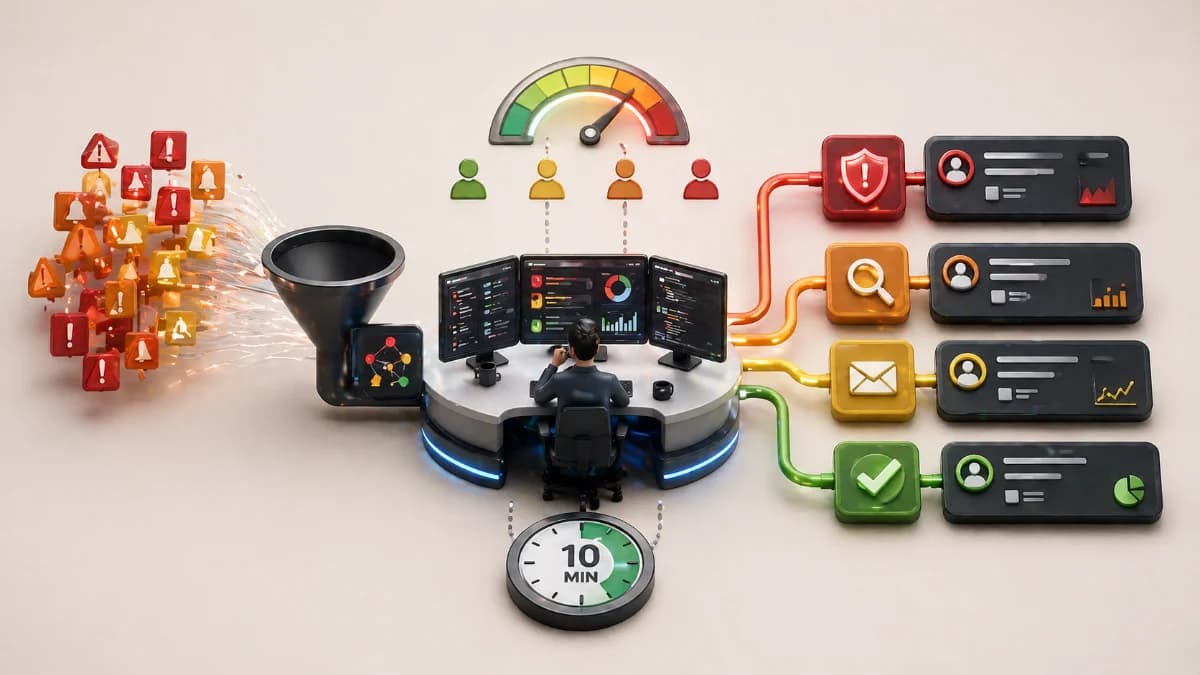
Incident triage for lean teams using severity scoring, incident prioritization, and an incident queue to decide next actions in 10 minutes with clear summaries.
Incident triage is the fast decision loop that turns a pile of alerts into an ordered incident queue your team can actually work. For lean teams, the goal is not perfect analysis in the moment, it is deciding what matters in about 10 minutes so you can contain risk early and avoid alert fatigue. A simple triage rubric uses three inputs, business impact, confidence, and urgency, then produces one of three outcomes: contain now, review quickly, or monitor. This article gives a practical severity scoring method, explains incident prioritization for an incident queue, and shows how to map triage to dashboard summaries and next actions that a non-specialist can follow.
Why this topic matters
Lean teams fail at security not because they do not care, but because they cannot afford to treat every alert as urgent. When everything is high priority, nothing is. Attackers benefit from that confusion because real incidents get buried under noise. Incident triage matters because it compresses decision-making into a predictable routine, so you can contain the true high-risk incidents quickly while keeping the workload manageable.
A realistic scenario is a Friday evening identity event. You see a suspicious login, an MFA prompt, and a password reset, but you do not know if it is a user mistake, a phishing attack, or a brute force attempt. Without a rubric, one person might escalate it as critical, another might ignore it, and both outcomes create risk. With a rubric and an incident queue, you can score severity, capture a dashboard summary, take a safe next action, and move on. This keeps response consistent and reduces alert fatigue.
Key factors and features to consider
The 10-minute triage goal: decide, do, document
A 10-minute triage goal does not mean you solve the incident in 10 minutes. It means you make a decision, take the first safe action, and document a summary so the next person can continue. In practice, that means you create a clear incident record, assign an owner, and decide whether to contain now, review soon, or monitor. This is how lean teams maintain momentum without requiring specialist depth.
The triage process should start with the minimum evidence package: what happened, what asset is involved, what changed recently, and what is the likely impact. If you cannot get this package quickly, your monitoring is too fragmented and you need better correlation. Tools like ShieldNet Defense can support this by producing a plain-language incident summary and a timeline automatically, but the rubric is what keeps decisions consistent.
Severity scoring: a simple three-axis rubric
Severity scoring works best when it is simple enough to use under pressure. A three-axis rubric is practical: business impact, confidence, and urgency. Business impact asks what would happen if this incident is real, such as financial loss, customer data exposure, or operational downtime. Confidence asks how strongly the evidence supports malicious activity, based on correlated signals and unusual behavior. Urgency asks whether the incident is actively progressing, such as ongoing logins, data transfers, or encryption behavior.
Each axis can be scored as low, medium, or high. Combine the scores to assign a severity label: critical, high, medium, or low. This method avoids false precision and keeps triage fast. It also supports incident prioritization because your incident queue can be sorted by severity and urgency, not by alert volume.
Incident prioritization: sorting the incident queue by outcomes
Incident prioritization means the incident queue is ordered by what you need to do next, not by what arrived first. Lean teams should prioritize incidents that are both high impact and time sensitive, such as account takeover in finance, ransomware-like behavior, or privileged access abuse. Medium priority incidents are those with moderate impact or uncertain confidence, requiring quick review but not immediate containment. Low priority incidents are those with low impact or low confidence, often handled by monitoring and evidence collection.
A useful operational trick is to define three queue lanes. Lane one is contain now, lane two is review within a defined SLA, and lane three is monitor. This structure maps directly to staffing reality and reduces decision churn. Your dashboard should mirror these lanes, so leadership and operators share the same mental model.
Dashboard summaries: the four-line format that prevents confusion
Lean teams need dashboard summaries that are readable in one minute. A practical format is four lines: what happened, what is at risk, what we did, and what you do next. This format keeps communication clear and reduces back-and-forth questions. It also allows non-specialists to participate in response, because the summary is operational rather than technical.
Each summary should include the minimum evidence highlights and a confidence indicator. If you have to open five tools to understand the incident, your summary is not working. A platform like ShieldNet Defense can help by generating these plain-language summaries consistently, but you should enforce the four-line structure in your runbooks so every incident record is comparable.
Next actions: safe containment versus approval-gated steps
The rubric must map to concrete next actions. For critical and high incidents, the first step should be a safe containment action that is reversible and scoped, such as session revocation, forced re-authentication, email quarantine, or isolating a single endpoint. For medium incidents, the next step is evidence enrichment and a human review, such as checking recent sign-ins or verifying user activity. For low incidents, the next step is monitoring with additional logging and possibly tuning to reduce noise.
Approval gates should be explicit for disruptive actions like disabling critical accounts, blocking broad domains, or isolating servers. Lean teams should use time-limited containment when confidence is high but approvals are needed, applying a reversible restriction briefly while waiting for a decision. This keeps response fast while protecting business continuity.
Detailed comparisons or explanations
A practical triage walk-through in 10 minutes
Minute 1 to 2: Identify the asset and the context. Determine whether the incident touches a critical account, a production server, or sensitive data. Check whether there were recent changes such as deployments, password resets, or travel that could explain activity. This context prevents misclassification.
Minute 3 to 5: Assess confidence by looking for correlated signals. A single anomaly is rarely enough. Look for supporting evidence like multiple failed logins, mailbox rule changes, unusual downloads, or endpoint process anomalies. If you can confirm at least two independent signals, confidence increases significantly.
Minute 6 to 8: Take the first safe action if impact and urgency justify it. For example, revoke suspicious sessions or quarantine a malicious email. Record exactly what was done and when. This is how you keep the incident from expanding while you continue analysis.
Minute 9 to 10: Write the dashboard summary and assign the next step. Use the four-line format and choose one lane for the incident queue: contain now, review soon, or monitor. Assign an owner and a time target. This ensures continuity and prevents the incident from being forgotten.
This walk-through is intentionally simple. It gives lean teams a repeatable cadence that reduces chaos. Over time, it also improves KPIs because time to first containment becomes faster and more consistent.
Example rubric: scoring a suspicious login incident
Business impact is high if the account is finance, admin, or has access to customer data, medium if it is a normal employee account, and low if it is a low-privilege test account. Confidence is high if there are correlated signals such as new device sign-in plus mailbox rule changes, medium if there is one strong signal like repeated MFA failures, and low if it is a single anomaly without follow-on actions. Urgency is high if activity is ongoing, such as repeated logins or downloads, medium if activity stopped but evidence suggests risk, and low if it is historical and not recurring.
From these three scores, you can quickly classify severity. A high impact, high confidence, high urgency incident goes into contain now. A medium confidence incident with high impact goes into review soon with evidence enrichment. A low confidence, low impact, low urgency incident goes into monitor. This is incident prioritization that fits lean-team reality.
How ShieldNet Defense can support triage without replacing judgment
ShieldNet Defense can support incident triage by producing consistent incident narratives, timelines, and evidence highlights across sources. That reduces the time spent gathering context and helps non-specialists understand what is happening. It also helps reduce alert fatigue by grouping alerts into incidents and raising confidence only when correlation supports it. For lean teams, this can make the 10-minute triage goal achievable more often.
The key is governance. The rubric should still be used to decide actions and approvals. ShieldNet Defense can propose safe actions, but disruptive actions should remain approval-gated until false positives are proven low. When tools support the rubric, triage becomes faster and more consistent without sacrificing safety.
Best practices and recommendations
- Define critical assets and accounts in advance so impact scoring is fast
- Use a three-axis severity scoring rubric: impact, confidence, urgency
- Operate an incident queue with three lanes: contain now, review soon, monitor
- Standardize dashboard summaries using the four-line format
- Map each severity to safe next actions and explicit approval gates
- Review triage outcomes monthly and tune correlation to reduce false positives
To implement, run a two-week trial where every incident is triaged using the rubric and recorded in the same summary format. Track how many incidents land in each lane and how often safe containment actions were taken. If too many incidents become contain now, tighten confidence requirements. If too many incidents are missed, improve integrations and correlation. This is how you refine incident prioritization without increasing alert fatigue.
FAQ
What is incident triage in a lean team context?
Incident triage is the quick process of deciding which incidents deserve immediate containment, which need review, and which can be monitored. Lean teams use triage to avoid treating every alert as urgent. The goal is a fast decision loop with clear documentation and an assigned owner. This prevents alert fatigue and missed high-severity incidents.
How should we score severity without overcomplicating it?
Use three axes: business impact, confidence, and urgency, each scored low, medium, or high. Then map combinations to a small set of severity labels and actions. Avoid detailed numeric scoring that slows decisions. A simple rubric keeps triage consistent under pressure and supports incident queue prioritization.
What belongs in the incident queue versus the alert queue?
Alerts are raw signals and can be noisy. The incident queue should contain grouped, correlated incidents with evidence and a clear owner. Lean teams should operate primarily from the incident queue, because it reflects actionable work. Alert triage automation or tooling should convert alerts into incidents before they reach humans.
How do we prevent the queue from filling up?
Prevent queue overload by tightening correlation thresholds, suppressing known benign patterns, and requiring multiple signals for escalation. Also define SLAs for review soon items so they do not linger. Regular monthly tuning is essential to keep alert fatigue low. The queue should represent manageable work, not every anomaly.
What is a good first containment action for high-severity incidents?
A good first action is reversible and scoped, such as revoking sessions, forcing re-authentication, quarantining a malicious email, or isolating one endpoint. These actions reduce attacker dwell time without shutting down core systems. Disruptive actions should be approval-gated. This keeps response fast and safe.
Conclusion
Incident triage for lean teams succeeds when it is fast, consistent, and mapped to action. A simple rubric using severity scoring across impact, confidence, and urgency lets you prioritize an incident queue in about 10 minutes. When dashboard summaries follow the four-line format and next actions are pre-defined with approval gates, response becomes predictable and alert fatigue drops. Over time, the result is faster containment and fewer missed critical incidents, even without a full SOC team.
Related Articles

Oct 22, 2026
Real or Fake? HR Asking You to Review Payroll
Got an email from HR asking you to review payroll? Learn how to identify fake payroll emails, verify HR requests, and protect your salary and bank details.

Oct 9, 2026
I replied to a phishing email. Am I at risk?
Replied to a phishing email? Learn what risks you face, what attackers can learn from your reply, and what to do next to protect your account and business.
Oct 8, 2026
Real or Fake? How to verify a sharepoint file invitation
Received a SharePoint file invitation? Learn how to spot fake SharePoint emails, verify shared files safely, and protect your Microsoft 365 account from phishing.

Protect your business with ShieldNet 360
Get started and learn how ShieldNet 360 can support your business.