
Nov 5, 2026
BlogUnderstanding the $6.3B Binance Attack & How ShieldNet 360 Stops It
On October 29–30, 2026, the digital asset industry recorded the largest security breach in cryptocurrency history: approximately $6.34 billion in digital assets was withdrawn without authorization from Binance hot wallets across ten blockchains in under four hours. That figure is nearly three times the combined losses of the two largest prior incidents – the February 2025 Bybit breach ($1.46 billion) and the 2022 Ronin Bridge attack ($625 million).
For business executives and security engineers alike, the most important point to understand clearly is what remained completely intact: neither multi-party computation (MPC) wallet cryptography nor the underlying blockchain networks were broken. The attackers did not crack a single cryptographic key. Instead, over five months, they worked through the human and software environment surrounding those keys – moving from a fake developer software ad and a staged two-round job interview to an internal AI coding tool, an unauthorized container connected to the wallet-signing service, and EIP-7702 smart-contract delegations on Ethereum.
This report walks chronologically through the five-month incident timeline, explains the underlying technical mechanisms in clear terms, and shows how ShieldNet 360 – combining unified Security Telemetry, a real-time Behavioral Detection Engine, and its Ultimate plan (15-minute after-hours AI Agent containment paired with a 4-hour human expert MTTR) – detects and stops this chain of events early.
Incident summary in 60 seconds
Category | Verified Details |
Incident Timeline | Intrusion began June 2026; unauthorized withdrawals occurred Oct 29, 17:15 UTC – Oct 30, 00:10 UTC (Oct 30, 00:15 – 07:10 UTC+7) |
Gross Assets Affected | ~$6.30B – $6.36B across 10 blockchains (including 18,270 BTC, 233.46M XRP, 970,500 SOL, 44.2M OP, ETH, and major stablecoins) |
Frozen & Replenished | ~$2.85B frozen on-chain with Tether, Circle, Ripple, and network security councils; Binance covered 100% of remaining impact via corporate reserves and SAFU (restoring 98%+ Proof of Reserves by Oct 31) |
Attributed Threat Group | TraderTraitor (DPRK / Lazarus Group nexus) – formally confirmed by the FBI, U.S. Secret Service, IRS-CI, TRM Labs, and Elliptic |
Initial Entry Point | Malicious search ad serving a tampered Homebrew installer (June 2026), followed by a two-round fake job interview delivering a zero-day |
Internal Lateral Path | Used an internal AI developer platform from Engineer B's laptop to access Engineers A & C, stealing a container deployment token for the Wallet Signing Service |
On-Chain Mechanism | Broadcast 50 pre-signed EIP-7702 authorizations across consecutive transaction counters ( |
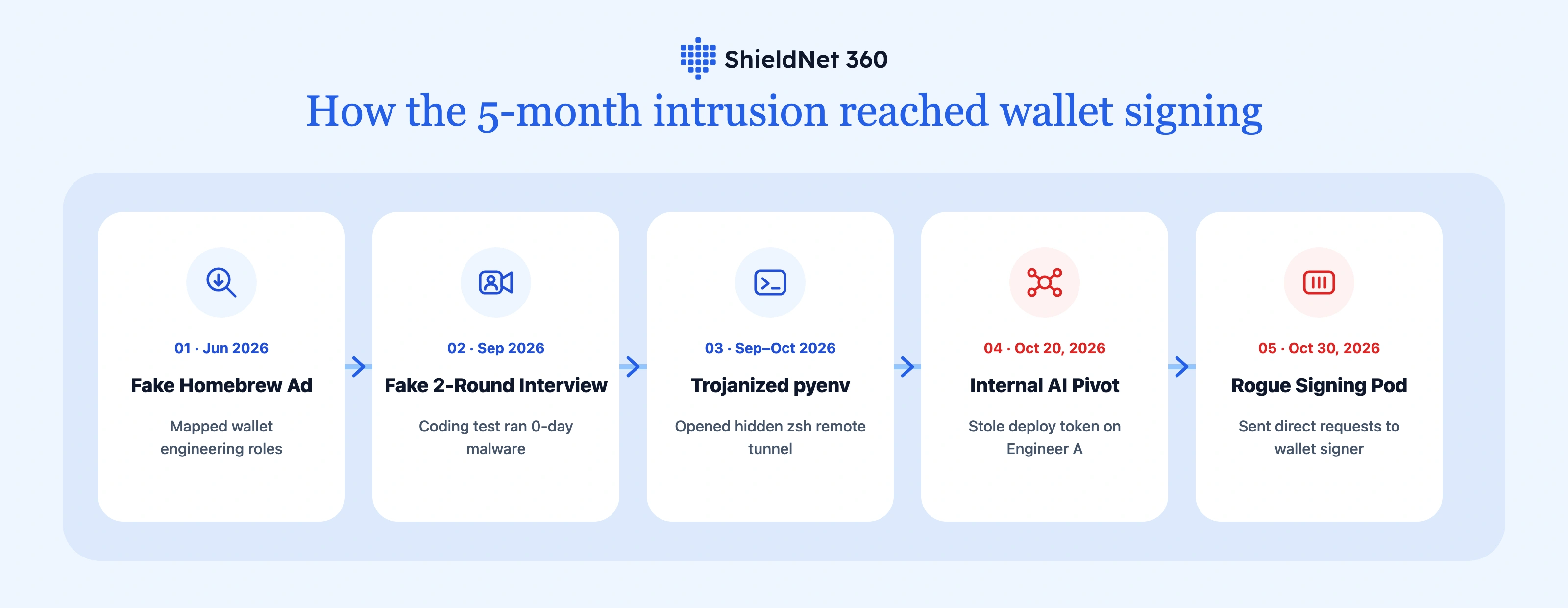
Figure 1. Full 5-month timeline of the intrusion into developer workstations, internal AI tooling, and wallet-signing infrastructure (Graphic: ShieldNet 360 Threat Intelligence).
1. Timeline of the 5-month intrusion: From a fake job interview to Wallet Signing
Based on Binance's official disclosure (29 October 2026 Binance Security Incident: Initial Findings and Response Update) and independent technical reports from Halborn and TRM Labs, the intrusion progressed across five stages involving three engineers on the wallet team (Engineer A, Engineer B, and Engineer C).
Stage 1 (June 2026): Team mapping via a malicious Homebrew search ad
The timeline opened when Engineer A, a Wallet DevOps engineer, searched online for an AI coding utility and clicked a malicious search advertisement. The page delivered a tampered installer for Homebrew, a widely used package manager on macOS.
Binance's security team detected anomalous activity, revoked certificates, and replaced Engineer A's laptop. However, that brief access was enough for the attackers to record internal identities and understand who operated Binance's wallet infrastructure.
Stage 2 (September 2026): Two-round fake executive interview targeting Engineer B
Three months later, following the Contagious Interview approach characteristic of TraderTraitor, an account posing as a "Project Director" contacted Engineer B on a professional recruiting platform:
Round 1 – Establishing credibility: An individual posing as an "HR specialist" held a live video call with camera enabled and shared convincing professional profiles.
Round 2 – Delivering the malicious project: A fake "CEO" interviewed Engineer B via chat and sent a "technical coding assessment." When Engineer B downloaded the repository onto a work laptop and ran its setup script, an unknown zero-day payload executed without matching any existing antivirus signature.
Stage 3: Replacing the pyenv launcher with a 70-byte difference
Rather than creating a visible system startup item that routine monitoring might flag, the malware placed itself inside a developer utility used throughout the workday:
An obfuscated setup script removed the legitimate
pyenvexecutable – a 3,344-byte launcher used to manage Python versions – and replaced it with a modified 3,414-byte binary, a difference of 70 bytes.The modified file created a symbolic link, opened a covert
zshcommand-and-control (C2) connection to attacker infrastructure, and deleted its initial setup files. Every time Engineer B ran Python commands afterward, the malicious code ran under Engineer B's normal user permissions.
Stage 4 (October 20, 2026): Lateral movement across laptops via an internal AI tool
On October 20, operating from Engineer B's compromised laptop, the attackers used the network reach of an internal AI coding platform to move laterally onto the workstations of Engineer A (Wallet DevOps) and Engineer C (Wallet Software Engineer).
From Engineer A's machine, they obtained a critical credential: a container deployment permission token used to deploy workloads into the wallet service environment.
Stage 5 (October 29, 17:15–19:56 UTC): Launching an unauthorized container in Wallet Signing
During late-night hours in Asia (00:15–02:56 UTC+7 on October 30), the attackers accessed Engineer C's laptop and combined local access with Engineer A's stolen deployment token to start an unauthorized container connected directly to the Wallet Signing Service – allowing signature requests to bypass standard external withdrawal checks.
2. Inside the 4-hour response window: Understanding EIP-7702 and MPC recovery
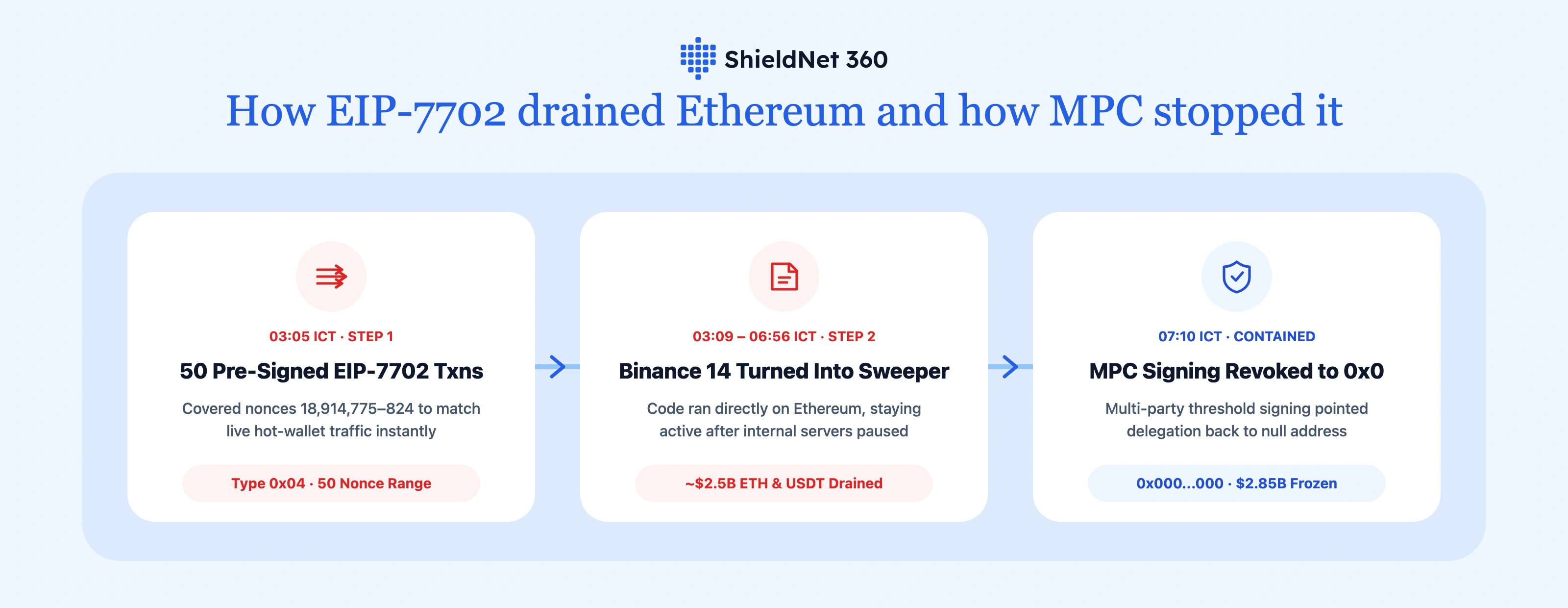
Figure 2. How 50 pre-signed EIP-7702 delegations attached automated sweeper code to hot wallet Binance 14 and how an emergency MPC signing flow to 0x0 stopped the transfers (Graphic: ShieldNet 360 Threat Intelligence).
Once connected to the signing service, the attackers ran automated withdrawal scripts across multiple networks:
20:05–20:09 UTC (4-minute multi-chain withdrawals): Automated requests transferred 233.46M XRP, 970,500 SOL, 44.2M OP, and 18,270 BTC out of hot wallets within four minutes.
50 pre-signed EIP-7702 authorizations on Ethereum: On Ethereum, the attackers used EIP-7702 – a protocol feature that lets a standard wallet temporarily attach automated smart-contract logic (via Type
0x04transactions). Because an exchange hot wallet processes customer transactions every second, its sequential transaction counter (nonce) changes constantly. To match that moving counter, the attackers pre-signed 50 consecutive EIP-7702 authorizations spanning nonces18,914,775through18,914,824. Once a matching nonce landed on-chain, hot walletBinance 14began executing attacker-controlled contract logic, transferring roughly $2.5 billion in ETH and stablecoins and automatically forwarding incoming deposits.
Why pausing internal withdrawal systems did not immediately stop Ethereum transfers
Binance's response team paused internal withdrawal systems within minutes. Even so, unauthorized Ethereum transfers continued until 23:56 UTC (with a final transfer of 2,961.9 ETH). Understanding why requires looking at two technical factors:
EIP-7702 delegations execute directly on the public blockchain: Once the authorization was recorded on Ethereum, the delegated contract logic resided in the account's on-chain state rather than on Binance's internal servers. Stopping backend withdrawal servers could not disable code already active on Ethereum.
Operational design of Multi-Party Computation (MPC) wallets: Hot wallet keys were protected using MPC – splitting signing authority across multiple separate shares (similar to a vault requiring several independent keys turned together) so that no single raw private key exists in one place. Because engineers could not export a single private key to manually cancel the delegation, they had to build and verify a custom MPC signing workflow to broadcast a new EIP-7702 transaction pointing to the null zero address (
0x0000000000000000000000000000000000000000) at 00:10 UTC on October 30, removing the unauthorized delegation fromBinance 14.
3. Understanding three core risks for modern technology enterprises
Viewed alongside the February 2025 Bybit incident ($1.46B, originating on a compromised Safe{Wallet} developer workstation) and the 2022 Ronin Bridge breach ($625M, initiated via a fake recruitment PDF on LinkedIn), three clear lessons emerge:
Attackers rarely break cryptography – they compromise authorized users and workloads: Even strong MPC and HSM architectures will sign requests if an unauthorized container holding valid deployment tokens is allowed to reach the signing service.
Routine developer utilities (
Homebrew,pyenv,npm,PyPI) provide quiet persistence: Small command-line binaries inside user directories run constantly during normal engineering work yet often go unnoticed by legacy signature-only antivirus tools.Internal AI tools can unintentionally connect separate trust zones: Enterprise AI coding assistants and internal agents frequently connect source repositories, developer laptops, and deployment infrastructure. Without strict Zero-Trust boundaries, a single compromised laptop can expose adjacent engineering systems.
4. How ShieldNet 360 detects and stops this attack across five defense layers
A five-month intrusion spanning developer workstations, modified Python utilities, credential access, and unauthorized containers produces clear behavioral telemetry at every stage. ShieldNet 360 brings together Security Telemetry across endpoints, networks, containers, and cloud environments, analyzing events in real time with its Behavioral Detection Engine across five independent defense layers.
To address off-hours attacks (such as the 00:15–03:05 UTC+7 window in this incident), ShieldNet 360's Ultimate plan combines two response layers: an autonomous AI Agent triages and contains threats outside business hours within 15 minutes, while human security experts investigate and complete full incident containment within a 4-hour MTTR.
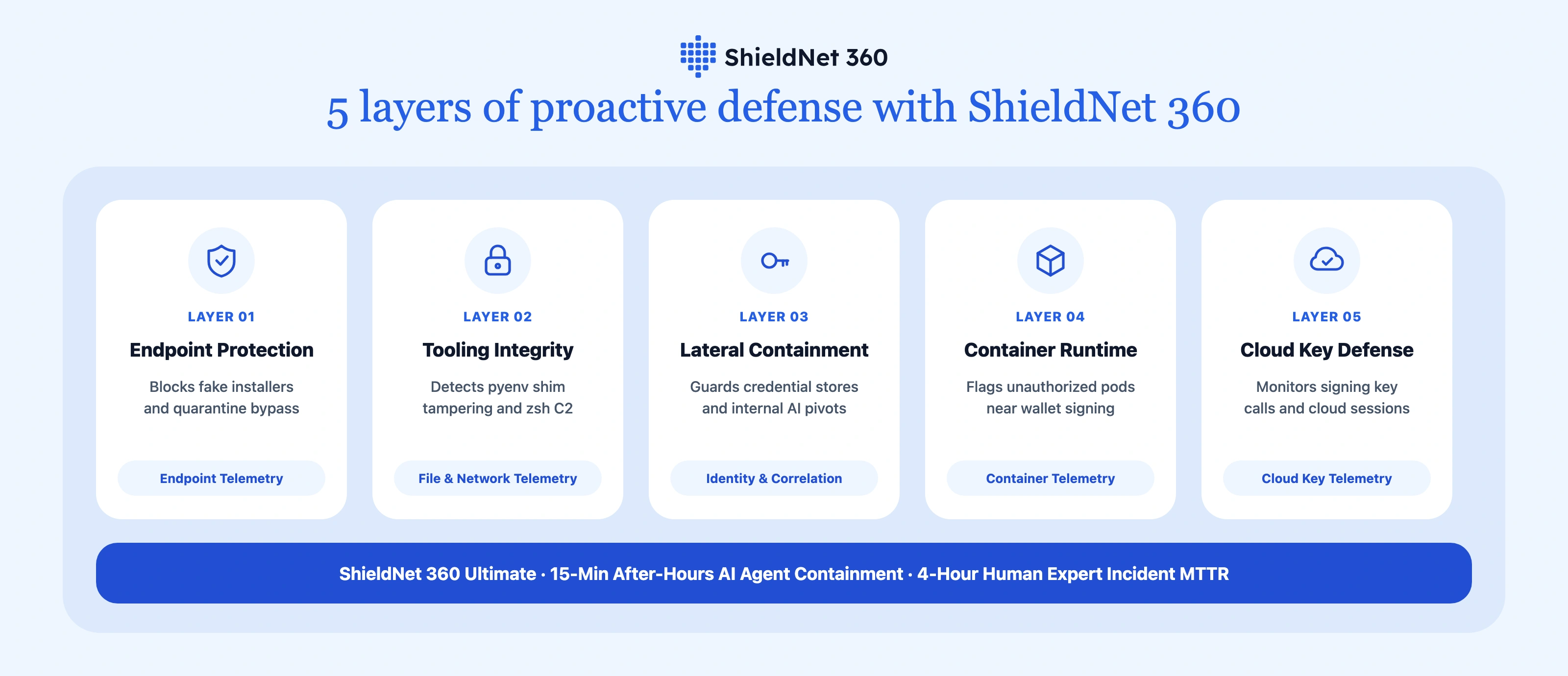
Figure 3. ShieldNet 360's 5-layer defense architecture combining unified Security Telemetry, Behavioral Detection Engine, 15-minute after-hours AI Agent response, and 4-hour Ultimate expert MTTR.
Layer 1: Stopping fake installers and macOS Gatekeeper bypasses on workstations
At Stages 1 and 2, when an engineer runs a tampered installer command or initializes an untrusted project repository:
Recorded Telemetry: The Protection Agent on the workstation captures process execution, full command-line arguments, application code-signing status, and newly created executable files in real time.
Detection Engine Analysis: Identifies terminal commands that download and execute remote scripts directly (
curl | bash,curl | zsh–MITRE T1204.004), detects package managers opening unexpected external network connections (T1195.001), and flags untrusted processes removing macOS quarantine attributes (com.apple.quarantine) to bypass Gatekeeper (T1553.001).Containment Action: Terminates the suspicious shell process automatically and quarantines the untrusted file before persistence is established.
Layer 2: Detecting the pyenv binary replacement and covert command channel
Even when a zero-day payload replaces pyenv (3,344B → 3,414B) without matching any known antivirus signature, operating-system behavior reveals the modification:
Recorded Telemetry: Continuous monitoring of binary file integrity, code signatures, shell startup files, and outbound network connections. On Apple Silicon Macs, modifying even one byte of an executable invalidates its original code signature – requiring the attacker either to re-sign the file locally or modify shell and Python startup scripts.
Detection Engine Analysis: Flags unexpected local ad-hoc code signing (
codesign -s -–T1036.001), unauthorized edits to.zshrcor.bash_profile, silent Python startup hooks (.pth,sitecustomize.py–T1546.018), and setup file deletion paired with persistent outboundzshconnections (T1070.004,T1572).Containment Action: Blocks outbound C2 traffic at the network boundary and blocks the modified
pyenvfile hash across all managed endpoints.
Layer 3: Stopping credential theft and lateral movement nine days before funds moved
On October 20 – nine days before any withdrawals occurred – when the attackers accessed credential files on Engineer B's laptop and moved laterally to Engineers A and C:
Event Correlation: ShieldNet 360's Correlation Engine connects suspicious process activity, sensitive file reads, and unusual workstation-to-workstation connections on the same host into a single high-priority alert.
Detection Engine Analysis: Detects unauthorized access to the macOS System Keychain (
T1555.001), alerts immediately when untrusted processes read DevOps credential paths (~/.aws/credentials,~/.kube/config,~/.docker/config.json,~/.ssh/, or local deployment tokens –T1552.001), and identifies abnormal internal lateral connections (T1021.004).Ultimate Plan Response: If triggered overnight or on weekends, ShieldNet 360's AI Agent automatically isolates the affected laptop from the internal network within 15 minutes, stopping lateral spread – while human security experts complete investigation and full incident containment within a 4-hour MTTR, protecting Engineer A's deployment token long before October 29.
Layers 4 & 5: Monitoring Kubernetes containers at runtime and protecting Cloud KMS
Even if valid deployment credentials were stolen and used to launch an unauthorized container near signing infrastructure:
Defense Layer | Security Telemetry Captured | Anomalous Behavior Detected | Ultimate Plan Response |
Container Runtime | Real-time process, file, and network telemetry inside Kubernetes pods | Unregistered container deployments ( | 15-min after-hours AI Agent containment; coordinated removal of the unauthorized pod |
In-Pod Behavior Sequences | Step-by-step activity correlation per container workload | A container opening an interactive shell followed immediately by secret reads or host access attempts | Immediate revocation of workload permissions and deployment tokens |
Cloud Identity (IAM) | Continuous cloud audit logs (AWS CloudTrail, GCP Audit Logs) | Unusual temporary session requests ( | Suspend unauthorized cloud sessions; human experts complete containment in ≤ 4h MTTR |
Cloud KMS Key Protection | Real-time monitoring of cryptographic API calls and key permissions | Abnormal wallet key calls, unauthorized KMS grants added, or modified key policies ( | Revoke unauthorized grants and initiate controlled key rotation |
Scope note: ShieldNet 360 monitors and protects endpoints, networks, Kubernetes runtimes, and cloud environments to detect and isolate threats early, while blockchain-specific signing rules are enforced by the organization's custody policy engine. Pairing ShieldNet 360 Ultimate with strict application-layer signing controls addresses both infrastructure and on-chain risk.
5. Six practical recommendations for CISOs, FinTech, and Web3 teams
Deploy behavior- and signature-aware protection on 100% of developer workstations: Monitor direct script execution (
curl | bash), quarantine-flag removal, localcodesign -s -commands, and changes inside developer tool directories (~/.pyenv,/opt/homebrew,.zshrc,.pth).Apply Zero-Trust access controls to internal AI tools: Restrict internal AI coding assistants and agent services to least-privilege permissions, preventing direct network bridges between user laptops and production environments.
Remove static long-lived deployment tokens from engineer laptops: Replace persistent local tokens with short-lived, session-bound credentials backed by hardware authentication (FIDO2/WebAuthn) and multi-party CI/CD approvals.
Enable real-time runtime monitoring inside Kubernetes clusters: Supplement build-time image scanning with live runtime telemetry to spot unauthorized pods, shell access, and secret reads immediately.
Block EIP-7702 (
0x04) authorizations by default in MPC signing policies: Organizations operating Ethereum or EVM wallets should configure signing policy engines to reject Type0x04transactions by default, permitting them only through verified offline approval procedures.Prepare emergency MPC revocation workflows and 24/7 automated containment: Maintain a tested zero-address (
0x0) EIP-7702 revocation procedure alongside automated off-hours endpoint and cloud containment.
To assess developer workstation security, Kubernetes runtime visibility, or ShieldNet 360 Ultimate deployment (featuring 15-minute after-hours AI Agent containment and 4-hour human expert MTTR), contact our team at [email protected].
6. References
Binance Official Security Report: 29 October 2026 Binance Security Incident: Initial Findings and Response Update
Federal Bureau of Investigation (FBI): FBI Public Alert – North Korea (TraderTraitor) Responsible for $6 Billion Binance Attack
TRM Labs Threat Intelligence: North Korea Steals USD 6.36 Billion from Binance in the Largest Hack in History
Halborn Security Analysis: Binance Hack Explained: EIP-7702, pyenv Compromise, and What It Means for Institutional Custody
BleepingComputer: Binance Says Fake Job Interview Led to $6.3 Billion Crypto Heist
The Hacker News: FBI Links North Korea's TraderTraitor to Record-Breaking October 2026 Binance Breach
Related Articles
Nov 13, 2026
N-able N-central security incident and lessons for protecting remote management
The N-central incident through 13 November 2026: Able2Shell, HF2, Legacy API controls and how ShieldNet 360 supports monitoring and response for RMM risks.
Nov 13, 2026
The MUJI security incident and lessons for protecting customer data
What MUJI's potential exposure of 1.09 million card records teaches retailers about login security, legacy data and monitoring with ShieldNet 360.

Nov 13, 2026
ShieldNet 360 at Dubai AI Festival 2026: Connecting AI, Cybersecurity and Business Growth
ShieldNet 360 joined Dubai AI Festival 2026 to showcase simpler cybersecurity for SMEs, connect with businesses, and explore secure AI-driven growth.

Protect your business with ShieldNet 360
Get started and learn how ShieldNet 360 can support your business.