
Nov 13, 2026
BlogThe MUJI security incident and lessons for protecting customer data
On 12 November 2026, Ryohin Keikaku, the company behind MUJI, apologized over unauthorized access that may have affected approximately 1.09 million MUJI Card records. Old card numbers remained in its systems after the business changed its member identification process in 2021. MUJI's 4 November notice and TV Asahi's coverage of the 12 November press conference highlight a gap between changing a business process and dealing with the data it leaves behind.
For businesses running online stores, apps or loyalty programs, the incident connects three responsibilities: securing applications, protecting sign-ins and managing the lifecycle of customer data. Information that has outlived its purpose still needs an explicit decision and an accountable owner.
Updated 13 November 2026. Incident details reflect company disclosures and the 12 November press conference.
What information may have been accessed
Ryohin Keikaku's 9 November update describes several categories:
Category | Reported scale | Information or account status |
App and online store members | Up to approximately 27.26 million records | Email, date of birth, gender and member ID; includes former members |
Members with additional contact details | Approximately 750,000 within the group above | Name, address and phone number |
Accounts with unauthorized sign-ins | Approximately 270,000, reported at the 12 November briefing | Purchase history, points and personal account information could be viewed |
MUJI Card issued by Credit Saison | Approximately 1.09 million records | Full card number, MUJI Card ID and date of birth; approximately 345,000 cards remained valid |
Cards registered in the app or online store | Approximately 120 records | First six and last two digits, and cardholder name |
Cash on delivery recipients | Approximately 440,000 records | Recipient name and postal code |
These groups can overlap and must not be added together as a count of distinct affected customers. Unauthorized sign-ins were confirmed for the account group discussed at the briefing; the card and member data figures describe potential access. TV Asahi
For the approximately 1.09 million MUJI Card records, the affected card information did not include cardholder names, expiry dates or security codes. This group concerns customers who joined MUJI Card by July 2021. Credit Saison
How the incident developed
29–30 October: Unauthorized access was detected, access was blocked and fixes were applied. The first notice followed on 30 October. Initial disclosure, Credit Saison
4 November: MUJI expanded its disclosure to include card information and additional personal data. Second notice
6 November: The online store was suspended and the app retained only its membership barcode display. The later update places the suspension at 16:00 Japan time. Suspension notice, 9 November update
9 November: Reopening was postponed after signs of mass login attempts using credentials potentially obtained elsewhere. Fourth notice
12 November: Management discussed a vulnerability in part of its systems and data that should have been deleted. Press conference coverage
The practical lesson is to investigate other access paths while fixing the first one. Reopening criteria should address customer data exposure and the ability to continue investigating new findings.
Three lessons for businesses holding customer data
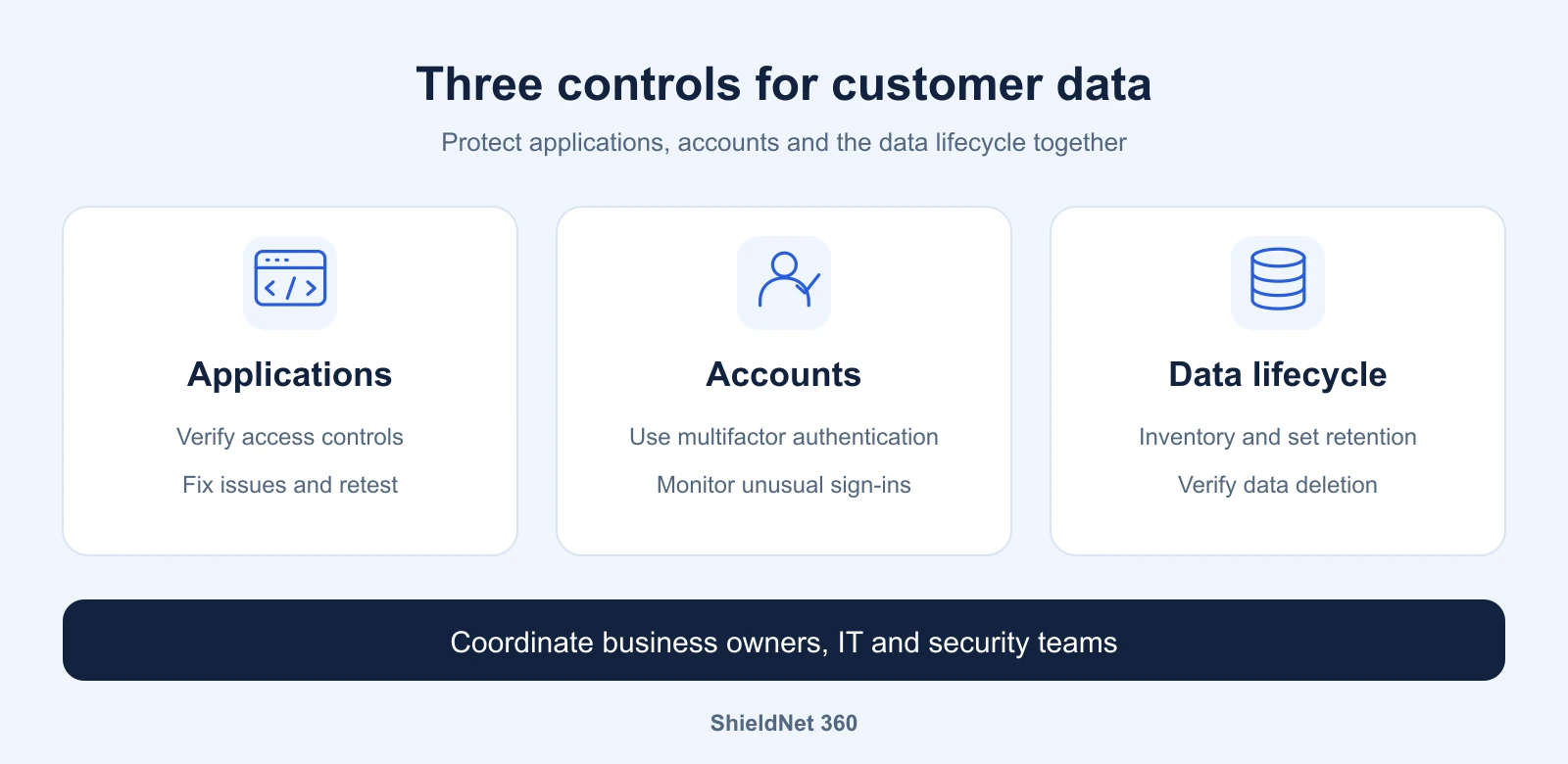
Three control areas for businesses covering applications, accounts and the data lifecycle. Graphic by ShieldNet 360.
Verify deletion when business processes change
A new loyalty mechanism, CRM migration or retired feature should trigger a decision about the old data: what must be retained, what should be removed, who owns the task and what proves completion. Include legacy tables, exports and reporting copies in that review. Retention should reflect the purpose of each dataset and applicable obligations.
For payment card numbers, assess whether a reference supplied by the payment provider can meet the business need. Every sensitive field should have a purpose, retention period and accountable owner. Encryption and access controls remain necessary for information the business must keep.
Protect sign-ins with multiple controls
Credential stuffing tests username and password pairs obtained from another service. It deserves separate attention from application vulnerability exploitation. MUJI's disclosures do not establish one continuous attack chain connecting every form of access.
Use multifactor authentication, rate limits and risk based checks together. Investigate a source attempting many accounts or a login from an unfamiliar device, while avoiding dependence on IP blocking alone. OWASP credential stuffing guidance
Keep logs that support investigation
Operations teams need to establish which account signed in, from where, when and which functions it accessed. Successful logins matter when an attacker has a valid password. Exclude passwords, access tokens and full payment card numbers from logs; mask sensitive values and restrict log access. OWASP logging guidance
One useful exercise is a new device signing in and then repeatedly accessing customer information pages. IT and security teams should agree who receives the alert, verifies the activity and can restrict access. These signals support investigation and require assessment against legitimate use.
How ShieldNet 360 can support a business
For organizations facing similar risks, ShieldNet Defense, part of ShieldNet 360, supports detection, analysis and response to suspicious activity within the monitored environment. Explore ShieldNet Defense
Continuous monitoring and investigation. On the Ultimate plan, the SecOps team supports monitoring, alert triage, scoping and investigation around the clock. Endpoint data and information from integrated systems help responders examine suspicious activity in context and give IT teams a clearer view of what needs attention.
Response through deployed integrations. Depending on the environment and agreed permissions, response integrations can support device isolation, malicious process termination, file quarantine or malicious connection blocking. Actions must match the customer's available controls and operating procedures.
Clear next steps from investigation. SecOps can help identify related systems, document the incident timeline and provide remediation recommendations. IT teams can use those findings to prioritize work with developers and service providers.
For a custom retail membership portal or API, coverage depends on available log integrations and validated detection use cases. Assess those inputs during deployment. Application fixes, authentication configuration, retention decisions and data deletion remain work for the business and its system operators, in coordination with SecOps.
Where to start
Review legacy data: Check membership, payment and order systems for sensitive fields left behind after a feature changed.
Review account protection: Assess MFA, login attempt controls and handling of suspected account compromise.
Find monitoring gaps: Establish which logs are collected and whether they can show who accessed which data.
Exercise the response: Run a safe account abuse scenario to check alert routing and decision authority.
Assign ownership: Track fixes and data cleanup until completion is supported by evidence.
Customers within MUJI's disclosed scope should follow official notices, review statements and contact the issuer about unfamiliar transactions. Treat messages asking for passwords or card information with caution. Credit Saison's customer guidance
Talk to ShieldNet 360 about the systems your business needs to protect, the logs to integrate and response options that fit your retail operations.
Incident sources
Related Articles
Nov 13, 2026
N-able N-central security incident and lessons for protecting remote management
The N-central incident through 13 November 2026: Able2Shell, HF2, Legacy API controls and how ShieldNet 360 supports monitoring and response for RMM risks.

Nov 13, 2026
ShieldNet 360 at Dubai AI Festival 2026: Connecting AI, Cybersecurity and Business Growth
ShieldNet 360 joined Dubai AI Festival 2026 to showcase simpler cybersecurity for SMEs, connect with businesses, and explore secure AI-driven growth.
Nov 12, 2026
What is Attachment Phishing and How can you spot it?
Learn how attachment phishing works, which email attachments can be dangerous, how to spot suspicious files, and what to do if you open one.

Protect your business with ShieldNet 360
Get started and learn how ShieldNet 360 can support your business.