
Nov 18, 2026
BlogJava4Shell CVE-2026-114938 and how to protect Java applications
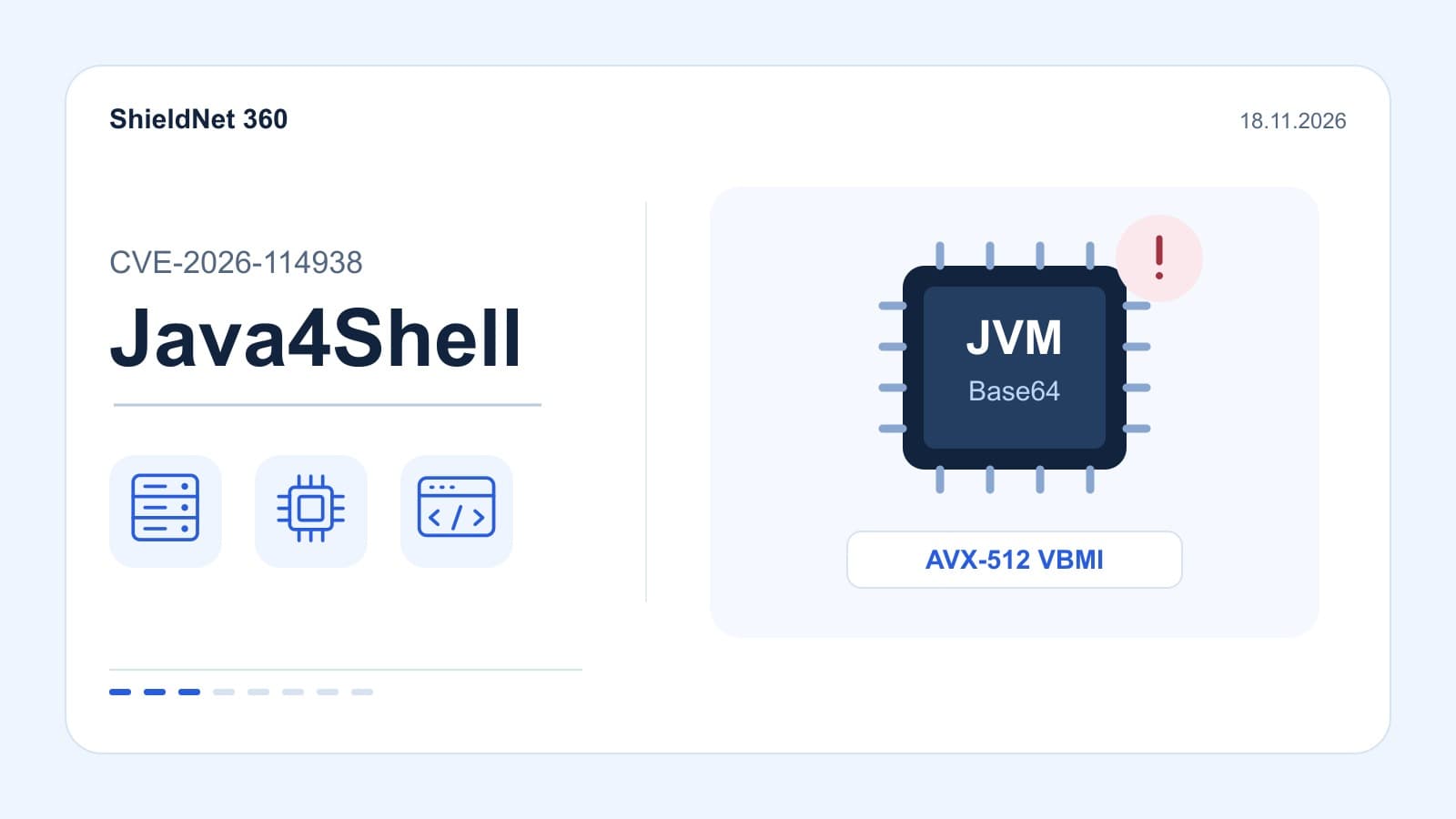
Java4Shell, CVE-2026-114938, is a memory corruption vulnerability in OpenJDK's accelerated Base64 decoding path. Depending on the application, processing untrusted input can lead to information disclosure, service disruption or remote code execution. Oracle and OpenJDK published security updates on 17 November 2026. OpenJDK advisory, Oracle advisory
For businesses, the priority is to identify the running Java runtime, CPU capabilities and the application's data path, then apply the appropriate fix. A server can contain several Java installations while an application or container uses its own bundled runtime.
Updated 18 November 2026.
How Java4Shell can affect applications
The accelerated Base64 decoding path can write beyond its intended JVM buffer when processing malformed data. Upwind reproduced the memory corruption in its lab. Upwind's findings
Calif demonstrated pre-authentication RCE against Keycloak, Jira, Confluence and Jenkins in research. Exploitation is application-specific; these demonstrations are not a count of compromised deployments. Calif's original research
Calif assigns 9.2 under CVSS 4.0; Oracle lists 8.1 under CVSS 3.1. The scores use different versions of the scoring system. Prioritization should also consider the runtime, configuration and exposure of each service. Calif, Oracle
Three conditions to assess together
The runtime includes affected code and has not been patched. The research scope begins at OpenJDK 17.0.6 and includes newer branches containing the relevant code. Verify the distributor and full build.
The CPU and JVM configuration allow the vulnerable accelerated path. The hardware condition involves x86-64 with AVX-512 VBMI; AVX-512 branding alone does not establish exposure.
Attacker-controlled input reaches that decoding path. Pre-authentication reachability and the ability to turn corruption into RCE depend on the application's processing.
Assess these conditions together using Red Hat's bulletin.
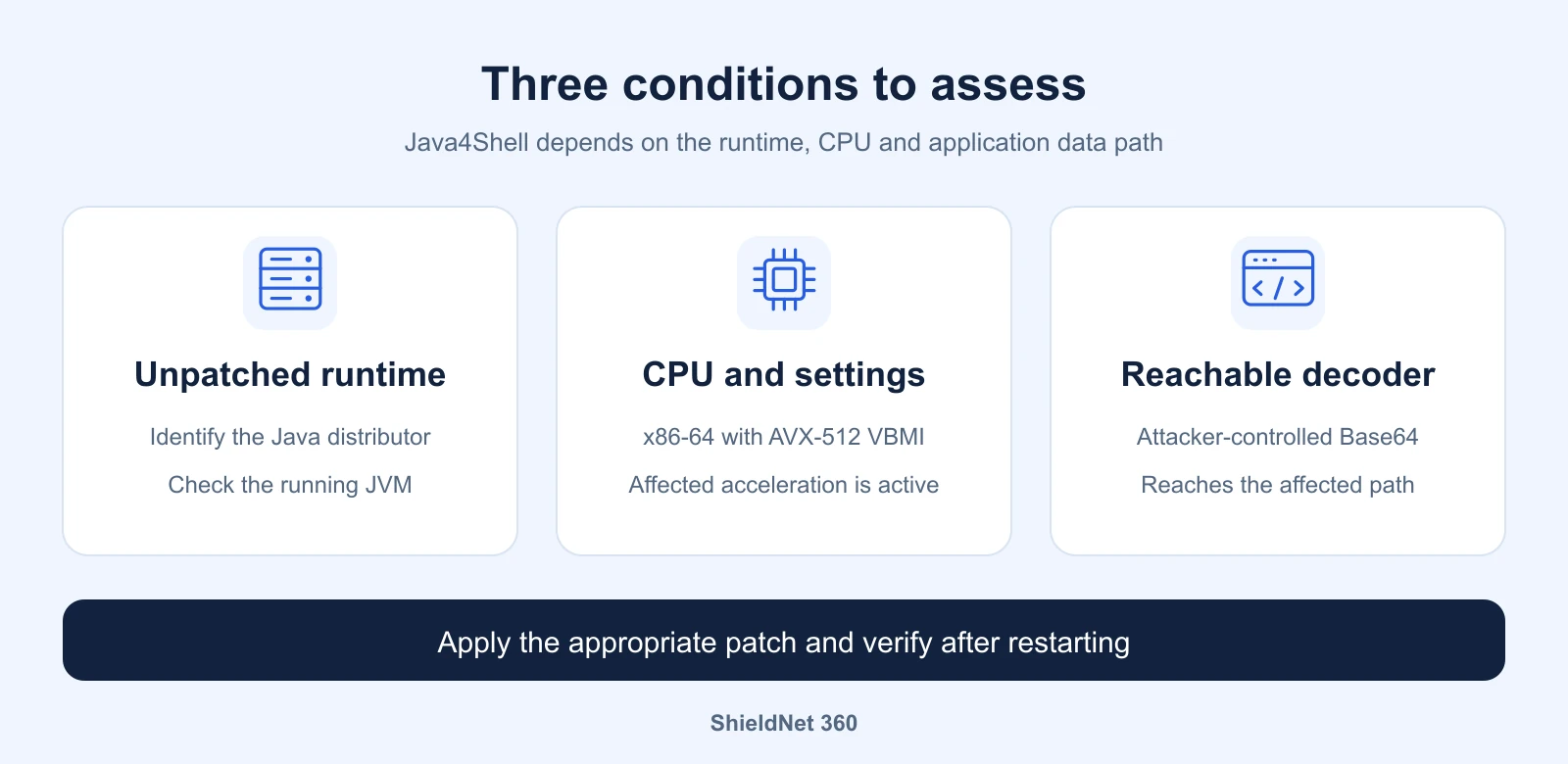
Three conditions for assessing Java4Shell covering an unpatched runtime, suitable CPU and input reaching the affected decoder. Graphic by ShieldNet 360.
ARM64 does not use this x86-64 path. OpenJDK's matrix does not mark Java 8 or 11 for this CVE; however, Oracle separately lists Java SE 8u511b33-perf as affected. Inventory Java 8 Performance Pack builds separately from ordinary OpenJDK 8. OpenJDK matrix, Oracle matrix
Match the patch to the distributor and application
The Oracle JDK releases below, issued on 17 November, are reference points for Oracle JDK:
Oracle JDK branch | Update | Release notes |
17 |
| |
21 |
| |
25 |
| |
27 |
|
For other distributions, check the package update and an advisory confirming remediation of CVE-2026-114938. Amazon Linux 2023, for example, published ALAS2023-2026-3478 for Corretto 17. Amazon advisory
For products bundling a JVM, follow the supported vendor upgrade path. For containers, update Java in the image, rebuild it and redeploy containers using that image. Updating host Java does not replace a runtime packaged inside an image. Docker image update guidance
After deployment, verify the runtime of each serving process or replica. Retain version and restart evidence to track completion.
Temporary mitigation and running JVM verification
While arranging the patch, -XX:-UseBASE64Intrinsics disables accelerated Base64 at JVM startup. Upwind validated this mitigation. For a JAR application:
java -XX:-UseBASE64Intrinsics -jar app.jarThis is a startup configuration example. For systemd services, Tomcat or container deployment tools, place the option in the service's actual startup configuration and perform a controlled restart.
-XX:UseAVX=2 is x86-64 only; adding it can prevent ARM64 JVMs from starting. Calif recommendations
Where JDK tools and access are available, use jcmd with the target process's user/group to inspect its version and effective flags. Replace example PID 12345 with the actual PID:
jcmd 12345 VM.version
jcmd 12345 VM.flags -all
When disabling Base64 intrinsics, verify UseBASE64Intrinsics is false in the intended process. Oracle jcmd documentation
Track the mitigation in the change plan, check functionality and performance, and assess removing it after the patch is verified. Completion means the service actually uses the updated runtime or configuration.
Operational and investigation priorities
Prioritize services accepting external input, especially authentication services and business critical applications. Assign an owner to each runtime.
Check every running copy, including standby nodes, workers, containers and bundled JVMs. A shell's
java -versiondescribes the Java command selected in that shell environment.Preserve investigation data. Monitor JVM crashes, application errors and unusual activity around the same time. A crash needs contextual analysis and does not establish RCE by itself.
Investigate suspicious behavior further. Compare child processes, new files, network connections and account activity with legitimate tasks before deciding on response.
These steps help IT and SecOps complete remediation while retaining the ability to scope unexpected activity.
How ShieldNet 360 can help
ShieldNet Defense supports detection, analysis and response within the monitored environment. For Java systems, endpoint data and integrated sources can help responders compare unusual processes, files and connections with operational context. Explore ShieldNet Defense
Around the clock monitoring and investigation with Ultimate. SecOps supports alert triage, scoping and remediation recommendations. Activity such as a Java service launching an unexpected task requires verification against the command and its legitimate purpose.
Response through deployed integrations. Depending on the environment and agreed permissions, integrations can support device isolation, malicious process termination, file quarantine or malicious connection blocking. JDK patching, JVM flag changes, image rebuilding and service recovery remain work for customer IT or the system operator.
Visibility depends on available data and validated detection use cases. Activity confined to JVM memory may require additional investigation data; an absence of alerts alone does not establish that a service is secure.
Talk to ShieldNet 360 about monitoring scope for Java systems, the data to integrate and response coordination with your IT team.
Sources
Related Articles
Nov 13, 2026
N-able N-central security incident and lessons for protecting remote management
The N-central incident through 13 November 2026: Able2Shell, HF2, Legacy API controls and how ShieldNet 360 supports monitoring and response for RMM risks.
Nov 13, 2026
The MUJI security incident and lessons for protecting customer data
What MUJI's potential exposure of 1.09 million card records teaches retailers about login security, legacy data and monitoring with ShieldNet 360.

Nov 13, 2026
ShieldNet 360 at Dubai AI Festival 2026: Connecting AI, Cybersecurity and Business Growth
ShieldNet 360 joined Dubai AI Festival 2026 to showcase simpler cybersecurity for SMEs, connect with businesses, and explore secure AI-driven growth.

Protect your business with ShieldNet 360
Get started and learn how ShieldNet 360 can support your business.