
Mar 13, 2026
BlogHow to Measure Cybersecurity ROI for SMEs
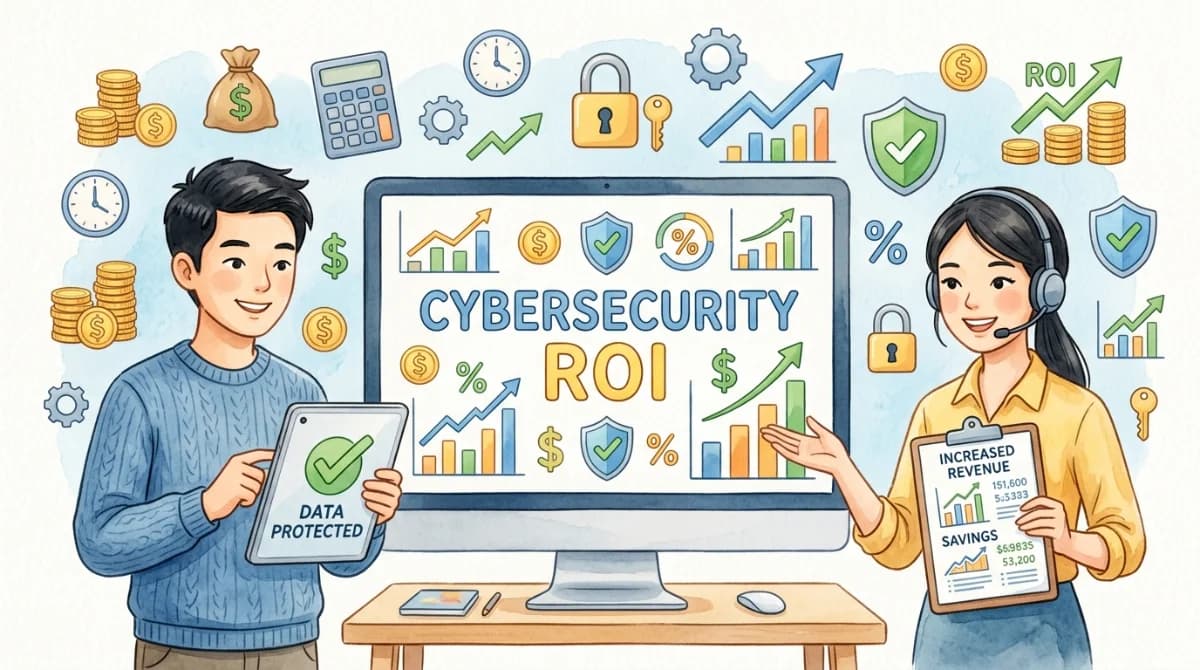
Your business was never attacked last year – but how do you know your cybersecurity investment actually earned that outcome?
Cybersecurity ROI for SMEs is measured by quantifying the financial losses your security tools help you avoid – including prevented downtime, reduced breach costs, and compliance fines dodged – rather than by revenue generated. For most small and medium businesses, three practical KPIs matter most: Mean Time to Detect (MTTD), cost per avoided incident, and hours of downtime prevented. These translate security spending into a language every business owner understands: money saved and operations kept running.
This guide gives SME owners and IT managers a practical, jargon-free framework for measuring what your cybersecurity investment is actually doing for your bottom line – without drowning in dashboards.
Why Is Measuring Cybersecurity ROI Different for SMEs?
Traditional ROI measures profit gained. Cybersecurity ROI measures disaster avoided – and that's a harder story to tell.
Unlike standard ROI which tracks revenue generated, cybersecurity ROI quantifies risk reduction and loss prevention – the value of something that didn't happen. For an SME without a dedicated CISO or security team, this creates a real problem: how do you justify a monthly security bill when the scariest outcome is one you hopefully never see?
The stakes are real and growing. One in three SMBs experienced a cyberattack in the preceding year, with attack costs running as high as $7 million, according to the Microsoft SMB Cybersecurity Report 2024. And the recovery timeline makes it worse: recovery from a breach took more than 100 days for most of the small number of breached organizations that were able to fully recover at all.
The key shift for SMEs is to stop measuring security in technical terms and start measuring it in business terms:
- Hours of downtime prevented instead of "threat detection rate"
- Regulatory fines avoided instead of "compliance posture score"
- Saved staff hours instead of "mean time to respond"
What Are the Most Important Cybersecurity KPIs for an SME?
Not all security metrics are worth your attention. For SMEs with lean teams and real budgets, focus on these five:
1. Mean Time to Detect (MTTD) How long does it take your system to notice a threat? This directly translates to how much damage a breach causes before it's stopped. Organizations that detected breaches with their own security tools had lower breach costs – nearly $1 million lower on average than those whose breach was identified by the attacker. For an SME, every hour of undetected intrusion is a window for data theft, ransomware, or service disruption.
2. Mean Time to Respond (MTTR) Once detected, how fast is the response? Traditional security teams can take 24–48 hours to contain an attack, while AI-driven response can dramatically shorten that window. ShieldNet Defense, for instance, targets detection-to-resolution in under 20 minutes – a metric that directly correlates to how much revenue and customer trust you keep intact.
3. Cost Per Avoided Incident Estimate your potential breach cost using industry benchmarks, then compare it to what you pay monthly for protection. The best method for calculating cybersecurity ROI compares investments made to strengthen your defenses with the potential costs of a successful cyberattack. If your sector faces an average breach cost of $200,000 and your annual security spend is $6,000, preventing even one incident delivers a 33x return.
4. Downtime Hours Prevented Calculate the revenue your business generates per hour, then estimate how many hours of downtime a breach would cause. A $100 million enterprise brings in about $11,000 an hour – by using direct measurements like this, you can calculate the value of reducing downtime from security-related outages. The same logic scales down to any SME: know your hourly revenue, and downtime becomes a dollar figure – not an abstract risk.
5. Compliance Fines Avoided If you operate under GDPR, ISO 27001, or PCI DSS requirements, non-compliance is a financial liability. GDPR non-compliance fines can reach €20M or 4% of revenue, while organizations avoiding compliance fines save an average of $1M per breach according to IBM.
How Do You Calculate Cybersecurity ROI in Practical Terms?
You don't need a PhD in risk quantification. Here's a simplified formula SME owners can actually use:
ROSI = (Potential Annual Loss × Risk Reduction %) − Cost of Security Solution
Break it down:
- Estimate your Annual Loss Expectancy (ALE): How much would a breach cost your business per year? Include downtime, data recovery, customer churn, and potential fines. Use IBM's average of $4.44M globally as a ceiling reference, or estimate based on your revenue and data sensitivity.
- Apply your risk reduction percentage: AI-powered tools have a measurable impact. Organizations that deployed AI and automation in prevention workflows incurred an average $2.2 million less in breach costs compared to those without it.
- Subtract your security investment: If your ALE is $150,000, your solution reduces risk by 60%, and you spend $10,000/year – your ROSI is ($90,000 − $10,000) = $80,000 net value.
For smaller SMEs, the numbers are proportionally lower – but the ratio often improves because attack costs don't scale as gradually as protection costs do.
Cybersecurity ROI: Traditional Approach vs. ShieldNet Defense Approach
Metric | Traditional Approach (In-House or Ad-Hoc) | ShieldNet Defense Approach |
|---|---|---|
Detection Speed | 24–48 hours to identify and contain a threat | Under 20 minutes from detection to resolution |
MTTD Visibility | Manual log review, irregular monitoring | Continuous 24/7 AI-powered monitoring with real-time alerts |
Compliance Evidence | Requires manual documentation and audit prep | Automated log retention (7–180 days by plan) for audit-ready evidence |
Cost to SME | Hiring one cybersecurity specialist: avg. $132,962/year | For $50/month (Pro plan) – fraction of one specialist's salary |
Cloud Coverage | Limited without dedicated cloud security tools | AWS, GCP, Office 365, Google Workspace covered across plans |
Incident Response | Dependent on availability of staff | Autopilot response (Pro) with 24/7 priority support (Ultimate) |
How Should SMEs Track These KPIs Without Overloading Their Team?
The trap most SMEs fall into is collecting too many metrics and acting on none. The most effective approach is the opposite: pick three metrics, measure them consistently, and connect each one to a business outcome.
Here's a practical monthly tracking habit:
- Week 1: Pull MTTD from your security platform dashboard
- Week 2: Calculate hours of operational uptime maintained
- Week 3: Review any alert-to-resolution events and log response times
- Week 4: Compare your monthly security spend against the estimated cost of any incident that occurred (or was blocked)
Consistent use of the same ROI measurement method is crucial for comparing alternatives and tracking improvements over time, and ROI measures should be written into your security policy to ensure consistency.
Platforms like ShieldNet Defense make this straightforward: the unified dashboard surfaces incident timelines, log data, and resolution records that double as both operational intel and audit-ready documentation – without requiring your IT manager to build a separate reporting workflow.
Comparison: What Does Cybersecurity ROI Look Like Across SME Scenarios?
Business Type | Biggest Risk | Key ROI Metric to Track | Estimated Annual Breach Cost (No Protection) |
|---|---|---|---|
Fintech / Finance SME | Regulatory audit failure, transaction fraud | Compliance fines avoided + MTTR | $200K–$500K+ |
Digital / Tech Startup | Source code theft, admin credential compromise | IP protection value + Downtime hours | $150K–$400K |
General SME (20–100 staff) | Ransomware, phishing-led access | Hours of downtime prevented | $80K–$200K |
FAQ: Cybersecurity ROI for Small and Medium Businesses
What is a good cybersecurity ROI for a small business?
A strong ROSI for SMEs typically shows the security investment costing 3–10% of the potential annual breach cost it protects against. If you spend $6,000/year and your estimated breach risk is $100,000, that's a 17x protection ratio – which most risk advisors would consider a strong return.
How do I measure cybersecurity ROI without a security team?
Focus on three proxy metrics your business already tracks: operational uptime, staff hours spent responding to security incidents, and whether any compliance reporting deadlines were missed. A managed security platform like ShieldNet Defense provides dashboard-level visibility into incident timelines and response records, removing the need for a dedicated security analyst.
Is cybersecurity spending tax-deductible for SMEs?
In most jurisdictions, cybersecurity tools and services qualify as a deductible business expense under IT or operations costs. However, tax treatment varies by country and structure – consult your accountant or local tax authority for specific guidance.
Measuring cybersecurity ROI isn't about building a complex financial model. For SMEs, it's about translating three simple questions into dollar figures: What did a threat cost us? How fast did we catch it? What would have happened if we didn't? The businesses that answer those questions consistently are the ones that make smarter security decisions – and avoid the ones that shut companies down.
See how ShieldNet Defense protects your business and your bottom line
Authoritative Citations:
- IBM Cost of a Data Breach Report 2024 – https://newsroom.ibm.com/2024-07-30-ibm-report-escalating-data-breach-disruption-pushes-costs-to-new-highs
- IBM Cost of a Data Breach Report 2025 – https://www.ibm.com/reports/data-breach
- Safe Security: Measuring Cybersecurity ROI Framework for 2026 – https://safe.security/resources/blog/measuring-cybersecurity-roi-a-framework-for-2026-decision-makers/
- Corsica Technologies: Cybersecurity ROSI Calculator – https://corsicatech.com/blog/cybersecurity-roi-rosi-calculator/
- JumpCloud: ROI of Cybersecurity Investments 2025 – https://jumpcloud.com/blog/cybersecurity-roi
Related Articles

Oct 22, 2026
Real or Fake? HR Asking You to Review Payroll
Got an email from HR asking you to review payroll? Learn how to identify fake payroll emails, verify HR requests, and protect your salary and bank details.

Oct 9, 2026
I replied to a phishing email. Am I at risk?
Replied to a phishing email? Learn what risks you face, what attackers can learn from your reply, and what to do next to protect your account and business.
Oct 8, 2026
Real or Fake? How to verify a sharepoint file invitation
Received a SharePoint file invitation? Learn how to spot fake SharePoint emails, verify shared files safely, and protect your Microsoft 365 account from phishing.

Protect your business with ShieldNet 360
Get started and learn how ShieldNet 360 can support your business.