
Nov 11, 2026
BlogCVE-2026-111760: Git Recursive Clone Vulnerability Enables Remote Code Execution
On November 10, 2026, the Git Project released urgent maintenance updates to patch CVE-2026-111760 (GHSA-vp2w-7xxj-jvxr), a high-severity (CVSS 8.0 High) vulnerability that allows Remote Code Execution (RCE) when cloning a repository recursively with --recurse-submodules. Crucially, malicious commands can execute on a developer workstation or CI/CD build server during the clone operation itself – before a developer ever builds, runs, or opens the downloaded project.
This advisory helps engineering leaders, system administrators, and DevSecOps teams clearly understand how the flaw works, where real-world enterprise exposure lies, which patched versions to deploy, and how to defend developer endpoints and build pipelines immediately.
At a Glance
Item | Details |
Identifier | CVE-2026-111760 ( |
Disclosure Date | November 10, 2026 |
Affected Component | Git Core (submodule recursive clone & index path handling) and products bundling Git |
Root Cause | Integer truncation in Git index path handling allows an overlong path to bypass validation and overwrite a submodule |
Impact | Arbitrary code execution on the host operating system (Remote Code Execution) |
CVSS v3.1 Score | 8.0 High ( |
Trigger Condition | Running |
Patched Git Versions | 2.56.1 (latest), plus maintenance releases 2.55.1, 2.54.1, 2.53.1, 2.52.1, 2.51.3, 2.50.2 |
Patched GitHub Enterprise Server | 3.22.4, 3.21.9, 3.20.11, 3.19.15 ( |
Remediation Credits | Elijah Newren (reviewed by Jeff King and Johannes Schindelin) |
1. Understanding How CVE-2026-111760 Works
Under normal circumstances, Git carefully validates file paths before writing working-tree files to disk, blocking any attempt by a repository to overwrite internal .git metadata. However, repositories that use submodules (nested Git repositories) rely on an important structural detail: instead of containing a .git/ directory, a newly cloned submodule places a plain-text .git gitfile inside the submodule folder pointing back to the parent repository (../.git/modules/<submodule_name>).
Attackers combine this behavior with an index path length flaw across four sequential steps:
Initial Trigger: A developer or automated CI/CD runner executes
git clone --recurse-submodulesagainst a malicious repository (or a repository whose submodule URL points to an attacker-controlled Git server).Integer Truncation Bypasses Path Validation: The attacker includes a specially crafted index entry with an extremely long path. During Git's pre-checkout safety check, the full path appears benign and passes validation. When written to disk, however, an integer truncation bug cuts off the path length so that the resulting filename becomes
.git.Symlink Replaces the Submodule
.gitFile: That truncated write overwrites the submodule's plain-text.gitgitfile with a symbolic link (symlink) pointing to an attacker-controlled directory containing crafted Git configuration or executable Git hooks.Automatic Host Code Execution: As Git continues operating inside that submodule during the same recursive clone, it follows the swapped
.gitsymlink and automatically executes the attacker's hooks under the privileges of the local user or CI/CD build agent.
The official fix in Git 2.56.1 eliminates this vector by rejecting overly long index entry paths upfront before truncation can occur, while adding integer overflow safeguards to related index entry memory allocations.
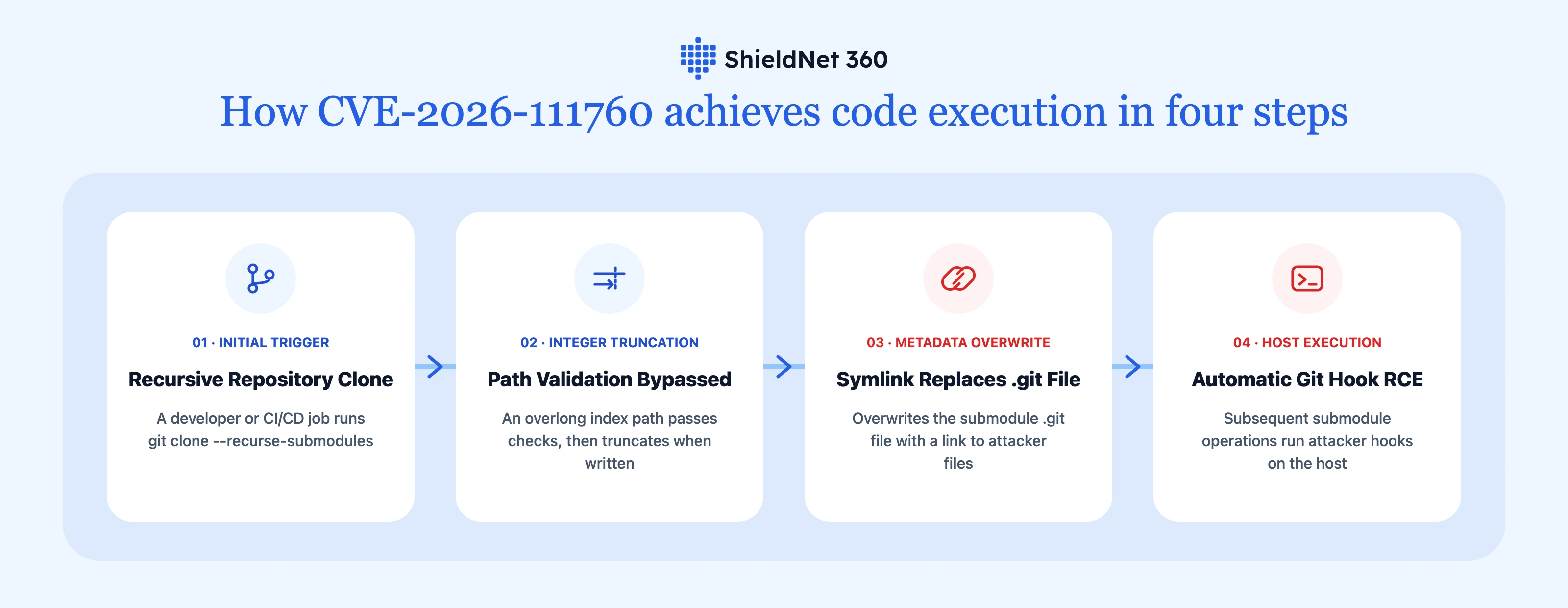
Figure 1. Four-step exploitation flow of CVE-2026-111760 from git clone --recurse-submodules to automatic Git hook execution (Graphic: ShieldNet 360).
2. Real-World Enterprise Exposure and the November 2026 Git Release
Although the CVSS vector includes User Interaction: Required, cloning repositories with submodules is routine across modern software engineering and automated build infrastructure:
Developer Workstations and Recruitment Lures: Threat actors targeting software, cloud, and Web3 engineers routinely distribute fake "coding assessments" or partner repositories instructing candidates to run
git clone --recurse-submodules. With CVE-2026-111760, host compromise happens the momentgit clonefinishes – even if the developer never runsnpm install,cargo build, or opens an IDE.Automated CI/CD Build Runners: Pipelines configured with recursive submodule checkouts – such as GitHub Actions (
submodules: recursive), GitLab CI (GIT_SUBMODULE_STRATEGY: recursive), Jenkins, or self-hosted runners – can trigger exploitation automatically when building untrusted forks or repositories referencing external submodule hosts, exposing deployment keys and cloud tokens.Bundled Git Binaries Across Developer Tooling: Updating the operating system's default
gitbinary is often not enough. Many desktop tools and build containers ship private copies of Git, including Git for Windows, GitHub Desktop, the GitHub Copilot app, IDE plugins, and pinned Docker build images.
Companion Vulnerabilities Patched in Git 2.56.1
Alongside CVE-2026-111760, the November 10, 2026 Git security release addresses five additional vulnerabilities. Upgrading to the patched maintenance releases protects environments against the entire batch:
CVE ID | Vulnerability Type | Primary Security Impact |
CVE-2026-113408 | Path traversal via server-advertised | Allows a malicious server to write ref files outside the intended |
CVE-2026-114467 | Stack buffer overflow when stripping more than two GPG signatures | Causes memory corruption or process crash (DoS) when merging crafted multi-signature tags/commits |
CVE-2026-114469 | Out-of-bounds read when applying compressed binary patches | Binary patches expanding past Git's ~1 GiB limit trigger out-of-bounds memory reads and crashes |
CVE-2026-105437 | Integer overflow leading to heap corruption in large merges | Memory corruption during merges with very high conflict counts and large |
CVE-2026-114466 | Arbitrary file read and file write/append in | Untrusted |
3. Patched Versions and Upgrade Commands
Organizations should update Git across workstations, servers, and build images to one of the patched releases published on November 10, 2026:
Platform / Product | Patch Status | Minimum Safe Version |
Git Core (Upstream) | Patched |
|
Git for Windows | Patched | Upgrade to |
GitHub Enterprise Server (GHES) | Patched |
|
GitHub Desktop & GitHub Copilot App | Coordinated rollout | Update to the latest application release immediately |
Linux Distributions (Ubuntu, Debian, RHEL, SUSE) | Rolling out | Upgrade the |
Quick Verification and Upgrade Commands
Check all installed git binaries on a host:
git --version
which -a git
Upgrade on macOS (Homebrew):
brew update && brew upgrade gitUpgrade on Ubuntu / Debian:
sudo apt update && sudo apt install --only-upgrade git -yUpgrade on RHEL / Rocky Linux / AlmaLinux / Fedora:
sudo dnf upgrade git -yUpgrade on Windows (Winget):
winget upgrade --id Git.Git -e4. Temporary Mitigations When Immediate Patching Is Not Possible
If build images or managed developer workstations cannot be upgraded right away, apply these three practical controls immediately:
1. Avoid --recurse-submodules on Untrusted Repositories
Never run recursive clones on unfamiliar repositories, external recruitment tests, or unreviewed third-party projects. Clone the top-level repository without checkout first and inspect .gitmodules before initializing any submodules:
git clone --no-checkout <repository_url> repo-audit
cd repo-audit
git show HEAD:.gitmodules
Confirm that every url = ... entry points exclusively to trusted platforms (such as internal enterprise servers or github.com, where server-side protections are active) rather than arbitrary external hosts or raw IP addresses.
2. Disable Automatic Recursive Submodules in Untrusted CI/CD Jobs
Review pipeline configurations and disable automatic recursive submodule checkout on workflows triggered by external forks or untrusted inputs until runner images run Git >= 2.56.1:
GitHub Actions: Keep
submodules: false(default) inactions/checkoutfor external pull request workflows.GitLab CI: Set
GIT_SUBMODULE_STRATEGY: noneon untrusted pipelines and rebuild runner images with patched Git packages.
3. Check Cloned Repositories for Suspicious .git Symlinks
In a legitimate Git working tree or submodule, .git is always either a standard directory or a regular text file – never a symbolic link. Security teams can scan workspaces for suspicious .git symlinks with:
find /path/to/workspace -name ".git" -type l -lsAny match warrants immediate host isolation and process review.
5. Administrator and DevSecOps Checklist
☐ Inventory installed Git versions across developer laptops, bastion hosts, and CI/CD runners (
git --version).☐ Update bundled Git installations inside Git for Windows, GitHub Desktop, GitHub Copilot, IDE extensions, and Docker build images.
☐ Upgrade self-hosted GitHub Enterprise Server instances to
3.22.4,3.21.9,3.20.11, or3.19.15.☐ Instruct engineering teams not to run
git clone --recurse-submodulesorgit submodule update --init --recursiveon untrusted repositories without auditing.gitmodulesfirst.☐ Audit
submodules: recursiveandGIT_SUBMODULE_STRATEGY: recursivesettings across CI/CD pipelines.☐ Monitor endpoints and build servers for unexpected shells or network connections spawned by
gitprocesses.
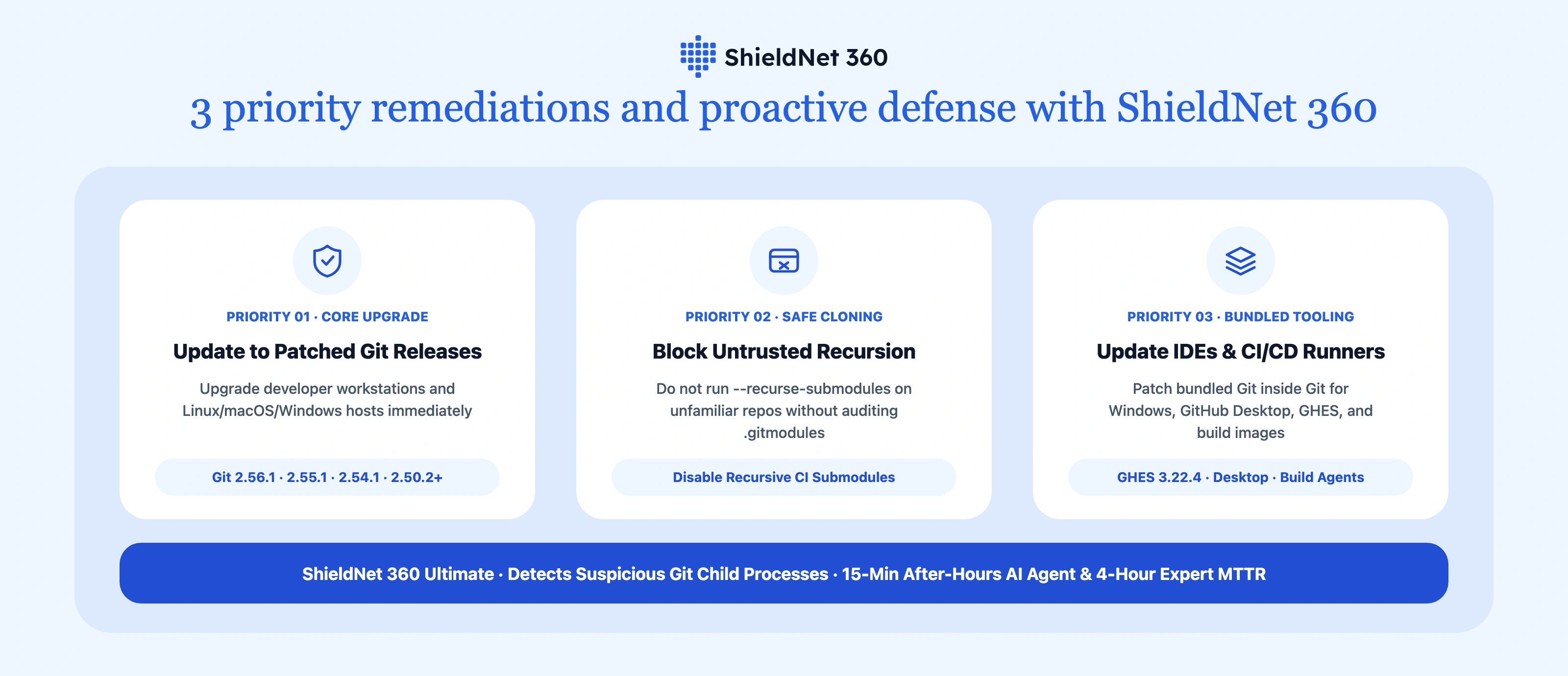
Figure 2. Three priority remediations and proactive endpoint and CI/CD defense with ShieldNet 360 Ultimate (Graphic: ShieldNet 360).
6. How ShieldNet 360 Protects Your Organization
When a vulnerability turns an everyday developer command like git clone into an immediate code execution vector, relying on manual patching alone leaves gaps across remote laptops and ephemeral build servers. ShieldNet 360 provides layered visibility, behavioral detection, and rapid containment:
Centralized Endpoint Visibility: The Devices view on the ShieldNet 360 Portal gives IT and security teams immediate inventory visibility across Windows, macOS, and Linux developer endpoints and servers running the Protection Agent, helping teams prioritize patching on critical assets.
Real-Time Behavioral Detection: Powered by continuous endpoint Security Telemetry, ShieldNet 360's Detection Engine and Correlation Engine monitor process lineage around
git. If agitoperation or malicious hook spawns anomalous shells (sh,bash,zsh,powershell,cmd), initiates suspicious outbound downloads, or attempts to harvest SSH keys,.envfiles, or cloud credentials, high-priority alerts are raised immediately.Rapid Containment with ShieldNet 360 Ultimate: Organizations on the ShieldNet 360 Ultimate tier are protected around the clock: our autonomous AI Agent triages alerts and executes initial containment (Isolate Host / Kill Process) outside business hours within 15 minutes – stopping outbound C2 activity even if an engineer clones a malicious repository late at night or over the weekend – while human security experts investigate and complete full incident containment within a 4-hour MTTR.
Direct SecOps Assistance: If your team needs help auditing CI/CD exposure or investigating suspicious
gitactivity, reach out to our security operations team at [email protected].
CVE-2026-111760 underscores that software supply-chain compromise can begin at the very first git clone. Upgrade Git across all developer tools and build runners today.
Related Articles
Nov 13, 2026
N-able N-central security incident and lessons for protecting remote management
The N-central incident through 13 November 2026: Able2Shell, HF2, Legacy API controls and how ShieldNet 360 supports monitoring and response for RMM risks.
Nov 13, 2026
The MUJI security incident and lessons for protecting customer data
What MUJI's potential exposure of 1.09 million card records teaches retailers about login security, legacy data and monitoring with ShieldNet 360.

Nov 13, 2026
ShieldNet 360 at Dubai AI Festival 2026: Connecting AI, Cybersecurity and Business Growth
ShieldNet 360 joined Dubai AI Festival 2026 to showcase simpler cybersecurity for SMEs, connect with businesses, and explore secure AI-driven growth.

Protect your business with ShieldNet 360
Get started and learn how ShieldNet 360 can support your business.