
Mar 13, 2026
Blog24/7 Security Monitoring vs MDR: What's the Real Difference?
Most small businesses are buying "24/7 protection" without realizing they're getting three completely different things – and vendors rarely explain the distinction.
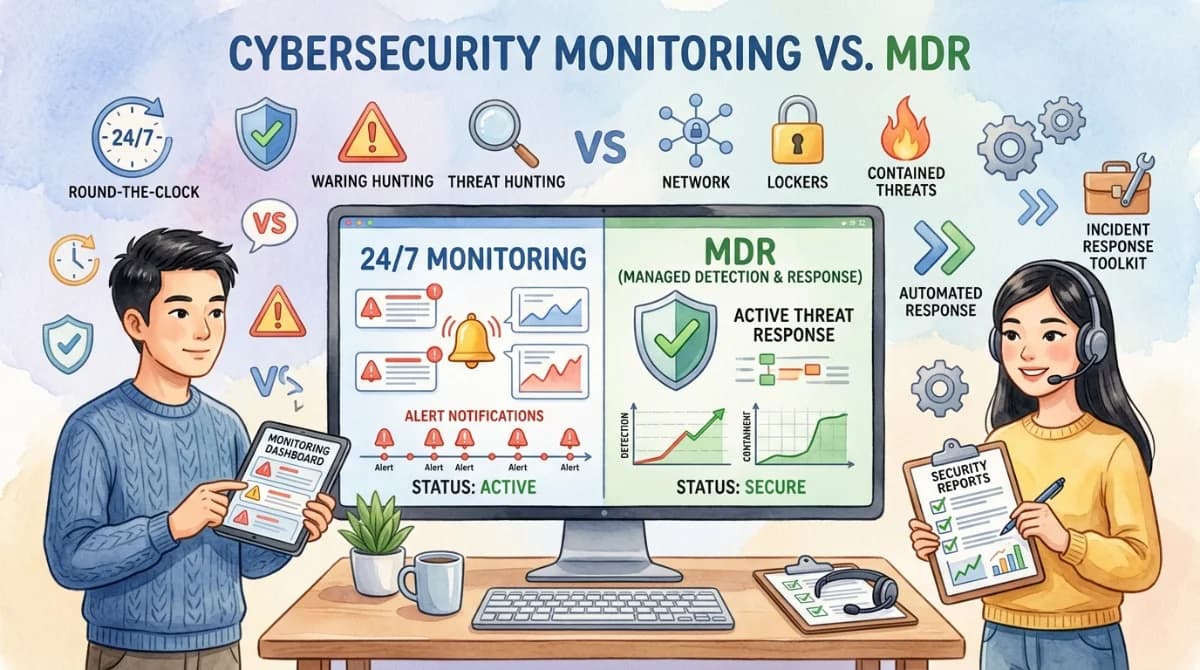
24/7 security monitoring, 24/7 security support, and Managed Detection and Response (MDR) are not the same service. Monitoring watches for alerts and passes them to your team. Support answers tickets when you ask. MDR detects threats, investigates them, and actively contains the damage – often before you even know an attack is underway.
Understanding which service you're actually purchasing could be the difference between a contained incident and a business-ending breach. This guide breaks down each model, exposes the buyer pitfalls, and helps you match the right protection level to your business.
What Is 24/7 Security Monitoring vs MDR – and Why Does the Label Matter?
The phrase "24/7 security" appears on nearly every vendor's website. But the label alone tells you nothing about what happens when your network is actually compromised.
Here's how the three models differ at the operational level:
24/7 Security Monitoring is a passive surveillance service. Tools like SIEM platforms continuously collect and analyze logs from your endpoints, cloud environments, and network traffic. When a rule fires or an anomaly appears, the system generates an alert. That alert lands in a dashboard – or your inbox. What happens next is your problem.
- Watches: ✅ Alerts: ✅ Investigates: ❌ Responds: ❌
24/7 Security Support refers to help desk availability – ticketing systems, email, chat, or phone channels staffed around the clock. It means someone is available to answer your questions at 2 a.m. It does not mean anyone is actively hunting threats in your environment.
- Available: ✅ Proactive: ❌ Threat-aware: ❌ Contained: ❌
Managed Detection and Response (MDR) is an active, outcome-driven security service. According to Microsoft Security, MDR combines advanced detection technologies with human expertise to proactively protect organizations from cyberthreats using monitoring, threat hunting, investigation, and rapid incident response – all managed externally.
- Watches: ✅ Investigates: ✅ Responds: ✅ Hunts proactively: ✅
The critical distinction: monitoring surfaces problems. MDR solves them.
Why Do SMBs Get This Wrong? The 3 Buyer Pitfalls
Most growing businesses fall into at least one of the following traps when evaluating security services.
Pitfall 1: Confusing "support" with "protection." A vendor offering 24/7 support is selling access to a helpdesk team – not security analysts. If your network is being actively compromised at midnight, a ticketing system will not save you. Response requires security expertise, not IT availability.
Pitfall 2: Assuming alerts equal action. Basic monitoring platforms generate thousands of alerts daily. Arctic Wolf's 2025 Trends Report found that nearly half of all security alerts in 2024 occurred outside of regular working hours – precisely when understaffed teams are unavailable to act on them. An alert no one investigates is operationally useless.
Pitfall 3: Equating MDR with expensive enterprise contracts. Many SMBs assume MDR is out of reach because it's associated with large SOC operations costing upwards of $735,000 annually to build in-house, according to Acronis's 2025 MDR Guide. The managed service model has changed this equation significantly – MDR is now accessible at the SMB level.
How Does MDR Actually Work During an Incident?
Understanding the operational flow helps clarify why MDR outperforms basic monitoring when it matters most.
A mature MDR service follows this cycle:
- Event triage and prioritization – Telemetry is ingested from endpoints, cloud workloads, and network layers. Automation and analyst review filter false positives before anything reaches your screen.
- Threat hunting – Analysts proactively look for attacker behavior and indicators of compromise that automated tools miss, rather than waiting for a rule to fire.
- Deep investigation – Once a confirmed threat is identified, a forensic timeline is constructed to understand origin, scope, and lateral movement.
- Containment and response – The compromised asset is isolated. Malicious processes are terminated. Your team is notified with actionable context.
- Post-incident reporting – Evidence is documented for compliance purposes, and detection rules are updated to prevent recurrence.
Basic monitoring only contributes to step one. Everything else requires human expertise and pre-authorized response capability – which is precisely what MDR provides.
Gartner's Market Guide for Managed Detection and Response notes that MDR mindshare grew 29% year over year, with strong adoption across all organization sizes – driven by the recognition that alert-only services are insufficient against modern adversaries.
24/7 Support vs Monitoring vs MDR: Side-by-Side Comparison
Capability | 24/7 IT Support | 24/7 Security Monitoring | MDR |
|---|---|---|---|
What it delivers | Ticket resolution, helpdesk access | Alert generation from log analysis | Detection, investigation, and active response |
Who acts on threats | Your internal team | Your internal team | MDR provider's analysts |
Proactive threat hunting | ❌ | ❌ | ✅ |
Automated containment | ❌ | ❌ | ✅ |
Log retention | N/A | Varies (often 7–14 days) | 30–180+ days |
Compliance evidence | ❌ | Partial | ✅ Documented incident records |
ShieldNet Defense equivalent | Basic (Community Support) | Pro (AI Defense 24/7 + Autopilot) | Ultimate (24/7 Priority + Monthly Security Support) |
ShieldNet Defense's Pro plan delivers AI-powered 24/7 monitoring with autopilot response and cloud workload protection – significantly beyond passive alerting. The Ultimate plan adds 24/7 priority support and monthly security support sessions, giving SMBs the closest available equivalent to a managed SOC without the enterprise price tag. Features visible at shieldnet360.com/pricing.
Which Model Is Right for Your Business?
The right service level depends on your team's internal capacity to act on security events.
Choose 24/7 monitoring if:
- You have an internal IT team available most hours who can investigate and respond to alerts
- You need compliance evidence of continuous log collection
- Your risk profile is low-to-moderate and threats are unlikely to be sophisticated
Choose MDR if:
- Your IT team is lean, part-time, or focused on operations rather than security
- You operate in a regulated industry (fintech, healthcare, SaaS) where breach dwell time has serious consequences
- You cannot afford to miss attacks that occur outside business hours
- Ransomware or credential theft would cause immediate operational or reputational damage
For most SMBs operating with fewer than 10 IT staff, the internal capacity to investigate and act on security alerts around the clock simply does not exist. MDR closes that gap without requiring you to hire a security operations team.
FAQ
Is 24/7 security monitoring the same as MDR?
No. Monitoring generates and surfaces alerts. MDR goes further – analysts investigate each alert, validate threats, and take containment action on your behalf. Monitoring requires your team to respond. MDR responds for you.
What is the difference between MDR support and general IT support?
MDR support is delivered by security analysts with threat detection expertise. General IT support resolves operational issues (connectivity, software, user access). When a cyberattack is underway, only security-focused MDR support has the tools and authority to contain it.
Do small businesses actually need MDR, or is monitoring enough?
It depends on your internal capacity. If your team cannot monitor dashboards overnight or investigate complex alerts, monitoring alone creates a false sense of security. According to Arctic Wolf's 2025 Trends Report, only 50% of global organizations report adequate security staffing – making MDR the more reliable option for lean teams.
Related Articles

Oct 22, 2026
Real or Fake? HR Asking You to Review Payroll
Got an email from HR asking you to review payroll? Learn how to identify fake payroll emails, verify HR requests, and protect your salary and bank details.

Oct 9, 2026
I replied to a phishing email. Am I at risk?
Replied to a phishing email? Learn what risks you face, what attackers can learn from your reply, and what to do next to protect your account and business.
Oct 8, 2026
Real or Fake? How to verify a sharepoint file invitation
Received a SharePoint file invitation? Learn how to spot fake SharePoint emails, verify shared files safely, and protect your Microsoft 365 account from phishing.

Protect your business with ShieldNet 360
Get started and learn how ShieldNet 360 can support your business.