
Feb 27, 2026
BlogSecurity orchestration: 7 SOAR basics for SOC in 2025 today
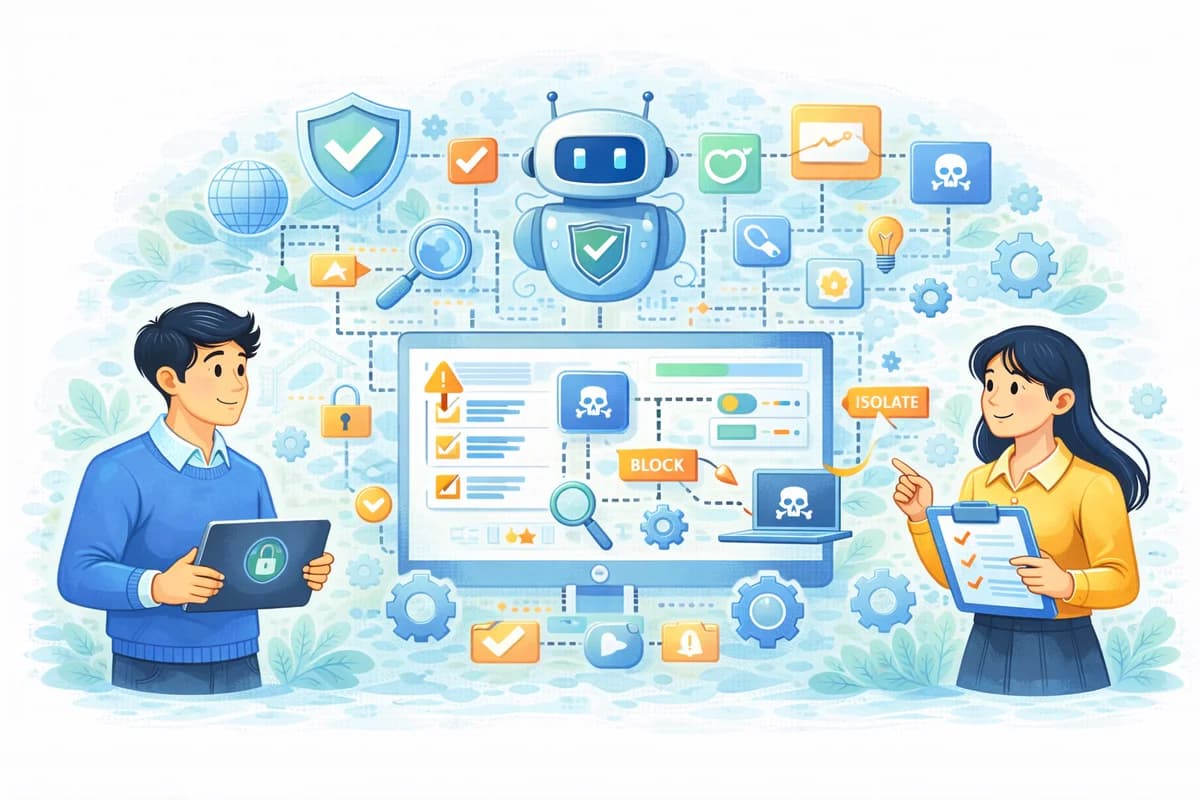
Learn security orchestration for small SOC teams: SOAR basics, alert triage, security playbooks, and automated incident response to cut noise and speed action.
Security orchestration is the practical glue that helps a small security team turn scattered alerts into consistent action. If you run a lean IT or security function, you do not need more dashboards, you need repeatable outcomes: know what matters, decide fast, and contain risk with minimal disruption. That is what security orchestration delivers when it connects tools, standardizes triage, and enforces clear handoffs. This article will explain SOAR basics in plain language and show how small teams use security playbooks, response orchestration, automated incident response, and alert triage to improve speed and confidence.
Why this topic matters
Security orchestration matters because SMEs and small SOC teams usually fail at the same step: converting signals into action under time pressure. Attackers do not present a single obvious warning; they trigger multiple small events across identity, email, endpoints, and cloud apps. Without orchestration, teams waste time collecting context and debating severity, while the attacker gains an “overnight window” to expand access. When security orchestration is in place, you reduce uncertainty and make response predictable, even when only one person is on call.
A realistic scenario is a 150-person company where one IT generalist supports everything and the “SOC function” is shared across roles. After hours, there is a risky sign-in, new mailbox rules appear, and a finance folder sees unusual downloads, but each system generates separate notifications. Without alert triage and response orchestration, the team spends the next morning reconstructing what happened instead of containing it quickly. With SOAR basics applied, those signals become one incident narrative, a clear owner, and a short set of steps that can be executed safely and consistently.
Key factors and features to consider
What security orchestration means in plain language
Security orchestration means connecting your security and IT tools so they behave like one coordinated workflow rather than isolated products. In practice, it links data, context, and actions so you can move from “something looks weird” to “here is what happened and what we do next” quickly. For small teams, the benefit is fewer handoffs and fewer judgment calls under stress. A good implementation keeps the language simple and makes the next step obvious.
SOAR basics that small teams should internalize
SOAR basics begin with the idea that automation should follow a documented process, not replace thinking. A SOAR-style workflow takes inputs from multiple systems, enriches them with context, and triggers a playbook that guides or executes actions. This is not about building an enterprise SOC; it is about reducing manual triage and standardizing your first response steps. When SOAR basics are applied well, your team becomes faster without becoming reckless.
Alert triage that prioritizes impact, not volume
Alert triage is the discipline of deciding what matters now, what can wait, and what is noise. For small SOC teams, triage should use business impact signals like privileged account changes, financial mailbox activity, and abnormal data access rather than chasing every anomaly. A practical triage approach groups related events into a single case and escalates only when multiple risk signals align. This reduces fatigue while preserving coverage where it matters most.
Security playbooks that non-specialists can execute
Security playbooks are short, repeatable response guides that turn incidents into clear tasks with owners and evidence. A strong playbook includes what to verify, what actions to take in order, what can be automated safely, and what requires approval. For example, a “suspicious login plus mailbox changes” playbook can define session revocation, password reset, and mailbox rule review as the first steps. When security playbooks are simple, your team can execute correctly even outside office hours.
Response orchestration and automated incident response with guardrails
Response orchestration coordinates actions across systems so containment is consistent and auditable. Automated incident response is the controlled use of automation to execute safe steps, such as revoking risky sessions or quarantining high-confidence malicious email, before a human reviews the full scope. For SMEs, guardrails matter more than sophistication, because accidental disruption is costly. The best pattern is “automate reversible steps, require approval for disruptive steps” to protect both security and operations.
Detailed comparisons or explanations
Security orchestration versus adding another security tool
Adding tools often adds alerts, while security orchestration reduces the work required to interpret and act on those alerts. A small team may already have email filtering, endpoint protection, and cloud logs, yet still respond slowly because signals are disconnected. Orchestration creates one workflow that correlates events, assigns ownership, and tracks actions taken. In practical terms, security orchestration improves speed and consistency without requiring you to replace every product you already use.
Mini case study: from “next morning” to “same hour” response
In many lean environments, the biggest delay is not detection, but uncertainty about what to do next and who owns the decision. A realistic improvement is reducing the overnight response gap from 8–12 hours to under 60 minutes for high-severity incidents, assuming you have correlation, clear alert triage, and a simple on-call policy. The key mechanism is converting three separate alerts into one incident story and one security playbook that begins with safe containment. When that structure exists, response becomes routine rather than improvisation.
Where SOAR basics deliver the most value first
SOAR basics are most valuable where incidents are common and actions are repeatable, such as identity risk, email compromise indicators, and endpoint malware containment. These areas benefit from response orchestration because actions span multiple tools, and automated incident response can safely execute early containment steps. If you start with complex, rare scenarios, teams lose trust because playbooks are hard to validate. Small teams win by automating the “first 15 minutes” actions that prevent incidents from spreading.
Best practices and recommendations
- Define your top 5 incident types and map each to a simple incident story and owner
- Implement alert triage rules that group related events and suppress duplicates
- Write security playbooks that fit on one page and specify approvals for disruptive steps
- Start automated incident response with reversible actions like session revocation and forced re-authentication
- Use response orchestration to attach evidence automatically and create clear tickets for follow-up
- Review playbook outcomes weekly and improve one step at a time based on false positives and business impact
To apply this checklist, start with one workflow that causes the most stress, such as suspicious sign-ins affecting finance or executives, and make the playbook executable by a generalist. Next, tune triage so only incidents that require action are escalated, which is the fastest way to cut noise without reducing coverage. Finally, add automation cautiously by proving alert quality and measuring outcomes, because small teams need reliability more than complexity. This phased approach is how security orchestration becomes trusted and sustainable.
A practical 30-day rollout for small SOC teams
In week one, baseline how long it takes you to detect, understand, and contain your two most common incident types, then document owners and escalation paths. In weeks two and three, implement correlation and one or two security playbooks that standardize the first containment steps. In week four, add limited automated incident response for reversible actions and verify that response orchestration records evidence and approvals. By the end of 30 days, you should see fewer duplicated alerts and faster containment for the scenarios you prioritized.
Governance that keeps automation safe
Governance does not need to be heavy, but it must be explicit, especially for SMEs. Define which actions are always allowed automatically, which require a human click, and which require leadership approval, then test those rules in a short tabletop exercise. Treat guardrails as part of alert triage, because escalation should depend on both confidence and business impact. When governance is clear, SOAR basics feel safe and practical rather than risky and confusing.
FAQ
What is security orchestration in everyday terms?
Security orchestration is a way to make your security tools work together so your team follows one consistent workflow from detection to response. Instead of chasing separate alerts, you get one incident story with context, ownership, and next steps. For small teams, this reduces confusion and shortens the time between “we saw something” and “we contained it.”
How do SOAR basics help when we do not have a full SOC?
SOAR basics help because they standardize the repetitive parts of response, like gathering context, assigning ownership, and executing safe containment actions. You do not need a large team to benefit; you need clear playbooks and a small set of reliable automations. When workflows are repeatable, a lean team can respond quickly without relying on a few experts being available at the perfect moment.
How do we improve alert triage without missing important threats?
Improving alert triage starts with grouping related events into one incident and suppressing duplicates, then escalating only when multiple risk signals align. A single anomaly might be monitored, but anomaly plus mailbox changes plus unusual downloads should trigger action. This approach reduces noise while preserving high-impact coverage, and it makes triage decisions easier for non-specialists after hours.
What should be inside security playbooks for SMEs?
Security playbooks should include what to verify, what actions to take in order, what can be automated safely, and what requires approval. They should also specify who owns the playbook and what evidence must be recorded for accountability. For SMEs, a one-page playbook that focuses on the first 15–30 minutes of containment is often more effective than a complex document nobody uses.
When is automated incident response safe to enable?
Automated incident response is safest when it starts with reversible actions that are unlikely to disrupt the business, such as revoking suspicious sessions, forcing re-authentication, and quarantining high-confidence malicious email. More disruptive actions should require approval until you understand false positives and user impact. With clear response orchestration and evidence trails, automation becomes a controlled accelerator rather than a risky black box.
Conclusion
Security orchestration helps small SOC teams achieve consistent, measurable response without adding headcount or drowning in alerts. When you apply SOAR basics with strong alert triage, simple security playbooks, and guarded automated incident response, response orchestration becomes faster and more reliable, especially after hours. The most practical path is phased: start with common incidents, automate reversible actions, and tighten governance as you learn from real outcomes. If you want a next step, pick one high-impact workflow, write a one-page playbook, and implement minimal orchestration that turns scattered alerts into a single incident story.
Related Articles
Apr 17, 2026
How to automate incident response safely step by step
How to automated incident response with a SOAR workflow, containment automation, playbooks and runbooks, and response orchestration using a safe phased rollout.
Apr 17, 2026
Managing automated incident response without alert chaos
Managing automated incident response with false positive reduction, playbooks and runbooks, response orchestration, and MTTD and MTTR governance for SMEs.
Apr 14, 2026
Checklist: Automated security monitoring for lean teams
Checklist automated security monitoring for lean teams with always-on security, security monitoring service options, alert triage automation, and playbooks and runbooks.

Protect your business with ShieldNet 360
Get started and learn how ShieldNet 360 can support your business.