
Apr 17, 2026
BlogManaging automated incident response without alert chaos
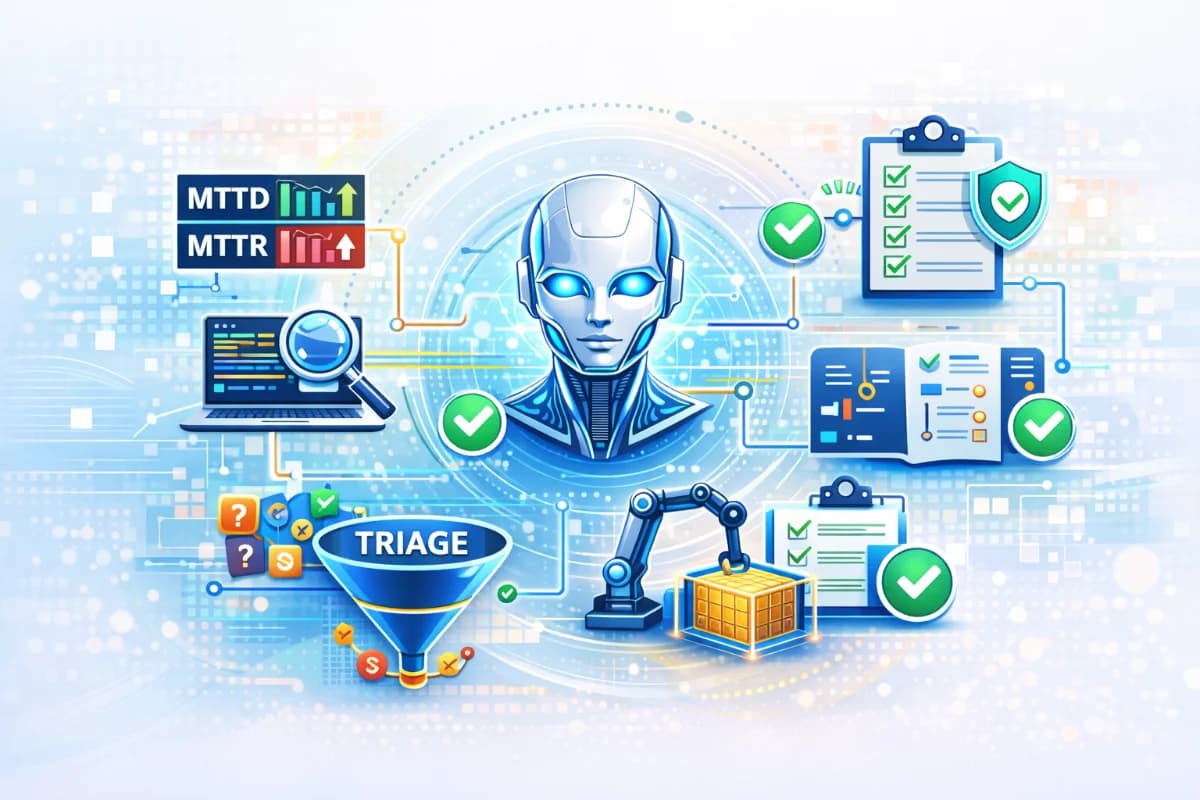
Managing automated incident response with false positive reduction, playbooks and runbooks, response orchestration, and MTTD and MTTR governance for SMEs.
Managing automated incident responses is not about turning on more automations. It is about governance: clear ownership, safe approvals, and a tuning cadence that keeps alerts quiet and response predictable. Lean teams adopt automation to move faster, but many end up with alert chaos, because rules are inconsistent, confidence thresholds are unclear, and disruptive actions are enabled too early. The right model treats automation as an operating system: incidents are grouped, evidence is consistent, and only high-confidence situations trigger actions. This guide explains practical governance for SMEs, including who owns the automation, how approvals should work, how to run playbooks and runbooks, and how to measure MTTD and MTTR while reducing alert fatigue.
Why this topic matters
Alert chaos is not just annoying; it is a risk multiplier. When responders receive too many low-quality alerts, they stop trusting the system, and the truly important incidents get missed. SMEs feel this pain quickly because they do not have dedicated analysts to triage noise. Worse, automation can create business disruption if it takes aggressive actions on false positives. That combination leads teams to disable automation entirely, returning to slow manual response.
Consider a weekend incident where an employee account shows a suspicious login, but it is actually a legitimate travel sign-in. If automation disables the account immediately, you may block critical work and lose confidence. If the same system also creates dozens of related alerts, the team learns to ignore pages. Governance prevents both outcomes by requiring correlation, confidence thresholds, and approval gates for disruptive actions. The goal is predictable first containment and predictable communication, not maximum automation.
Key factors and features to consider
Ownership: one person must own the automation system
Automation fails when nobody owns it. SMEs should assign a single automation owner, distinct from the incident commander role, responsible for rule quality, tuning, and change control. This person ensures playbooks are current, thresholds are rational, and integrations remain healthy. The automation owner also chairs the monthly review and is accountable for reducing alert fatigue.
In practice, the automation owner should maintain a simple register of automations: what triggers them, what actions they take, what approval gates exist, and what rollback steps are available. This prevents hidden automations from surprising the business. It also makes audits and leadership conversations easier because you can explain exactly what the system will do at 2 a.m.
Approvals: define which actions are safe versus disruptive
A core governance principle is separating safe actions from disruptive actions. Safe actions are reversible and scoped, such as creating an incident, attaching evidence, revoking a suspicious session, forcing re-authentication, quarantining a specific email, or isolating a single endpoint. Disruptive actions affect business continuity, such as disabling critical accounts, blocking broad domains, isolating servers, or revoking wide vendor access. Disruptive actions should require approval until false positives are proven low.
Approvals must be fast, otherwise they become a bottleneck that harms time-to-response. SMEs should define who can approve after hours, what the time limit is, and what happens if approval is not granted. A practical model is time-limited containment: apply a reversible restriction for 30 minutes, notify the on-call owner, then require approval to extend. This reduces attacker dwell time without creating long disruptions.
Tuning: false positive reduction is a monthly operational loop
False positive reduction is the main way to prevent alert chaos. It requires correlation rules, baselining, allowlists for known benign behavior, and a monthly tuning loop. The tuning loop should review the top false positives, identify why they triggered, and decide one improvement action. The improvement might be adding correlation requirements, narrowing thresholds, or adding context such as asset criticality.
A key metric is alert-to-incident conversion rate: what percentage of alerts become real incidents. If conversion is low, you are generating noise. Another useful metric is pages per week after hours. Lean teams should aim to reduce after-hours pages while keeping detection coverage strong. This is how automation stays trusted and used. If you use ShieldNet Defense, you can leverage its incident narratives and evidence timelines to make tuning decisions based on clear stories rather than raw logs.
Playbooks and runbooks: keep response predictable and teachable
Playbooks define what to do and when for each incident type. Runbooks define how to do it step by step, including approvals and rollback. Governance means these documents are short, current, and used. SMEs should limit playbooks to the top five incidents that drive most business risk, such as account takeover, invoice fraud attempts, ransomware suspicion, data sharing exposure, and vendor access anomalies.
Each playbook should define the first safe action, the escalation path, and the evidence package required. Each runbook should include stop conditions that prevent harmful automation, such as do not isolate billing servers without approval. This prevents chaos because responders do not improvise under stress. It also improves MTTD and MTTR because the workflow is consistent and evidence is captured the same way every time.
Response orchestration: make actions consistent across systems
Response orchestration connects identity, email, endpoints, and cloud controls so response steps can be executed consistently. Without orchestration, teams waste time moving between tools and manual steps vary by person. With orchestration, the same incident type triggers the same sequence of actions and evidence capture, reducing variance and improving speed. Orchestration also provides action logs, which are essential for governance and audits.
For SMEs, orchestration should be used to automate the repetitive steps first. That includes evidence collection, incident ticket creation, and safe containment actions. Only after false positives are low should orchestration be allowed to trigger broader actions. This staged approach protects the business while still improving time-to-first containment.
Detailed comparisons or explanations
A governance model that works for SMEs
A simple governance model has four layers: policy, workflows, approvals, and review. Policy defines what incidents you care about and your risk tolerance for automation. Workflows define playbooks and runbooks, plus correlation and confidence thresholds. Approvals define who can authorize disruptive actions, especially after hours. Review defines a monthly tuning meeting and a quarterly drill.
In SMEs, the governance model must be lightweight to survive. A one-page automation register, five playbooks, and a monthly 45-minute review is usually enough to maintain predictability. The most important principle is change control: no new automation goes live without a rollback plan and a measurement plan. This prevents slow drift into chaos.
How this governance improves MTTD and MTTR
Governance improves MTTD because it forces a focus on high-signal detections and correlation, which reduces noise and increases trust. When trust is higher, responders act faster, which reduces time to first containment. MTTR improves because containment happens earlier and evidence is consistent, reducing rework during recovery. The result is fewer, clearer incidents and a calmer response process.
A practical example is account takeover. With governance, you require at least two supporting signals and tag finance accounts as critical, so incidents are recognized quickly and escalated correctly. Safe actions like session revocation can happen automatically, stopping the attacker early. Evidence is logged consistently, so recovery steps and follow-up controls are clear. This is how SMEs improve both speed and confidence.
Where ShieldNet Defense fits
ShieldNet Defense can fit as an AI-first layer that helps reduce alert chaos by grouping alerts into incidents, presenting plain-language narratives, and attaching evidence timelines. It can also support safe response orchestration actions with guardrails. For governance, it helps by making incidents easier to review and tune, because the story and evidence are structured. However, it still requires ownership, approvals, and tuning cadence to keep automation predictable.
Best practices and recommendations
- Assign an automation owner and maintain a one-page automation register
- Separate safe actions from disruptive actions and put disruptive actions behind approvals
- Require correlation and confidence thresholds before paging after hours
- Run a monthly tuning review focused on the top false positives and one improvement action
- Keep playbooks and runbooks short, current, and tested quarterly
- Track KPIs: MTTD, time to first containment, MTTR, pages after hours, and alert-to-incident conversion
To implement this, start by auditing your current automations and disabling any that have unclear triggers or no rollback plan. Then define a small set of safe actions that can run automatically, and set approval gates for everything else. Create or refresh playbooks for your top incident types and define evidence packages. Finally, schedule a monthly review and commit to one tuning decision per month. If you use ShieldNet Defense, configure it to generate plain-language incidents and safe actions, then use its evidence timelines to guide tuning.
- Safe actions examples: incident creation, evidence capture, session revocation, email quarantine, endpoint isolation
- Disruptive actions examples: disabling critical accounts, blocking broad domains, isolating servers, mass vendor access revocation
- Monthly review agenda: top incidents, top false positives, after-hours pages, one tuning decision, one runbook test
These structures keep the system stable. Safe actions reduce risk quickly with minimal disruption. Disruptive actions are controlled so the business does not get surprised. The monthly agenda ensures continuous improvement without heavy overhead. Over time, alert chaos declines and response becomes predictable.
FAQ
Why does automation often increase alert fatigue at first?
Automation often increases alert fatigue because detections are enabled before baselines and correlation are tuned. Single anomalies trigger pages, and teams are not yet clear on confidence thresholds. Without governance, every new integration adds more noise. The fix is staged rollout: correlate first, page less, and tune monthly.
How do we decide what actions are safe to automate?
Safe actions are reversible and scoped. They should not shut down critical business functions and should be easy to roll back. Examples include session revocation, forcing re-authentication, and quarantining a specific email. SMEs should test these actions in drills and track false positives before expanding automation.
What KPIs best reflect whether alert chaos is improving?
Look at after-hours pages per week, alert-to-incident conversion rate, and false positive rate. If these improve while MTTD and time to first containment also improve, you are reducing chaos without losing coverage. Also monitor whether incidents are being grouped properly, because poor grouping creates noise. KPIs should be reviewed monthly to drive tuning decisions.
How often should we tune detections and playbooks?
Most SMEs should tune monthly, with a short review that focuses on the biggest pain points and one change. Playbooks and runbooks should be tested quarterly in tabletop drills. Tuning too rarely causes drift and rising noise. Tuning too often without structure can also create instability. A monthly cadence balances stability and improvement.
Can we manage automated incident response without a full SOC team?
Yes, if governance is lightweight and disciplined. You need ownership, clear approvals, and a small set of playbooks, plus automation that focuses on safe actions. Lean teams can achieve predictable response by using correlation, staged automation, and consistent evidence packages. Tools like ShieldNet Defense can help by reducing cognitive load, but the governance model is what keeps things calm.
Conclusion
Managing automated incident response without alert chaos requires governance: assign ownership, set approval gates, tune monthly, and keep playbooks and runbooks practical. Focus on false positive reduction through correlation and baseline, and automate only safe, reversible actions until trust is proven. Track MTTD and MTTR alongside after-hours pages to ensure you are improving speed without increasing disruption.
Related Articles

Oct 9, 2026
I replied to a phishing email. Am I at risk?
Replied to a phishing email? Learn what risks you face, what attackers can learn from your reply, and what to do next to protect your account and business.

Oct 8, 2026
Real or Fake? How to verify a sharepoint file invitation
Received a SharePoint file invitation? Learn how to spot fake SharePoint emails, verify shared files safely, and protect your Microsoft 365 account from phishing.

Oct 1, 2026
I paid a fake invoice. What should my business do?
Paid a fake invoice? Learn what your business should do immediately to contact the bank, preserve evidence, secure accounts, investigate the fraud, and reduce further losses.