
Mar 18, 2026
BlogNetwork traffic analysis fundamentals for SMEs in 2026

Network traffic analysis for SMEs: network monitoring, anomaly detection, packet inspection, network visibility, and threat detection to reduce noise and speed response.
Network traffic analysis is the practice of observing how data moves across your network, so you can detect suspicious behavior early and respond faster when something goes wrong. For SMEs, the goal is not to capture every packet forever, but to build enough network visibility to answer practical questions: which devices are talking to which services, what “normal” looks like, and what changes should trigger investigation. Many SMEs already have some network monitoring, but it produces noise because baselines are missing, and alerts do not map to business impact. This guide explains network traffic analysis fundamentals in plain language, highlights signal to watch, shows how to reduce noise with simple anomaly detection, and connects monitoring to a faster incident response workflow.
Why this topic matters
Network traffic analysis matters because attackers and misconfigurations often show up first as unusual network behavior, even when endpoints look normal. When credentials are stolen, you may see unusual remote access patterns, unexpected data transfers, or new connections to unfamiliar services. When malware spreads, you may see lateral movement between internal devices, repeated connection attempts, or spikes in traffic to command-and-control infrastructure. SMEs usually discover incidents late because they rely on user reports or system outages, not on early network signals.
Consider a mid-sized services company with a shared office network and a growing set of cloud services. A staff device becomes infected via a malicious email attachment, and the attacker begins probing internal file shares while quietly uploading data to an external storage service. Endpoint alerts may be ambiguous, but network visibility can show the new internal scanning behavior and the unusual outbound transfer pattern. If the team sees these signals quickly, they can isolate the device and cut off access before the incident expands. This is why network traffic analysis is a practical lever for faster containment, not just a technical exercise.
Key factors and features to consider
Network visibility: What you need to see and why?
Network visibility means knowing what devices, users, and services are communicating, and being able to review patterns over time. For SMEs, the baseline requirement is reliable flow-level visibility, such as “who talked to whom, when, and how much,” which is often enough for triage. You do not need full packet inspection for every segment to get value. When you have visibility, you can answer questions like whether a device suddenly contacted many internal hosts or whether an admin account initiated unusual remote access.
Network monitoring: The difference between collection and detection
Network monitoring is collecting network telemetry, while detection is turning that telemetry into actionable signals. Many SMEs collect logs but lack rules, thresholds, or baselines, so monitoring becomes a sea of data. Effective monitoring includes clear ownership, alert routing, and a small set of high-value detections. A practical approach is to start with detections that map to common business-impact scenarios, such as data exfiltration, ransomware propagation, and credential misuse.
Anomaly detection: Making “unusual” measurable
Anomaly detection is a method for flagging behavior that deviates from a normal baseline. For SMEs, anomaly detection should be simple and explainable: unusual outbound data volume, new external destinations, unusual internal scanning, or activity outside business hours. Complex models are not required; a good baseline plus thresholds often delivers most value. The key is to tune anomalies to your environment so they generate a small number of investigations, not constant noise.
Packet inspection: When deep detail is worth the overhead
Packet inspection means analyzing the contents of network packets to see exactly what is being transmitted. It can be valuable for investigating specific incidents, validating malware behavior, or confirming data exfiltration paths. However, packet inspection increases complexity, storage cost, and privacy considerations, and it can be difficult in encrypted traffic environments. For most SMEs, packet inspection is best used selectively on high-risk segments or during focused investigations, rather than as a blanket strategy.
Threat detection: How network signals support incident response
Threat detection improves when network signals are combined with identity, endpoint, and cloud activity. Network traffic analysis can reveal command-and-control connections, lateral movement, unusual DNS queries, and large outbound transfers, which are strong indicators of compromise. The incident response value is speed: if you can confirm suspicious network behavior quickly, you can contain faster by isolating devices, revoking sessions, or blocking destinations. Network visibility provides the evidence needed to prioritize actions and avoid guesswork.
Detailed comparisons or explanations
Flow logs vs full packet capture: Choosing the right level
Flow logs summarize connections and volumes, while full packet capture stores detailed packet data. For SMEs, flow logs are usually the best starting point because they are cheaper, simpler, and often sufficient for anomaly detection and triage. Full packet capture can be powerful, but it introduces higher cost and operational complexity, and it can create data handling burdens. A pragmatic SME strategy is to use flow logs everywhere and reserve packet inspection for limited scope when investigation requires deeper proof.
A common example is investigating unusual outbound data. Flow logs can show that a device sent a large amount of data to a new external destination, which is enough to trigger containment and a targeted investigation. If you need to confirm what data was sent, packet inspection may help, but encryption often limits visibility unless you have decryption controls and clear governance. SMEs should therefore treat packet inspection as an escalation tool, not the baseline. This keeps network traffic analysis cost-effective and operationally realistic.
Reducing noise: Baselines, allowlists, and business context
Noise comes from alerting normal behavior without context. SMEs can reduce noise by establishing baselines for critical systems and by allowlisting known services and update mechanisms. For example, cloud backups, video conferencing, and software updates can generate large transfers that look suspicious if your anomaly detection thresholds are naive. Adding business contexts such as which devices are servers, which are finance endpoints, and which are guest networks helps you set different thresholds. This is how network monitoring becomes actionable rather than distracting.
A practical noise reduction technique is to define high-risk signals that always deserve review, such as internal scanning from a user workstation, repeated authentication-related network activity, or new external destinations contacted by privileged systems. Then define low-risk anomalies that are logged but not alerted unless they combine with other signals. This approach mirrors good security alert management: fewer alerts, more meaningful investigations. Over time, you tune based on false positives and incident outcomes, which improves both trust and speed.
How network monitoring supports faster incident response
Network traffic analysis supports faster incident response by shortening triage time and improving confidence. If an endpoint alert says “suspicious,” network signals can confirm whether the device is beaconing to known malicious infrastructure or scanning internal hosts. If an account looks compromised, network monitoring can reveal whether there was unusual data transfer or unusual access paths. This lets SMEs take containment steps sooner, such as isolating a device or blocking a destination, rather than waiting for certainty that may arrive too late.
A simple incident workflow is triage, enrich, and respond. Network visibility enriches incidents by providing who-communicated-with-who evidence and by revealing whether behavior is widespread or isolated. That evidence supports response decisions and reduces accidental disruption because you can target containment precisely. SMEs that integrate network signals into their incident workflows often reduce time-to-contain, which is a major driver of reduced business interruption. This is why network traffic analysis is valuable even when the team is small.
Best practices and recommendations
· Start with flow-level network monitoring for broad visibility, then add packet inspection selectively
· Define a small set of high-value detections aligned to business risks: data exfiltration, lateral movement, and command-and-control patterns
· Build simple anomaly detection thresholds with clear baselines for critical systems and privileged endpoints
· Reduce noise using allowlists for known services, separate thresholds for different device roles, and periodic tuning
· Integrate network signals into incident response workflows so triage is faster and containment is more precise
· Review monthly metrics: alert volume, false positives, time-to-triage, and time-to-contain
To implement this in an SME, begin by identifying your critical network segments and critical systems, such as finance endpoints, servers, and administrative access paths. Enable flow logs where possible and store them with enough retention to investigate incidents, often measured in weeks rather than years. Then deploy a small number of anomaly rules and tune them for two to four weeks until alert volume is manageable. Finally, connect network alerts to your incident response process with clear ownership and playbooks so monitoring turns into action.
· High-signal patterns to watch: new external destinations, unusual outbound volume, internal scanning, and repeated failed connection attempts
· Low-signal patterns to log but not alert immediately: small spikes during updates, known backup traffic bursts, and predictable SaaS synchronization
· Investigation questions to standardize: what changed, what is normal for this device, what other systems are affected, and what containment is safest
These lists help SMEs build monitoring discipline. High-signal patterns deserve immediate review because they often map to real threat detection outcomes. Low-signal patterns should be recorded and used for context, because alerting on them creates noise and alert fatigue. Standardizing investigation questions reduces time-to-triage because responders follow a consistent process rather than improvising. This makes network traffic analysis repeatable and scalable.
FAQ
What is network traffic analysis in simple terms?
Network traffic analysis is watching how devices and services communicate so you can spot suspicious behavior early. It uses network monitoring data like connection patterns and volumes to identify anomalies and potential threats. For SMEs, it helps answer practical questions such as whether a device is contacting new external destinations or scanning internal systems. The goal is faster, more confident incident response.
Do SMEs need packet inspection to get value from network monitoring?
Most SMEs can get significant value from flow-level monitoring without full packet inspection. Flow logs can reveal unusual destinations, volume spikes, and lateral movement patterns that are enough for triage and containment decisions. Packet inspection is useful for deeper investigations, but it increases operational overhead and can be limited by encryption. A selective approach is usually the most cost-effective.
How do we reduce noise from anomaly detection?
Reduce noise by creating baselines for different device roles and allowlisting known services that generate predictable traffic. Use thresholds that reflect your environment rather than generic defaults, and review false positives regularly. Focus alerts on high-signal behaviors like internal scanning and new external destinations from sensitive systems. Over time, tuning based on real outcomes is what makes anomaly detection trustworthy.
How does network visibility help with threat detection?
Network visibility helps threat detection by revealing patterns that indicate compromise, such as command-and-control connections, unusual DNS behavior, and large outbound transfers. It also helps you correlate endpoint and identity alerts with network behavior to confirm severity quickly. This reduces guesswork and supports faster containment. For SMEs, the main benefit is improved decision speed during incident triage.
What is a practical first step for SMEs starting network traffic analysis?
A practical first step is enabling flow logs on key network devices and defining three to five high-value detections tied to your biggest business risks. Identify critical systems, set simple baselines, and ensure there is an owner who reviews alerts. Keep retention long enough to investigate, then tune alerts until volume is manageable. This creates immediate operational value without requiring complex tooling.
Conclusion
Network traffic analysis fundamentals come down to building network visibility, applying explainable anomaly detection, and using network monitoring signals to support faster incident response. SMEs should start with flow-level monitoring, reduce noise with baselines and allowlists, and add packet inspection only where the investigation needs deeper proof. When network signals are integrated into incident workflows, triage becomes faster and containment becomes more precise, reducing business interruption. If you want an actionable next step, enable flow logs on critical segments, define a small set of high-signal detections, and tune them monthly, so your network traffic analysis stays useful rather than noisy.
Related Articles
Apr 28, 2026
Incident triage for lean teams: prioritize what matters fast
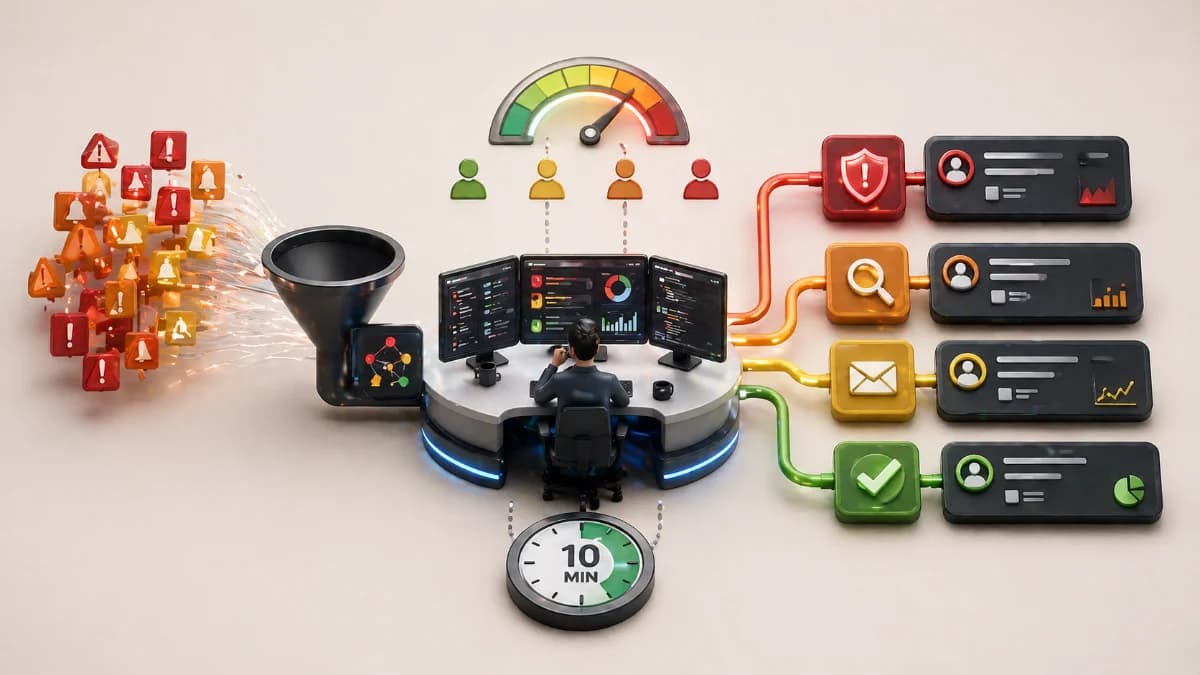
Incident triage for lean teams using severity scoring, incident prioritization, and an incident queue to decide next actions in 10 minutes with clear summaries.

Apr 27, 2026
Suspicious File Analysis: How to Tell If It's Malicious
Discover how suspicious file analysis works—static, dynamic, and IOC investigation steps—and the key evidence that proves a file is malicious

Apr 27, 2026
How to Prevent Insider Threats with Smarter Access Controls
Learn how to prevent insider threats with identity-based access controls, continuous verification, and least-privilege strategies built for SMEs.

Protect your business with ShieldNet 360
Get started and learn how ShieldNet 360 can support your business.