
Apr 8, 2026
BlogContainer security monitoring: Signals, alerts, automation
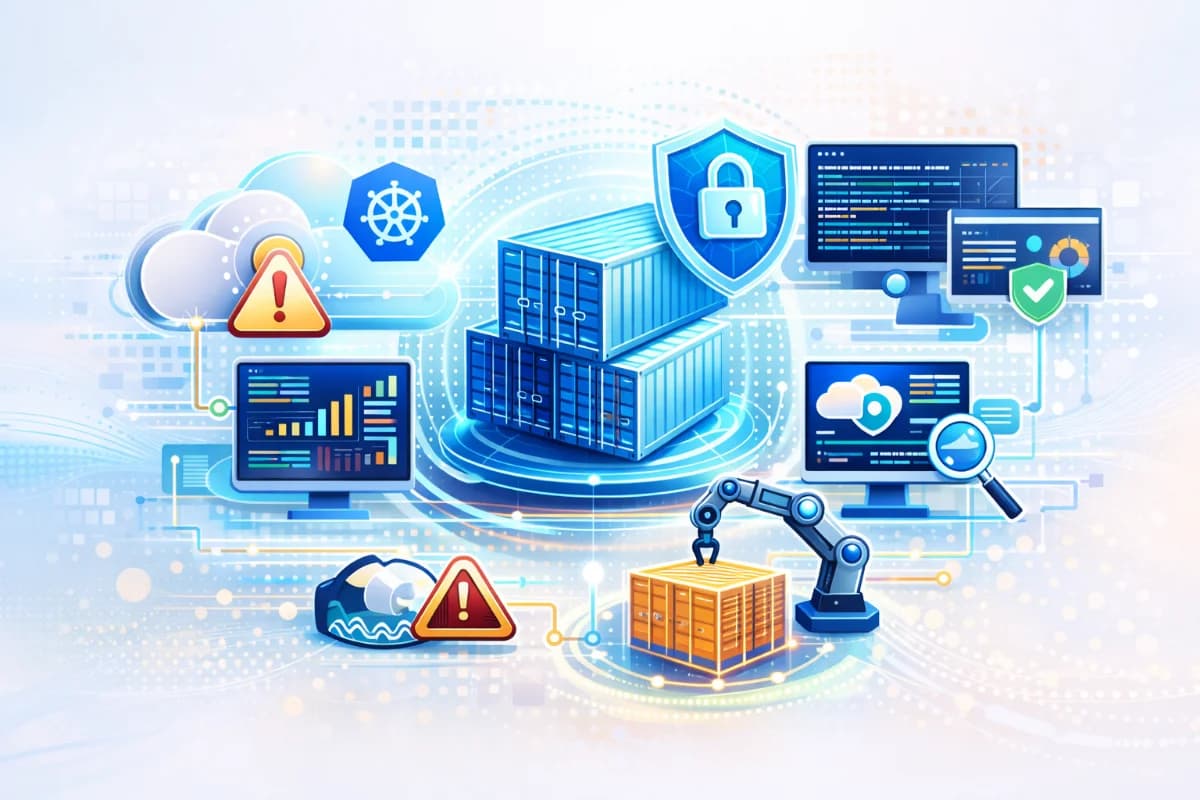
Container security monitoring: actionable signals, container runtime telemetry, Kubernetes security, cloud workload protection, and automated containment.
Container security monitoring is not just more logs for your DevOps team - it is the shortest path to catching risky behavior early, containing it safely, and proving what happened after the fact. Containers move fast, change often, and disappear quickly, so a traditional server monitoring mindset usually misses the incident story. Good monitoring combines what you can prevent before deployment with what you can detect at runtime, then turns that into a small number of incidents your team can actually act on.
Why this topic matters
Container environments compress risk into minutes because workloads scale rapidly and a single compromised container can access secrets, service accounts, or internal APIs faster than a human can triage raw alerts. In many SMEs, Kubernetes security is operated by generalists who are juggling uptime, costs, and releases, so security noise gets ignored until the incident is already large. Container security monitoring matters because it creates a reliable feedback loop that detects suspicious behavior quickly and triggers the first safe action, even outside business hours. That is what always-on security should mean in practice: predictable detection and predictable containment, not an overwhelming dashboard.
A realistic scenario is a vulnerable image pushed on Friday, deployed to production, and then exploited over the weekend through an exposed endpoint. The attacker runs a crypto-miner, tries to reach the Kubernetes API, and probes for mounted secrets and cloud metadata. If your monitoring only watches CPU and memory, you will see a performance issue but not the root cause or the blast radius. With container runtime telemetry and Kubernetes-aware context, you can detect the suspicious process, identify the specific pod and image digest, and contain it by isolating the pod or revoking the compromised identity before it spreads.
Key factors and features to consider
Build-time controls in container security monitoring
Build-time monitoring is everything you can evaluate before a container runs, including image vulnerability scanning, dependency inventory, and policy checks at admission time. A strong approach reduces the number of avoidable incidents caused by known vulnerable packages or risky configurations shipped into production. In practice, this means scanning images in CI, failing builds on critical issues, and blocking deployments that violate baseline policies. When build-time controls are consistent, your runtime monitoring becomes quieter and your team trusts alerts more.
Container runtime telemetry that is actually useful
Container runtime telemetry should capture what the container did, not just what resources it used, including process starts, network connections, file access patterns, and identity usage. The value is not raw volume; the value is high-signal events that indicate compromise, such as a shell spawned in a production pod or an unexpected outbound connection to a rare destination. Good container runtime telemetry is also scoped to the container context, so you can answer “which pod, which namespace, which image, which node, which service account.” That context is what turns a scary alert into a containment decision.
Kubernetes security context for faster triage
Kubernetes security monitoring should enrich every alert with cluster context, because the same event can be low risk in one namespace and high risk in another. A suspicious process in a test namespace might be a developer action, while the same process in a payments namespace should trigger immediate containment. The practical features to demand are namespace labels, workload identity, RBAC permissions, and recent deployment changes, so you can connect “what changed” to “what happened.” This is how you avoid alert fatigue while still keeping high-confidence detection.
Cloud workload protection as the container “outer layer”
Cloud workload protection focuses on the broader environment around containers: nodes, managed control plane events, cloud identities, and service-to-service access in the cloud. Container security monitoring is incomplete if it cannot connect pod activity to cloud API calls, storage access, and identity tokens used outside the cluster. For SMEs, cloud workload protection matters because attackers often pivot from a container to cloud resources using credentials or metadata access. A combined view helps you see whether the incident stayed inside the cluster or became a cloud identity problem.
Always-on security with safe automation, not blanket blocking
Always-on security in containers should be designed around safe automated actions, because containers are ephemeral and incidents escalate quickly. The key is to automate actions that are reversible and scoped, such as isolating a single pod, applying a temporary network policy, or revoking a suspicious session. Blanket blocking at the cluster level is risky and often unnecessary for SMEs. The goal is to reduce attacker dwell time without causing self-inflicted downtime, which requires clear guardrails and staged automation.
Detailed comparisons or explanations
Build-time vs runtime: why you need both
Build-time controls reduce the probability of a known-bad artifact entering production, while runtime monitoring detects unexpected behavior that slips through or emerges after deployment. If you rely only on build-time scanning, you will miss misused credentials, runtime exploits, and policy bypasses that occur during execution. If you rely only on runtime detection, you will be constantly “discovering” preventable vulnerabilities after they already reached production. Container security monitoring works best when build-time reduces noise and runtime focuses on behavior, so alerts become rarer but more meaningful.
A practical way to connect the two is to tie runtime alerts back to image identity, such as image digest, provenance, and deployment source. When a runtime alert fires, you want to know whether the image was recently introduced, whether it bypassed policy, and whether the same image is running elsewhere. This closes the loop from incident response back to engineering, so the fix becomes “stop the pattern” rather than “clean up this one pod.” Over time, this is how SMEs see measurable improvements in MTTD and MTTR without hiring a dedicated SOC team.
Actionable alerts: the minimum incident package for containers
A container alert is actionable when it provides enough context to decide a containment step without opening five tools. The minimum package should include the workload identity (pod, namespace, deployment), the triggering behavior (process, network, file, or API call), the suspected objective (crypto-mining, credential access, lateral movement), and the likely blast radius. It should also include a short explanation of confidence, such as “unusual in this namespace” or “matches known exploit chain.” Without this package, container security monitoring devolves into noisy telemetry that slows response rather than speeding it up.
In practice, the best alerts also include “what changed” context, like a new deployment, a new image version, or a recently modified service account permission. That context helps SMEs distinguish between developer-driven change and attacker-driven behavior quickly. It also supports executive communication, because you can explain the incident in plain language and justify containment actions. If you are using an AI-first workflow like ShieldNet Defense, the platform can be positioned to summarize the incident narrative and evidence highlights so non-specialists can make decisions faster.
Automated containment: how to stop spread without breaking production
Automated containment for containers should prioritize scoped actions that reduce risk quickly. Examples include killing a single container process, restarting a pod, isolating a pod with a restrictive network policy, or cordoning a node if there is evidence of node-level compromise. Another high-value action is revoking or rotating the specific identity or token used by the compromised workload. These actions align with response orchestration and a SOAR workflow approach: detect, enrich, contain, and document, all within minutes for high-severity incidents.
A phased automation model is what keeps SMEs safe. Phase one automates evidence capture and incident grouping, so every event becomes a coherent story. Phase two automates low-risk containment like pod isolation and session revocation for high-confidence patterns. Phase three adds approval gates for higher-impact steps, such as scaling down a deployment or blocking broader egress. This staged approach keeps “false positive reduction” as an operational requirement, because the more you automate, the more you must be confident and transparent.
Best practices and recommendations
- Define your top three container incident types: compromised image, suspicious runtime behavior, and credential misuse
- Require contextual alerts: pod, namespace, image digest, service account, and what changed recently
- Start with high-signal rules: shell in production, unexpected outbound egress, secret access anomalies, and privilege changes
- Implement phased automation: evidence first, then scoped containment, then approval-based stronger actions
- Standardize evidence: incident timeline, affected workloads, cloud identity usage, actions taken, and follow-up tasks
- Review monthly: alert volume, false positives, time to first containment, and the top recurring root causes
To apply these practices, pick one Kubernetes security environment and run a 30-day pilot that measures operational outcomes, not just alert counts. Start by tuning alerts so they produce a small number of incidents with clear context, then automate one or two containment actions that are reversible, such as isolating a pod and revoking a suspicious token. Keep high-impact actions behind approvals until you see stable false positive reduction over several weeks. If you use ShieldNet Defense, note it can help by producing plain-language incident summaries, preserving evidence timelines, and triggering safe response steps in a controlled way for lean teams.
- Safe automation examples: isolate pod egress, restart a suspicious pod, revoke a workload token, create a ticket with evidence
- Approval-gated actions: scale down a critical deployment, cordon a production node, block broad egress domains, revoke wide service account permissions
- Monitoring hygiene tasks: verify telemetry collection, confirm labels and ownership, and test one containment runbook monthly
These steps keep container security monitoring practical for SMEs. Safe automation buys time without breaking production, which keeps engineering supportive of the program. Approval gates prevent automation mistakes from becoming outages, especially during early tuning. Hygiene tasks ensure you can trust your signals, because missing telemetry is one of the fastest ways to lose confidence in alerts. Over time, this creates always-on security that is measurable and sustainable.
FAQ
What is “good” container security monitoring for SMEs?
Good container security monitoring combines build-time checks with runtime detection and produces a small number of actionable incidents, not a flood of alerts. It should include container runtime telemetry with Kubernetes security context, so the incident is tied to a pod, namespace, image, and identity. It should also support safe containment steps that reduce attacker dwell time quickly. If your team can act within minutes using a single incident view and a clear runbook, your monitoring is doing its job.
How do we reduce false positives in container alerts?
False positive reduction comes from correlation, baselining, and adding business context to detection rules. Require multiple signals for escalation, such as unusual process plus unusual egress, rather than treating single anomalies as critical. Use namespace labels and workload ownership to distinguish dev/test behavior from production risk. Review false positives monthly and tune rules based on real outcomes so alert volume stays operationally manageable.
What container runtime telemetry signals are most actionable?
The most actionable signals are those that indicate attacker intent, such as an interactive shell in a production container, unusual outbound connections, secret or token access anomalies, and unexpected privilege or role changes. Rapid creation of new processes or tools not present in the image is another strong indicator. Combine these with Kubernetes security context like service account permissions and recent deployment changes. This makes the alert explainable and supports quick containment decisions.
What should we automate first in container incident response?
Automate evidence capture and incident grouping first, then add scoped, reversible containment actions such as isolating a pod’s network access or revoking a single token. Avoid broad egress blocks or scaling down critical deployments early because mistakes can cause outages. Use a SOAR workflow approach with approval gates for disruptive actions. This phased automation model helps SMEs gain speed while protecting business continuity.
How does cloud workload protection relate to containers?
Cloud workload protection connects container activity to the broader cloud environment, including node events, cloud identities, and cloud API usage. This matters because attackers may pivot from a compromised container to cloud resources using service account tokens or metadata access. If you can see both the container behavior and the cloud actions, you can scope the incident accurately and contain the right identity. In practice, cloud workload protection makes container security monitoring more complete and reduces investigation time.
Conclusion
Container security monitoring works when it is outcomes-driven: build-time checks reduce preventable risk, runtime telemetry detects suspicious behavior, alerts are enriched with Kubernetes security context, and automation delivers safe containment within minutes. For SMEs, the winning approach is phasing automation with guardrails, so you get always-on security without self-inflicted disruption. Start by defining high-signal incidents, standardizing evidence, and automating a small set of reversible containment steps, then expand as false positive reduction improves. If you want to accelerate this operating model, ShieldNet Defense can be positioned as an AI-first layer that helps produce plain-language incidents, preserve evidence timelines, and trigger safe response steps your team can run consistently.
Related Articles

Oct 9, 2026
I replied to a phishing email. Am I at risk?
Replied to a phishing email? Learn what risks you face, what attackers can learn from your reply, and what to do next to protect your account and business.
Oct 8, 2026
Real or Fake? How to verify a sharepoint file invitation
Received a SharePoint file invitation? Learn how to spot fake SharePoint emails, verify shared files safely, and protect your Microsoft 365 account from phishing.

Oct 1, 2026
I paid a fake invoice. What should my business do?
Paid a fake invoice? Learn what your business should do immediately to contact the bank, preserve evidence, secure accounts, investigate the fraud, and reduce further losses.