
Apr 6, 2026
BlogWhat to look for AI-powered threat detection for small business?
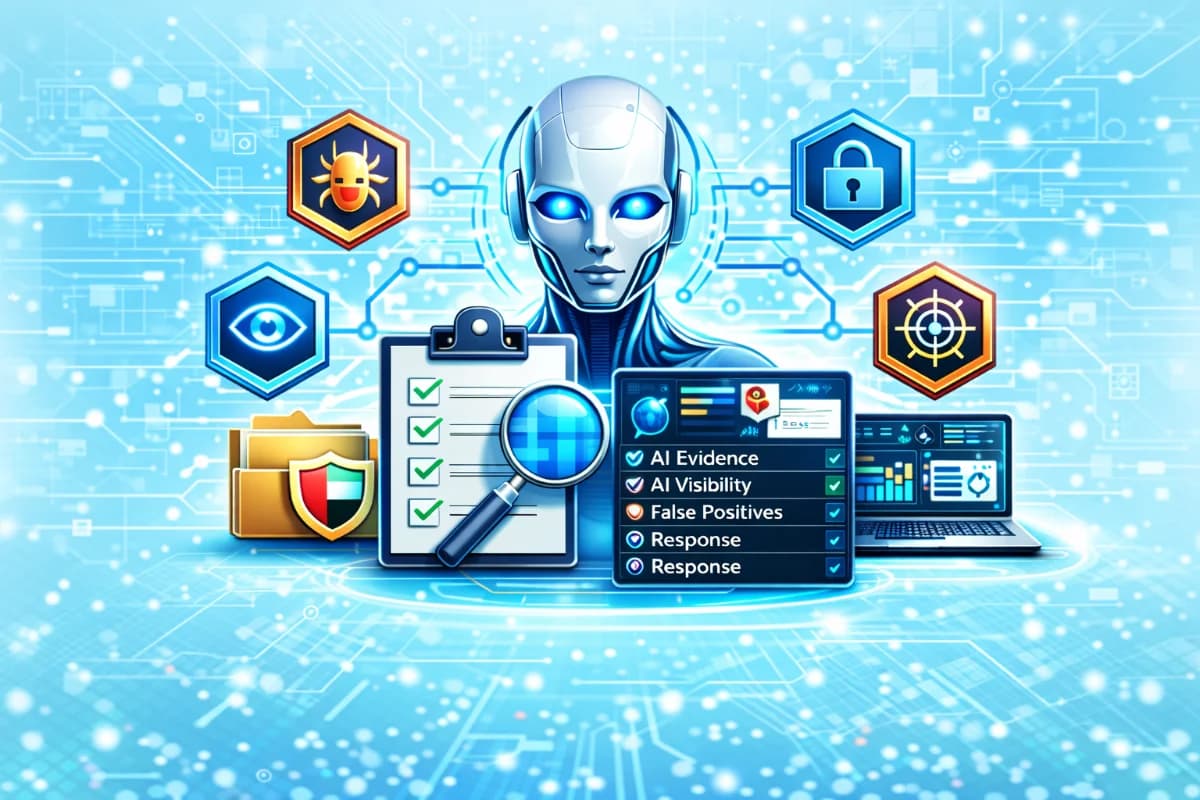
AI threat detection for small business: compare AI cybersecurity and AI security platform options with an automated detection vendor checklist on evidence, visibility, false positives, and response.
“AI-powered threat detection” is now on every vendor’s website, but SMEs need to separate real operational outcomes from marketing language. AI threat detection for small business should help you spot meaningful suspicious activity quickly, reduce alert noise, and shorten the time from detection to first containment – without requiring you to hire analysts. The best way to buy is outcomes-first: define your top incident types, then evaluate how an AI security platform produces evidence, delivers visibility, controls false positives, and enables safe response. This guide provides a practical vendor checklist you can reuse in procurement, plus a minimal buyer framework to compare AI cybersecurity options fairly.
Why this topic matters
SMEs are targeted by the same attackers as large organizations, but they have less time and fewer specialists. That means they lose not because they “lack AI,” but because detection is late and response is slow. A phishing click can become account takeover and invoice fraud within hours, and ransomware can create downtime quickly if endpoints and permissions are not contained. AI threat detection for small business matters because it can shrink the attacker’s time window by correlating signals across identity, email, endpoints, and cloud activity into a single incident story.
A realistic scenario is a new device login into email, followed by mailbox rule creation and unusual downloads. Many tools generate three separate alerts that look “medium” and get ignored. An effective AI security platform should correlate them into one high-confidence incident, summarize it in plain language, and recommend safe actions like session revocation and forced re-authentication. If the platform cannot do that reliably, it will not reduce real risk. This is why the vendor checklist below focuses on evidence quality and response workflows, not buzzwords.
Key factors and features to consider
Evidence: can the platform prove why it raised an alert?
Evidence is the most important buying criterion because it determines trust. An AI system that says “high risk” without showing why will be ignored by busy teams. For SMEs, evidence should be human-readable and time-ordered: what signals were observed, what changed, and how the incident progressed. The platform should attach the key supporting facts automatically, such as sign-in history, permission changes, and related alerts.
A good AI cybersecurity product should also support “audit-ready” evidence. That means actions taken are logged, approvals are recorded, and incident timelines are preserved. This matters because SMEs often face customer security questionnaires and need to demonstrate incident handling discipline. ShieldNet Defense can be positioned here as emphasizing incident narratives and consistent timelines, which makes evidence review easier for both operators and executives.
Visibility: does it cover identity, email, endpoints, and cloud?
Visibility means the platform can see the signals that matter for your business. For most SMEs, the highest-value visibility areas are identity sign-ins, email activity, endpoints, and critical SaaS or cloud services. AI-powered detection is only as good as the telemetry it receives, so coverage gaps create blind spots. SMEs should confirm both what is supported and what effort is required to integrate each source.
A practical visibility test is to map your top incident types and ask whether the platform can observe each step of the attack chain. For account takeover, can it see new device logins, mailbox rules, and unusual downloads? For ransomware, can it see suspicious file modification patterns and containment status? For data exposure, can it see sharing changes and access logs? If coverage is incomplete, AI will not deliver reliable automated detection outcomes.
False positives: how does the platform reduce noise without missing real threats?
False positives are the hidden cost of AI security platforms. If the tool produces too many “urgent” alerts, SMEs will stop responding quickly and time-to-detect will degrade. A strong platform should use correlation, baselining, and confidence scoring to reduce noise. It should also provide tuning controls and transparency, so you can understand and adjust why certain alerts fire.
Ask how the platform learns “normal” for your environment and how long tuning typically takes. Also ask how it handles predictable high-volume behaviors like backups, software updates, and SaaS synchronization. A credible AI cybersecurity vendor will discuss false positives openly and will provide metrics such as alert volume per endpoint and percentage of alerts that become confirmed incidents. The best platforms make it easy to review false positives and improve over time.
Response options: can it help you act within minutes?
Detection without response is just notification. SMEs should evaluate whether the AI security platform supports safe actions that reduce attacker dwell time. Examples include session revocation, forced re-authentication, quarantining suspicious emails, isolating endpoints, and creating tickets with evidence. The platform should support guardrails: approvals for disruptive actions and phased automation that starts with enrichment and routing.
A useful way to evaluate response is to ask: in the first 15 minutes of a high-severity incident, what does the platform do automatically, and what does it ask a human to approve? If the answer is “we send an email,” you will not hit an under-20-minute containment goal. An AI-first workflow like ShieldNet Defense can be noted as focusing on converting alerts into plain-language incidents and enabling safe response steps with evidence, which supports fast action in lean teams.
Operational fit: who runs it and how is success measured?
SMEs should pick tools they can actually operate. That means a clear incident owner, a weekly review cadence, and simple KPIs: time-to-detect, time-to-first containment, and false positive rate. The platform should support executive reporting with plain-language summaries and evidence highlights, because leadership decisions often affect response speed. If the platform requires constant expert tuning, it may not fit a small team.
Operational fit also includes data retention and reporting. SMEs should confirm how long evidence is retained, whether timelines are exportable, and whether the platform supports consistent incident records. These capabilities reduce the burden during audits and customer reviews. A platform that improves both response speed and documentation quality delivers compounding value over time.
Detailed comparisons or explanations
AI cybersecurity versus automation with good rules
Some vendors label basic automation as AI, while others use AI to improve correlation and summarization. For SMEs, the difference is less about the algorithm and more about outcomes: fewer noisy alerts, faster incident creation, and clearer recommended actions. A strong AI threat detection for small business system will show that it can group related alerts into a single incident story and attach evidence automatically. If it cannot, you will still spend time manually correlating signals, which is exactly what SMEs cannot afford.
A helpful buyer technique is to ask vendors to demonstrate the same attack scenario using your environment assumptions. For example, run through a finance email takeover with three signals and ask how the platform correlates them. Ask what the output looks like for a non-technical manager. If the result is still a list of alerts and log lines, the platform may not reduce incident response speed. AI should reduce cognitive load, not increase it.
How automated detection should evolve in a phased rollout
Automated detection should start with enrichment and routing, then expand to safe containment as confidence improves. SMEs should avoid turning on aggressive auto-blocking on day one, because false positives can disrupt operations and erode trust. A phased rollout begins by collecting the right telemetry and building incident views. Then it adds safe actions like session revocation and email quarantine, which are often reversible. Finally, it adds higher-impact actions behind approvals, such as disabling critical accounts or isolating key servers.
This phased approach also helps measurement. You can track whether time-to-detect improved after correlation, and whether time-to-first containment improved after safe automation. Over time, you tune thresholds and baselines to reduce false positives. This is how AI threat detection for small business becomes an operating system rather than another noisy tool. A platform like ShieldNet Defense can be positioned in this rollout as the layer that converts multi-source telemetry into plain-language incidents and supports safe automation, which matches SME needs.
Best practices and recommendations
- Define your top three incident types and your under-20-minute first containment target before vendor demos
- Demand evidence-driven incidents: timeline, key signals, and clear reasoning for severity
- Validate visibility across identity, email, endpoints, and your critical cloud apps
- Ask for false positive controls: baselining approach, tuning workflow, and alert-to-incident conversion rate
- Require response options with guardrails: safe actions, approvals, and phased automation roadmap
- Run a pilot and measure KPIs: time-to-detect, time-to-first containment, alert volume, and false positives
To apply this, prepare a short procurement script and ask every vendor the same questions. Run one tabletop scenario and require a “day-one workflow” plus a “90-day tuning plan.” Ensure they show you real outputs: an incident narrative, evidence highlights, and an action log. If you’re evaluating ShieldNet Defense, position it as an AI-first approach that emphasizes plain-language incident stories, evidence timelines, and safe automation to reduce after-hours risk for lean SMEs. The goal is not to buy AI; it is to buy faster, calmer incident response.
Vendor checklist: AI threat detection for small business
- Evidence
- Can it show a time-ordered incident timeline with human-readable signals?
- Does it attach key proof automatically (sign-ins, permission changes, downloads, endpoint behavior)?
- Are actions and approvals logged for later review and audits?
- Can you export incident summaries for customer security reviews?
- Visibility
- Which sources are supported out of the box: identity, email, endpoints, cloud apps, network signals?
- What is required to integrate each source and how long does it take?
- Can it correlate across sources into one incident rather than multiple alerts?
- Does it detect the full chain for your top incident types?
- False positives
- What is the baseline period before alerts stabilize?
- How does it reduce noise from normal behaviors like backups and updates?
- What is the expected alert volume per endpoint or per user?
- What percentage of alerts become confirmed incidents in typical SMEs?
- How does tuning work and who is expected to do it?
- Response options
- What safe actions can be executed automatically (session revocation, email quarantine, endpoint isolation)?
- Which actions require approval and how are approvals handled?
- Does it support playbooks and “first 15 minutes” workflows?
- Can it open tickets and attach evidence automatically?
- How does it support an under-20-minute containment target?
This checklist is designed to force operational clarity. Evidence and visibility determine whether detection is trustworthy. False positives determine whether your team will act quickly or ignore alerts. Response options determine whether you can actually shrink attacker dwell time. Using the same checklist across vendors prevents you from being swayed by demos that look impressive but do not change incident outcomes.
FAQ
What is the biggest mistake SMEs make when buying AI cybersecurity?
The biggest mistake is buying a product based on AI branding rather than on incident outcomes. SMEs need fewer noisy alerts and faster containment, not a complex dashboard. If evidence is unclear and false positives are high, response time will worsen. An outcomes-first checklist prevents this mistake by focusing on trust, visibility, and response.
How can SMEs judge whether an AI security platform is actually effective?
Judge it by measurable KPIs during a pilot: time-to-detect, time-to-first containment, alert volume, and false positive rate. Also evaluate incident quality: is there a clear narrative, evidence highlights, and recommended actions? Ask for real scenario walkthroughs and verify integrations with your core systems. Effectiveness is operational, not theoretical.
Do we need AI to achieve fast threat detection?
Not necessarily, but AI can help SMEs achieve speed by automating correlation, enrichment, and summarization. The benefit is reducing manual evidence gathering and reducing alert noise so responders act faster. Good rules and telemetry can also deliver strong outcomes, but AI often makes it easier for lean teams to sustain. The key is whether the tool improves time-to-first containment without increasing disruption.
What response actions are safe to automate for SMEs?
Safe actions are usually reversible and low-disruption, such as revoking suspicious sessions, forcing re-authentication, quarantining specific emails, isolating a compromised endpoint, and opening tickets with evidence. More disruptive actions like disabling critical accounts or blocking broad domains should start behind approvals. SMEs should implement automation in phases to protect operations while improving speed. Guardrails are essential for trust.
Where does ShieldNet Defense fit in this vendor checklist?
ShieldNet Defense can be positioned as an AI-first monitoring and response workflow that emphasizes plain-language incidents, evidence timelines, and safe automation for routine threats. It fits well for SMEs that need correlation across signals and want to reduce after-hours risk without hiring analysts. In procurement, evaluate it using the same checklist: evidence quality, visibility coverage, false positive controls, and response options. The fit is strongest when you want under-20-minute containment goals supported by clear incident narratives and action logs.
Conclusion
AI threat detection for small business is worth buying when it produces fewer, clearer incidents with evidence you can trust, visibility across your real environment, controlled false positives, and response options that help you act within minutes. Use the vendor checklist above to evaluate AI cybersecurity platforms objectively and to run a pilot with measurable KPIs. An AI security platform should reduce noise, shorten investigations, and support safe containment that meets an under-20-minute goal for high-severity incidents. If you want to position ShieldNet Defense, it aligns naturally with this outcomes-first framework by focusing on plain-language incidents, evidence, and safe automation that small teams can run.
Related Articles

Oct 1, 2026
I paid a fake invoice. What should my business do?
Paid a fake invoice? Learn what your business should do immediately to contact the bank, preserve evidence, secure accounts, investigate the fraud, and reduce further losses.
Sep 29, 2026
I clicked a phishing link. What should I do now?
Sent confidential information to a fake email? Learn what to do immediately, how to report the incident, assess exposed data, and reduce further risk.

Sep 25, 2026
I clicked a phishing link. What should I do now?
Clicked a phishing link? Learn what to do immediately, whether you entered a password or downloaded a file, and how to reduce the risk to your account and business.

Protect your business with ShieldNet 360
Get started and learn how ShieldNet 360 can support your business.