
Mar 6, 2026
BlogWhat does 24/7 virtual security actually mean?
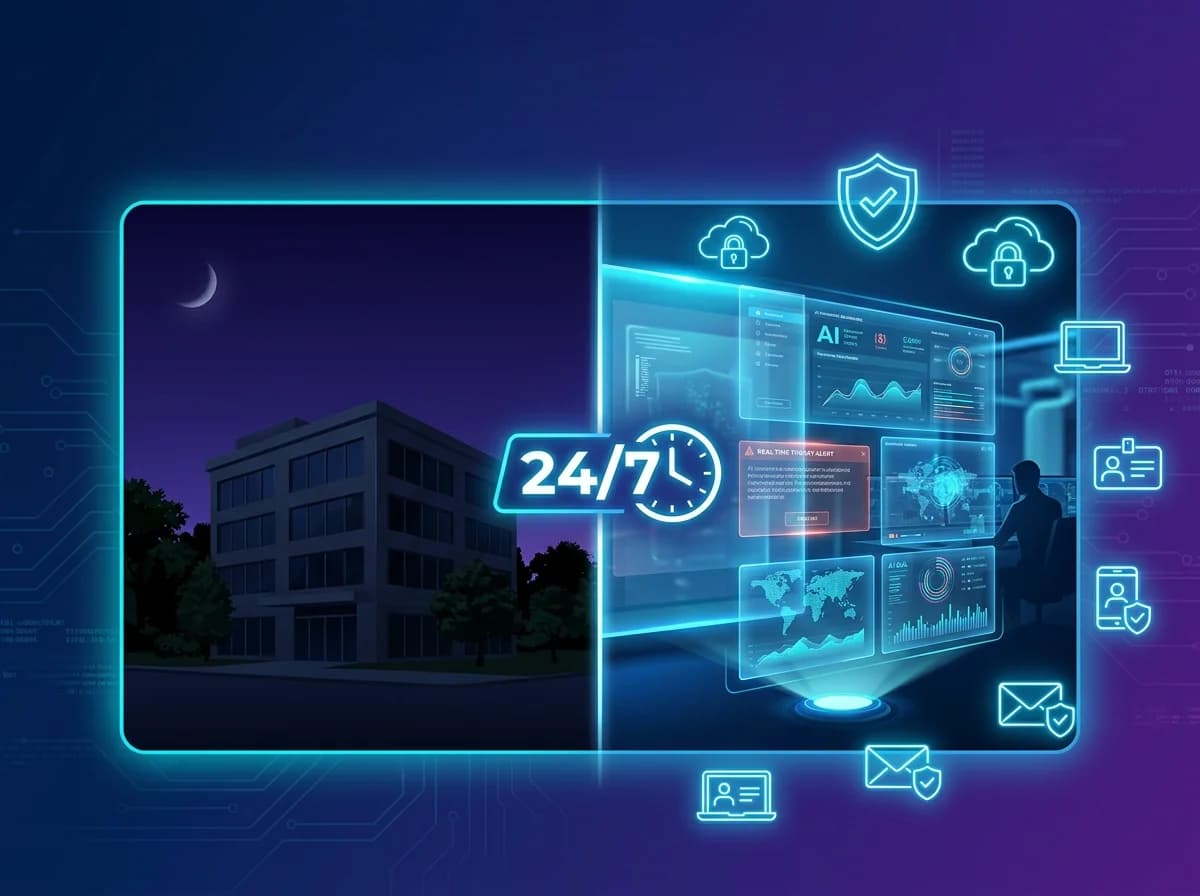
24/7 virtual security explained: virtual security monitoring, AI security monitoring, and virtual security service vs guards and MSSP for SMEs.
24/7 virtual security is often misunderstood as either physical guarding or a full outsourced security team. 24/7 virtual security is a way to deliver continuous security outcomes monitoring, triage, investigation, and safe response without putting people in your office or staffing your own night shift. For SMEs, the practical value is coverage during the hours when most teams are offline: nights, weekends, and holidays. Virtual security monitoring uses telemetry from identity, email, endpoints, cloud apps, and network activity to detect suspicious behavior and turn raw alerts into plain language incidents. This article clarifies what virtual security is, how AI security monitoring handles routine threats, and how a virtual security service differs from guarding and from a traditional MSSP.
Why this topic matters
SMEs face threats that do not respect business hours. Account takeovers, phishing campaigns, and ransomware often begin with one click or one credential reuse at the worst possible time. When there is no afterhours of coverage, attackers gain a large time window to escalate access, exfiltrate data, or disrupt operations before anyone notices. Many SMEs try to solve this with more tools, but tools alone often increase alert volume without improving response speed.
A realistic scenario is a weekend account takeover in cloud email that creates forwarding rules and initiates password reset attempts on downstream services. If nobody triages alerts until Monday, the attacker may have already harvested sensitive conversations, reset credentials elsewhere, and set up persistence. 24/7 virtual security matters because it shortens the attacker window by performing routine monitoring and first line response when humans are unavailable. The outcome is not perfect protection, but fewer missed incidents and faster containment for the highest risk events.
Key factors and features to consider
Virtual security monitoring: continuous detection and triage
Virtual security monitoring is the continuous observation of security signals and the conversion of those signals into prioritized incidents. For SMEs, it should include identity sign ins, email activity, endpoint behavior, and key cloud app events. The important feature is not “more alerts,” but correlation and prioritization grouping related signals into one incident and ranking by business impact. Good monitoring also includes evidence capture, so incidents are explainable and auditable.
AI security monitoring: where AI helps most
AI security monitoring is most valuable in repetitive, high-volume work: deduplicating alerts, enriching context, and summarizing incidents in plain language. It can recognize patterns such as suspicious sign ins plus mailbox rule change, or unusual downloads following a new device login. AI also helps by recommending the next best action based on playbooks, such as revoking sessions or quarantining a message. For SMEs, the key is that AI reduces time to triage and reduces the reliance on one expert who “knows where to look.”
24/7 virtual security as a workflow, not a promise
24/7 should be understood as an operational workflow with defined steps and escalation rules. A credible virtual security service defines what it monitors, how it decides severity, what actions it can take automatically, and when it escalates to a human or to your internal team. SMEs should look for guardrails: safe automation first, approvals for disruptive actions, and clear incident ownership. Without workflow clarity, 24/7 becomes a marketing claim rather than a measurable capability.
Virtual security service: what you should expect to receive
A virtual security service should provide more than dashboards. SMEs should expect incident summaries, evidence, and a response timeline that shows what was detected, what was investigated, and what actions were taken. You should also expect periodic reporting: top incidents, common attack patterns, and recommended improvements that reduce future risk. The service should integrate with your existing tools and ticketing, because response is where value is created. If the service cannot drive action, it will not reduce business interruption.
Routine threats: what can be handled safely and automatically
Routine threats are common events that can be detected and contained with standardized playbooks. Examples include suspicious sign ins, phishing messages, known malicious attachments, and unusual data sharing. AI can handle these by enriching context, grouping alerts into incidents, and executing reversible actions such as session revocation or message quarantine. SMEs should avoid full auto blocking at first, because false positives can disrupt operations, but safe automation is often enough to reduce risk dramatically. The goal is to automate the boring, repeatable parts, so humans focus on edge cases.
Detailed comparisons or explanations
Virtual security vs physical guarding
Physical guarding protects buildings and people; virtual security protects accounts, devices, and data flows. A guard can stop an intruder at a door, but cannot see a compromised cloud account or a malicious email rule. Virtual security monitoring focuses on digital signals and incident workflows, not on physical access control. SMEs should avoid mixing these concepts, because the controls, evidence, and response actions are completely different. If your risk is digital, the solution must be digital and integrated with your systems.
Virtual security vs MSSP: what changes in practice
A traditional MSSP often provides managed monitoring using a SOC style approach, but quality and responsiveness vary widely depending on scope, integrations, and how triage is handled. A virtual security service may look similar, but the key differentiator is how much of the routine work is standardized and automated, and how incidents are communicated in plain language for SMEs. AI security monitoring can reduce noise and speed up enrichment, which helps services scale without drowning teams in tickets. The best SME fit model combines automation for routine threats with human escalation for complex investigations.
A practical difference is incident clarity. Some MSSP models generate many tickets with limited context, leaving SMEs to investigate further. A well designed 24/7 virtual security workflow produces fewer, better incidents with evidence and recommended actions. Another difference is safe automation: virtual security services increasingly execute reversible actions to reduce attacker dwell time, while many MSSP models only notify. SMEs should evaluate which model matches their risk tolerance and internal capabilities.
How AI handles routine threats in an SME environment
AI handles routine threats by running the triage and enrichment loop consistently. It can correlate signals from multiple sources, score severity, and generate a plain language incident narrative. It can also follow playbooks to collect evidence sign in history, device context, recent permission changes so a human reviewer does not start from scratch. When configured with guardrails, AI can trigger safe response steps like revoking sessions, forcing re authentication, or quarantining suspicious emails.
The important caveat is that AI is only as effective as the telemetry and workflows you provide. If logs are missing or access is not tracked, AI cannot enrich accurately. SMEs should therefore treat 24/7 virtual security as a combination of technology and operating discipline: what signals are monitored, who receives escalations, and how actions are approved. When these pieces are in place, AI can meaningfully reduce time to contain for common incidents.
Best practices and recommendations
- Define what 24/7 means for your SME: monitoring scope, severity rules, and escalation paths
- Prioritize virtual security monitoring for identity, email, endpoints, and critical cloud apps
- Use AI security monitoring first for enrichment, correlation, and plain language summaries
- Implement safe automation in phases: evidence collection, routing, then reversible containment actions
- Require approval for disruptive steps until false positives are measured and tuned
- Review monthly: incident patterns, response times, and improvements that reduce repeat incidents
To apply this, SMEs should start by listing their top digital risks: account takeover, phishing, ransomware disruption, and sensitive data exposure. Then confirm that required telemetry exists for those risks, such as sign in logs and email activity logs. Next, choose a virtual security service that can convert signals into incidents with clear evidence and recommended actions, not just notifications. Finally, run a monthly review to tune detections and playbooks, because continuous improvement is what makes virtual security reliable over time.
- Indicators that a service is working: fewer noisy alerts, faster time to triage, clear incident narratives, and documented actions
- Guardrails to require: allowlists for critical services, approval gates for disruptive actions, and evidence retention
- Practical SME metrics: time to triage, time to contain, after hours coverage rate, and false positive rate
These indicators and metrics help SMEs evaluate value without relying on marketing. Fewer noisy alerts and faster triage show that AI is improving efficiency rather than adding work. Guardrails reduce the risk of business disruption from automation. Tracking after hours coverage rate makes 24/7 virtual security measurable, because the real benefit is reducing the attacker window when your team is offline.
FAQ
What does “24/7 virtual security” actually mean for an SME?
For an SME, 24/7 virtual security means continuous monitoring and incident handling workflows that operate outside business hours. It includes collecting signals, correlating them into incidents, enriching with context, and escalating or executing safe response actions. It should be defined by scope and rules, not by a vague promise. SMEs should ask what is monitored, what actions are taken, and what evidence is delivered.
Is a virtual security service the same as an MSSP?
A virtual security service can overlap with an MSSP, but the value depends on workflow quality and the balance of automation and human escalation. Many MSSPs focus on alert forwarding, while a strong virtual security service focuses on incident clarity, evidence, and safe containment. AI security monitoring is often used to reduce noise and speed enrichment, which can improve SME experience. SMEs should evaluate outcomes, not labels.
Can AI security monitoring replace humans completely?
AI security monitoring cannot replace humans in complex cases that require judgment, business context, and nuanced trade offs. It is most effective for routine threats where playbooks and evidence collection can be standardized. The best model is AI for triage, enrichment, and safe actions, with humans for escalation, deep investigation, and decision making on disruptive containment. SMEs benefit when AI reduces the workload so humans can focus on the highest impact cases.
What routine threats should be handled automatically?
Routine threats that are suitable for automation include suspicious sign ins, known phishing messages, repeated failed logins, and abnormal sharing links, especially when evidence is strong. Start with reversible actions like session revocation, forced re authentication, and message quarantine. Avoid aggressive auto blocking early, because false positives can disrupt operations. Over time, as accuracy improves, SMEs can expand automation scope safely.
How should SMEs choose a 24/7 virtual security provider?
SMEs should choose based on monitored scope, integration quality, incident clarity, and response guardrails. Ask whether incidents are delivered in plain language with evidence, and whether the provider can execute safe containment actions or only notify. Confirm there is an escalation path for complex cases and a monthly review process for tuning. The provider should make your team faster and calmer, not busier.
Conclusion
24/7 virtual security is a digital operating model that provides continuous monitoring, triage, investigation, and safe response without requiring SMEs to staff during night shifts. Virtual security monitoring and AI security monitoring work together to reduce noise, create plain language incidents, and shorten attacker dwell time for routine threats. The key differences versus guarding and traditional MSSP models are the digital scope, the incident workflow quality, and the use of safe automation with guardrails. If you want a next step, define your top risks, confirm telemetry coverage, and evaluate virtual security services based on incident clarity, measurable response times, and safe automation that reduces after hours of risk.
Related Articles
Oct 9, 2026
I replied to a phishing email. Am I at risk?
Replied to a phishing email? Learn what risks you face, what attackers can learn from your reply, and what to do next to protect your account and business.
Oct 8, 2026
Real or Fake? How to verify a sharepoint file invitation
Received a SharePoint file invitation? Learn how to spot fake SharePoint emails, verify shared files safely, and protect your Microsoft 365 account from phishing.
Oct 1, 2026
I paid a fake invoice. What should my business do?
Paid a fake invoice? Learn what your business should do immediately to contact the bank, preserve evidence, secure accounts, investigate the fraud, and reduce further losses.

Protect your business with ShieldNet 360
Get started and learn how ShieldNet 360 can support your business.