
Apr 3, 2026
BlogThe Principle of Least Privilege: Why Every SME Needs It
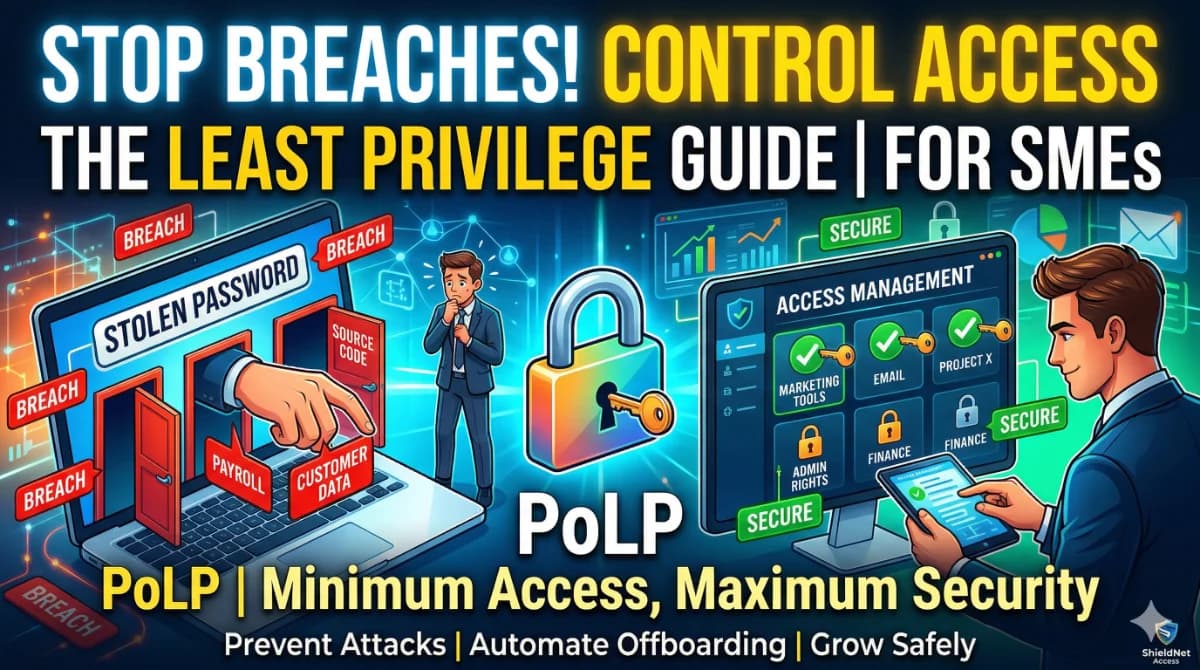
If your former employee, third-party contractor, or a compromised staff account can still access systems they no longer need – your business is one stolen password away from a serious breach.
The principle of least privilege (PoLP) is a security practice that ensures every user, device, and application can access only the minimum resources required to do their job – nothing more. For SMEs, this means restricting admin rights, limiting who can reach financial data or source code, and automatically removing access when someone leaves. It reduces your attack surface without slowing down your team.
Most small business security guides focus on firewalls and antivirus. This one focuses on something more fundamental: controlling who gets in, and how far they can go. This guide explains what the principle of least privilege is, why it matters specifically for growing businesses, and how to implement it practically – even without a dedicated security team.
What Is the Principle of Least Privilege (PoLP)?
The principle of least privilege is defined by NIST's Computer Security Resource Center as a security design where a system restricts users' access to the minimum necessary to accomplish their assigned tasks. In plain terms: people only get the keys to rooms they need to enter.
Originally a concept from 1970s system design, it now underpins modern Zero Trust security frameworks including NIST SP 800-207, which codifies least privilege as a non-negotiable tenet of any Zero Trust Architecture (ZTA).
For SMEs, this principle translates into three practical access rules:
- Users only access what their role requires. A sales manager does not need access to payroll or code repositories.
- Access is time-limited. Contractors and project-based team members get access for the duration they need – then it's revoked.
- Privileged accounts are separate. Admins use a dedicated admin account for elevated tasks, not their everyday login.
Why Does Least Privilege Access Matter for Small Businesses?
Most SMEs assume they are too small to be targeted. The data says otherwise.
According to the 2025 Verizon Data Breach Investigations Report, 88% of Basic Web Application attacks involved stolen credentials, and credential abuse was the leading initial access vector across all breach categories. The same report found that 30% of all breaches involved third-party relationships – a figure that doubled year-over-year – driven heavily by credential exposures from partners and misconfigured access settings.
The uncomfortable reality: most breaches don't start with sophisticated hacking. They start with an account that had more access than it needed. Here is why that is especially dangerous for SMEs:
- Small teams overprovision by default. When there is no IT department, it is easier to give everyone broad access than to define roles carefully.
- Offboarding is inconsistent. A former employee's account may remain active for weeks or months after they leave. That account, with full admin rights, becomes a silent open door.
- Shared admin credentials are common. One compromised shared password can unlock everything from financial systems to cloud environments.
- Malware moves through privilege. Once ransomware lands on one device, it spreads by exploiting excessive permissions. Least privilege creates walls that stop lateral movement cold.
What Are the Core Benefits of Implementing Least Privilege?
Least privilege is not just a security control – it is a compliance and business continuity tool.
1. Reduced Attack Surface
When each user account only has access to specific systems, a compromised credential causes limited damage. Attackers hit a wall instead of moving freely through your environment.
2. Compliance Alignment
Multiple frameworks mandate or strongly recommend least privilege access:
- ISO 27001 (Annex A controls A.5.15 and A.5.18) requires structured access provisioning, periodic review, and timely removal of rights.
- PCI DSS (Requirement 7) mandates a "business-need-to-know" approach for cardholder data access.
- GDPR expects data minimization principles, including limiting who can access personal data.
For SMEs in finance or tech, demonstrating audit-ready access logs is not optional – it is a condition of doing business with enterprise clients and regulators.
3. Simplified IT Operations
Automated role-based access control eliminates the manual permission scramble. A new sales hire automatically gets CRM access; they do not get access to developer environments or financial dashboards. When they leave, access is revoked instantly – no forgotten accounts.
4. Faster Incident Response
When a breach does occur, least privilege limits the blast radius. Investigators can quickly identify which systems were exposed because the access scope was narrow and documented.
How Do You Implement Least Privilege Access in an SME?
Implementation does not require enterprise-grade infrastructure. It requires a clear process.
Step 1: Conduct an Access Audit
Map who currently has access to what. Look for:
- Former employees still active in your identity provider
- Service accounts with unrestricted admin rights
- Contractors with broader access than their work requires
Tools like Microsoft Entra ID (formerly Azure AD) or Google Workspace admin dashboards make this audit straightforward for cloud-based teams.
Step 2: Define Role-Based Access Groups
Create access groups by function, not by individual. Examples:
- Finance team: Accounting software, invoicing platform – not developer tools or HR systems
- Developers: Code repositories, staging environments – not payment systems or customer PII
- Contractors: Only the specific project folder or application they are engaged for, time-limited
Step 3: Enforce Multi-Factor Authentication (MFA)
MFA is the first enforcement layer. Even if a credential is stolen, MFA prevents unauthorized login. According to NIST SP 800-207, continuous identity verification – including MFA – is essential to enforcing least privilege in a Zero Trust context.
Step 4: Automate Onboarding and Offboarding
Integrate your identity provider with your HR system. When someone joins, they get their role-based group automatically. When someone leaves, access is revoked the same day. Manual processes create gaps; automation closes them.
Step 5: Schedule Quarterly Access Reviews
At minimum, review all active user accounts quarterly. Ask: does this person still need this access for their current role? Remove anything that cannot be justified. ISO 27001 guidance recommends periodic access reviews as part of a traceable, auditable access management process.
Comparison: Traditional Access Management vs. Least Privilege Approach
Criterion | Traditional (Ad-hoc) Access | Least Privilege (PoLP) Approach | ShieldNet Access |
|---|---|---|---|
Access assignment | Manual, often overbroad | Role-based, minimum required | Continuous, identity-driven verification per session |
Offboarding process | Often delayed or forgotten | Revocation included in process | Automatic isolation of risky or inactive endpoints |
Audit readiness | Inconsistent logs, hard to trace | Structured access logs | Always-on access logs, ready for compliance reviews |
Compliance support | Manual evidence gathering | Aligned to ISO 27001 / PCI DSS | Built-in support for Microsoft 365 and Google Workspace access policies |
Third-party access | Often permanent, unmonitored | Time-limited, scoped to project | Unauthorized connections blocked and isolated automatically |
Setup complexity | Low (but insecure) | Medium (process required) | Cloud-based, no installation required |
FAQ
What is the least privilege access rule?
The least privilege access rule states that every user, process, or application should only have the minimum level of access required to perform their assigned task – and that access should be granted only for as long as it is needed. It is defined in NIST's security glossary as a foundational access control principle.
What is an example of least privilege access in a small business?
A marketing manager at a 30-person company should have access to the CRM, email marketing platform, and shared assets folder – but not to the accounting software, developer tools, or admin dashboards. If they leave the company, their access to all those tools is revoked automatically that day. That is least privilege in practice.
What are the disadvantages of least privilege?
The main challenge is the upfront effort required to define roles and map access correctly. Without automation, periodic access reviews and onboarding workflows can become time-consuming. Overly restrictive permissions can also create friction if roles are not defined clearly. However, modern identity platforms – especially cloud-native solutions integrated with Microsoft 365 or Google Workspace – reduce this overhead significantly.
Control Access Without Complexity
For SMEs, the principle of least privilege is the fastest way to reduce risk without adding complexity. You do not need a dedicated security team or an enterprise-grade PAM platform. You need clear roles, automated enforcement, and a tool that makes visibility the default – not an afterthought.
ShieldNet Access is designed for exactly this. It replaces traditional VPNs with continuous, identity-based access that verifies every connection – integrating with Microsoft 365 and Google Workspace to give you audit-ready access logs, automatic endpoint isolation, and zero installation overhead. Control who gets in, see everything they do, and revoke access instantly when the picture changes.
Related Articles

Oct 1, 2026
I paid a fake invoice. What should my business do?
Paid a fake invoice? Learn what your business should do immediately to contact the bank, preserve evidence, secure accounts, investigate the fraud, and reduce further losses.

Sep 29, 2026
I clicked a phishing link. What should I do now?
Sent confidential information to a fake email? Learn what to do immediately, how to report the incident, assess exposed data, and reduce further risk.

Sep 25, 2026
I clicked a phishing link. What should I do now?
Clicked a phishing link? Learn what to do immediately, whether you entered a password or downloaded a file, and how to reduce the risk to your account and business.

Protect your business with ShieldNet 360
Get started and learn how ShieldNet 360 can support your business.