
Mar 27, 2026
BlogSOC as a Service for small business: Costs and buyer guide
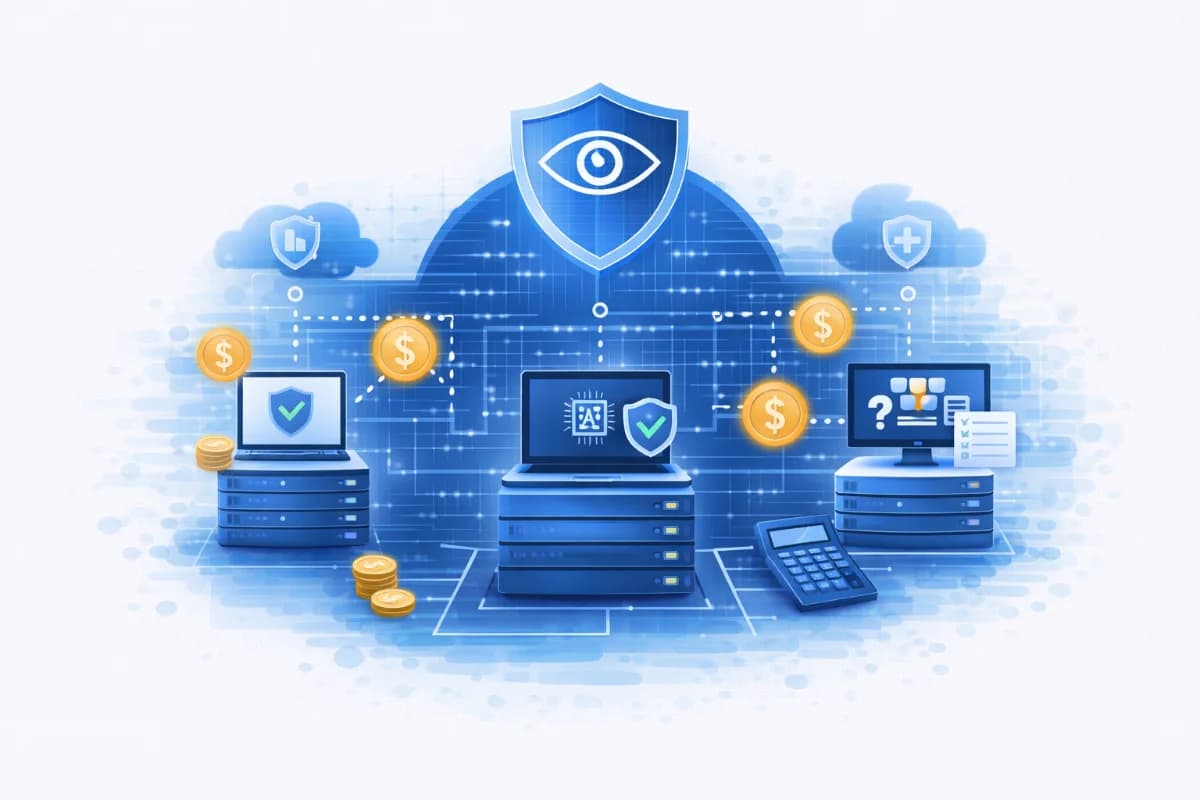
SOC as a Service (SOCasS) for small business explained with outsourced SOC, managed SOC, virtual SOC pricing models, pros/cons, AI-first alternatives, and vendor questions.
SOC as a Service for small business (often called SOCaaS) is a way to outsource security monitoring and incident response so a small team can get “SOC outcomes” without hiring analysts or running night shifts. The promise sounds simple, but buyers often struggle with scope, pricing, and what you truly get at 2 a.m. This guide clarifies what an outsourced SOC and a managed SOC typically include, how virtual SOC pricing is usually structured, and when an AI-first model can be a better fit.
Why this topic matters
Buying SOC as a Service for small businesses is often triggered by a painful moment: repeated phishing, a near-miss ransomware event, or a customer security review that asks, who is monitoring after hours? SMEs rarely fail because they do nothing, but because response is slow and inconsistent when alerts arrive across email, endpoints, identity, and cloud apps. The business impact of that delay is real: longer downtime, bigger breach scope, and more internal chaos pulling leaders into incident calls at the worst times.
A realistic example is a weekend account takeover that starts with a credential reuse login, followed by mailbox rule creation and a mass download of customer documents from a shared cloud folder. Without a clear outsourced SOC workflow, alerts arrive in different dashboards and get ignored until Monday. With a strong managed SOC, those signals should be correlated into one incident, triaged quickly, and escalated with specific containment steps. That ability to shrink the attacker’s time window is what makes SOCaaS a growth enabler, not just a security expense.
Key factors and features to consider
Outsourced SOC vs managed SOC: What’s the real difference?
An outsourced SOC generally means an external provider monitors alerts and notifies you when something looks serious, while a managed SOC usually implies deeper involvement in triage, investigation, and guided response workflows. The naming varies by vendor, so SMEs should focus on outcomes: who does enrichment, who confirms scope, and who can execute response actions. If the provider only sends tickets, your internal team still carries the hardest parts, which may not reduce real risk.
A practical way to test the difference is to ask for a sample incident package for a common scenario such as email compromise. A managed SOC should deliver a plain-language incident summary, evidence highlights, recommended actions, and a clear timeline, not just raw alerts. The more the provider can standardize triage and evidence capture, the more valuable the service becomes for small teams. This is also where AI-first approaches often compete well, because they automate routine triage and make incidents easier to understand.
Coverage scope: What is monitored and what is not?
SOCaaS (Security Operations Center as a Service) value is directly tied to telemetry coverage, meaning which systems the provider can see and correlate. SMEs should confirm whether the service monitors identity sign-ins, email activity, endpoints, cloud storage, and key SaaS applications, because most modern incidents span multiple layers. A gap in coverage creates blind spots where attackers can pivot without triggering a complete incident story. A good provider will define monitored sources and minimum log requirements clearly.
Scope should also include what “response” means. Some providers investigate and recommend actions, while others can execute safe steps like session revocation or email quarantine if you grant permissions and approvals. SMEs should decide upfront how much authority they are comfortable delegating. If you want faster after-hours containment, you need a workflow that includes safe, reversible actions with guardrails rather than pure notification.
Virtual SOC pricing: common models and what drives cost
Virtual SOC pricing is usually driven by a mix of scale and complexity, not just headcount. Common drivers include the number of endpoints, number of log sources, daily log volume, number of cloud accounts, and how many incident types are in scope. Many providers price in tiers that bundle monitoring plus an incident handling allowance, then charge more for high-volume environments or deeper response services. For SMEs, the cost question should always be linked to expected outcomes, such as response time targets and incident handling limits.
A helpful buyer mindset is to treat virtual SOC pricing as two layers: “keep the lights on” monitoring plus “incident workload” capacity. If you have frequent noisy alerts, your pricing will rise unless the provider uses strong correlation and automation to reduce noise. That is why AI-first models can be cost-effective: they can reduce manual analyst time by turning many alerts into fewer incidents. ShieldNet Defense can be positioned here as an AI-first approach that emphasizes plain-language incidents and safe automation for routine threats, reducing reliance on human night shifts.
Service levels: response time, escalation, and evidence quality
The difference between a good and a frustrating SOCaaS experience is often service level definition. SMEs should verify how quickly the provider acknowledges high-severity incidents, how escalation works, and what the deliverables look like. A service that wakes you up without context is not helpful, while a service that gives a clear story with evidence and recommended actions can materially reduce downtime. The best services also produce consistent evidence artifacts that support audits and customer reviews.
Evidence quality is not a “nice-to-have” for SMEs. A single customer security review can ask for incident history, response steps, and proof of control execution, and you need a provider whose reporting is defensible. Look for time-stamped timelines, linked signals, and documented actions taken. This is where both a strong managed SOC and an AI-first platform can outperform a basic outsourced SOC that only forwards alerts.
Detailed comparisons or explanations
SOCaaS vs AI-first: what you’re really buying
SOC as a Service for small business typically sells you human analyst time and an operational process, while an AI-first model sells you standardized workflows where automation handles routine triage and enrichment. In practice, SOCaaS can be excellent when you need deep human investigation frequently, or when your environment is complex and high risk. AI-first can be excellent when your biggest pain is alert noise, after-hours coverage, and the need for consistent, plain-language incidents without building a team. Many SMEs end up using a hybrid: AI-first for fast triage and evidence capture, and human escalation for complex cases.
A clear way to compare is to test the “detect→analyze→investigate→respond” loop. Ask how each model turns scattered alerts into a single incident, how evidence is collected, and what actions are taken in the first 15 minutes of a high-severity event. If SOCaaS requires you to do evidence gathering yourself, the ROI drops. If AI-first cannot escalate to humans for edge cases, you may feel exposed during serious incidents. ShieldNet Defense can be positioned as an AI-first SOC-style workflow that prioritizes minutes-level incident creation, clear narratives, and safe automation, with escalation paths when needed.
Pros and cons for SMEs
SOCaaS pros include access to experienced analysts, broader coverage for complex investigations, and a mature escalation process if the vendor is high quality. SOCaaS cons often include variable clarity, dependence on integrations, and virtual SOC pricing that rises with log volume and customization demands. AI-first pros include faster routine triage, fewer noisy alerts through correlation, and consistent evidence capture that supports lean teams. AI-first cons can include limitations in nuanced judgment for rare incidents and the need for good telemetry setup to work reliably.
SMEs should avoid framing this as “humans vs AI” and instead treat it as “workflow capacity.” If your incidents are mostly routine, automation can handle a large share safely and cheaply. If your incidents often involve targeted attacks, complex environments, or high-stakes compliance, a managed SOC with strong human investigation may be worth the cost. The decision is less about brand names and more about the shape of your risk and the maturity of your internal response processes.
Alternatives and hybrid paths that often work best
Many SMEs do not need a full SOCaaS immediately, but they do need consistent after-hours coverage for the highest-risk incidents. A common alternative is to implement an AI-first platform for correlation, plain-language incidents, and safe response actions, then purchase limited human escalation hours for complex investigations. Another option is to start with a smaller outsourced SOC scope focused on identity and email, then expand to endpoints and cloud as telemetry and playbooks mature. This staged approach prevents overspending early while still reducing real risk.
A practical hybrid design is “automation-first triage plus specialist escalation.” The automation layer reduces alert volume and generates evidence, so when you escalate, the human expert starts with context rather than guessing. This can reduce both cost and downtime impact. In this hybrid path, ShieldNet Defense can be noted as the automation-first layer that converts multi-source alerts into clear incidents, enabling SMEs to run a credible SOC-style process without staffing night shifts.
Best practices and recommendations
- Define your top three incident types and require vendors to demonstrate how they handle each end-to-end
- Ask for a sample incident report and verify plain-language clarity, evidence depth, and actionability
- Treat virtual SOC pricing as capacity plus scope, and validate what happens when alert volume spikes
- Require safe response options with guardrails, such as session revocation or email quarantine, and define approval rules
- Build an internal owner model so incidents never “stall,” even when the provider detects them quickly
- Use a pilot with success metrics: time-to-triage, time-to-contain, false positives, and after-hours coverage rate
To apply these steps, SMEs should run a structured vendor evaluation using one or two realistic tabletop scenarios and require providers to show their workflow, not just their slide deck. Make sure the provider can integrate with your identity and email systems first, because that is where most SMEs see fast wins. Then confirm how playbooks and escalation work during off-hours, since that is the real promise of SOCaaS. If you are considering an AI-first option like ShieldNet Defense, evaluate it on incident clarity and safe automation outcomes, because those are the levers that replace night shifts in practice.
- Pilot checklist: log sources connected, incident playbooks defined, escalation contacts tested, and evidence outputs verified
- Contract checklist: response time targets, incident handling limits, data retention for evidence, and change control for automation actions
- Operational checklist: monthly review cadence, tuning process, and a clear owner on your side for final decisions
These checklists keep the buyer process grounded in operations rather than marketing. A pilot should prove that the service can create coherent incidents from your real telemetry. A contract should remove ambiguity about what happens during a surge or a high-severity event. An operational checklist ensures the service improves over time through tuning and consistent reviews. This is what turns SOCaaS from a subscription into a measurable risk reduction program.
FAQ
How much does SOC as a Service for small business typically cost?
Costs vary widely because virtual SOC pricing depends on endpoints, log volume, and response scope. A common pattern is a base monthly fee for monitoring plus higher tiers for deeper investigation and response, especially if you need 24/7 handling. SMEs should model cost as a range and tie it to outcomes like response time targets and incident limits. The best way to estimate is a short pilot that reveals your true alert volume after correlation.
What questions should SMEs ask SOCaaS vendors before buying?
Ask about monitored scope, response actions, and evidence quality, not just “do you monitor 24/7.” Request a sample incident package for a realistic attack, and ask what actions can be taken automatically versus only recommended. Confirm escalation paths, response time targets, and what happens during a log surge. Also ask how they tune detections to reduce noise, because alert fatigue is the most common reason SOCaaS disappoints SMEs.
Is a managed SOC better than an outsourced SOC for SMEs?
A managed SOC is often better when you need help beyond notifications, such as investigation, response guidance, and consistent evidence. An outsourced SOC that only forwards alerts may not reduce downtime impact if your internal team still does all triage and containment. However, quality varies, so SMEs should evaluate deliverables and workflows rather than labels. If your main need is after-hours first response and fewer alerts, an AI-first model may also be a strong alternative.
When does an AI-first approach beat SOCaaS for small businesses?
AI-first often wins when incidents are mostly routine, alert volume is high, and you need minutes-level incident creation without paying for constant analyst attention. It can reduce noise by correlating signals and producing plain-language incidents with evidence, enabling fast safe containment actions. SMEs still need escalation for complex cases, but the overall workload becomes smaller and more predictable. In this scenario, an AI-first workflow like ShieldNet Defense can be positioned as the core engine for triage, evidence, and safe automation, with optional human escalation when needed.
What are the biggest hidden costs in SOCaaS contracts?
Hidden costs often come from log volume growth, additional integrations, and incident response work beyond included allowances. Virtual SOC pricing can rise when you add new SaaS tools, more endpoints, or when alert noise increases due to misconfiguration. Another hidden cost is internal coordination time if incidents arrive without clear evidence or action steps, because your team still spends hours reconstructing context. SMEs should insist on clarity, evidence, and a tuning process to keep costs and workload stable.
Conclusion
SOC as a Service for small business can be a powerful way to get after-hours coverage, consistent triage, and faster incident response, but only when scope, service levels, and virtual SOC pricing are aligned to your real environment. SMEs should compare SOCaaS with AI-first options based on how well each converts alerts into plain-language incidents, captures evidence, and enables safe response steps within minutes. A hybrid model is often the best path: automation-first triage and evidence capture, with human escalation for complex cases. If you want to position ShieldNet Defense in this buyer journey, it fits naturally as an AI-first SOC-style workflow that reduces alert noise, accelerates triage, and safely automates routine containment steps without building night shifts.
Related Articles
Sep 24, 2026
Real or Fake? Google Account Security Alert
Got a Google Account security alert? Learn how to tell if it is real or phishing, verify it safely, and protect your account without clicking suspicious links.

Sep 18, 2026
What is Invoice Fraud and How can employees spot it?
Learn how invoice fraud works, how attackers fake supplier payment requests, the warning signs employees should check, and how to verify invoices safely.
Sep 17, 2026
What Is DLP for AI and Why do Businesses need t?
Learn what DLP for AI is, how it prevents employees from sharing sensitive business data with AI tools, and why businesses need AI data protection.

Protect your business with ShieldNet 360
Get started and learn how ShieldNet 360 can support your business.