
Mar 6, 2026
BlogISO 27001 audit guide: requirements & process for SMEs, 2026
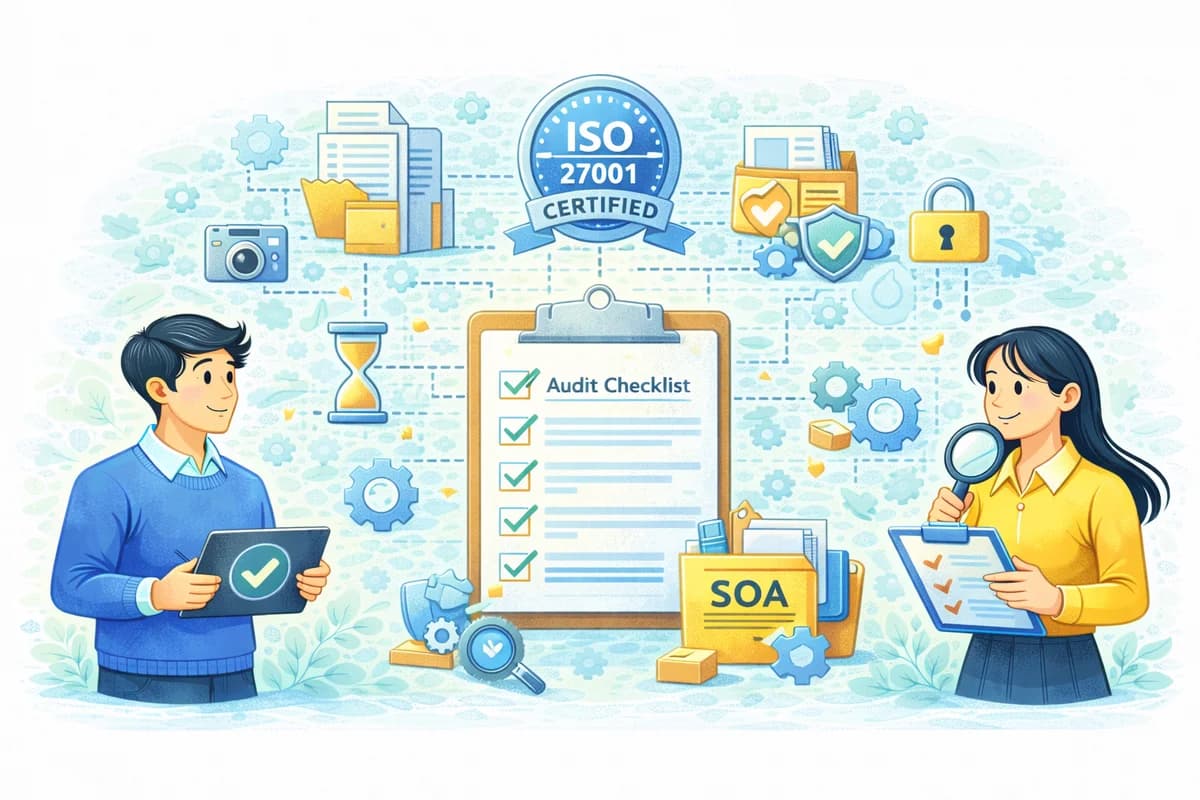
ISO 27001 audit guide for SMEs: audit checklist, internal audit process, evidence collection, statement of applicability, and audit preparation for 2026.
An ISO 27001 audit is a structured check of whether your information security management system is real, repeatable, and improving, not just documented. For SMEs, the biggest failure mode is “policy-first, proof-later,” where procedures exist but daily operations do not consistently produce evidence. This guide explains ISO 27001 audit expectations in plain language and shows how to prepare without building an enterprise compliance department. This article focus on what auditors actually sample, how to run a practical internal audit process, and how to build evidence collection habits that are defensible under time pressure.
Why this topic matters
An ISO 27001 audit matters because it affects revenue, trust, and deal velocity, especially when enterprise customers ask for certification as a minimum bar. Many SMEs pursue ISO 27001 after losing a contract or facing stricter vendor questionnaires, then discover that the audit tests operational consistency more than document completeness. If you cannot show repeatable execution with timestamps and owners, you can lose time, extend the audit window, and delay certification outcomes. Treating the audit as an operational readiness exercise prevents last-minute chaos and reduces business disruption.
Picture a 200-person SaaS company that has written policies quickly, but access reviews happen irregularly and incident response is “whoever is available.” During the ISO 27001 audit, the auditor asks for proof that access reviews occurred, how exceptions were handled, and what corrective actions were tracked to closure. The team can explain verbally, but cannot produce consistent evidence collection artifacts, so confidence drops and findings increase. A right-sized approach ensures your processes naturally generate audit-ready proof, so the audit becomes confirmation instead of discovery.
Key factors and features to consider
ISO 27001 audit checklist that mirrors auditor sampling
An ISO 27001 audit checklist works only if it mirrors how auditors operate, which is by sampling evidence rather than reading every document. Auditors typically pick a few controls and trace them end-to-end: policy intent, implementation, execution records, and corrective actions. For SMEs, a focused ISO 27001 audit checklist prioritizes high-risk areas such as identity access, change control, backups, supplier access, and incident handling. When your checklist forces “show the last time this ran,” it becomes a real readiness tool rather than a template exercise.
Internal audit process as a rehearsal, not paperwork
A practical internal audit process is your rehearsal for the external ISO 27001 audit, and it should feel like testing reality, not confirming documents. Define scope, sampling rules, and a short format for findings that includes owner and due date, then track closure consistently. SMEs often succeed by auditing a small slice quarterly rather than doing a huge annual audit that nobody can sustain. When the internal audit process is routine and honest, it prevents surprises in the audit window.
Evidence collection designed as an operational by product
Evidence collection should be an operational byproduct of normal work, not a frantic scramble two weeks before the audit. High-value evidence includes access review records, training completion logs, incident tickets, change approvals, backup restore test results, and supplier review notes, all time-stamped and easy to retrieve. SMEs reduce stress by assigning “evidence owners” per area and collecting lightweight artifacts monthly. When evidence collection is habitual, audits become a retrieval exercise, not a reconstruction exercise.
Statement of applicability as the audit “map”
The statement of applicability explains which ISO controls you apply, which you exclude, and why, based on your risk assessment and scope. Auditors use it like a map to decide where to sample and what questions to ask, so accuracy matters more than ambition. SMEs often create audit risk by listing controls they cannot operate consistently, which increases evidence demands and increases the chance of findings. A right-sized statement of applicability is specific, defensible, and aligned with what your team can execute reliably.
Audit preparation focused on predictable SME gaps
Audit preparation should prioritize closing predictable gaps, not polishing documents at the last minute. Common gaps include unclear scope boundaries, inconsistent access reviews, missing backup restore evidence, weak change control trails, and corrective actions that are not tracked to closure. For SMEs, the fastest gains come from tightening a few recurring routines that produce strong evidence every month. When those routines are stable, documentation naturally becomes consistent with operations, which is what auditors reward.
Detailed comparisons or explanations
“Designed controls” versus “operating controls”
In an ISO 27001 audit, designed controls are what you wrote, while operating controls are what you can prove happened. SMEs often overinvest in writing policies and underinvest in running the associated routines, which creates findings like “no evidence of periodic review” or “inconsistent execution.” A simple rule is that every important control should produce a small repeatable artifact, such as a monthly privileged-access review note or a backup restore test record. When you plan artifacts upfront, evidence collection becomes easier and audit outcomes become more predictable.
A realistic mini example is access review. You may have a policy stating quarterly reviews, but the auditor will ask for the last completed review, who performed it, what accounts were reviewed, and what actions were taken for exceptions. If you cannot produce that chain, the policy becomes a liability rather than a strength. This is why the ISO 27001 audit checklist should contain “show me the last run” prompts, because it forces operating proof long before the audit window.
How statement of applicability drives audit sampling
Auditors often sample controls that are both high-risk and clearly claimed in your statement of applicability, such as access management, incident response, and supplier controls. If you mark a control as applicable, you must demonstrate execution and monitoring, usually through evidence collection artifacts and internal audit process results. If you exclude a control, you must justify the exclusion based on scope and risk, not simply resource constraints. SMEs avoid unnecessary findings when they keep the statement of applicability truthful and aligned to real workflows.
A common “too ambitious” pattern is listing complex controls to appear mature, then failing to run them consistently due to staffing limits. This increases SOC-like operational demands that SMEs cannot sustain and leads to gaps that auditors will detect quickly. A more realistic strategy is to operate fewer controls very well, show improvement through corrective actions, and expand scope over future cycles. That approach aligns with how ISO management systems are meant to mature over time.
Common gaps to fix before the audit window
Most ISO 27001 audit findings for SMEs are predictable and fixable if you start early enough. Frequent gaps include incomplete asset inventories, irregular privileged-access reviews, weak change documentation for production systems, and backup restore tests that exist in theory but not in records. Another gap is training records that show completion but do not match role relevance, making the program look generic. A final recurring issue is corrective actions that are recorded but not tracked to closure, weakening credibility during auditor interviews.
Fixing these gaps usually requires small operational changes, not new tools. A monthly privileged-access review with a short sign-off note, a monthly restore test of a real file with a recorded recovery time, and a consistent place to store evidence can eliminate many findings. Run a focused internal audit process sample on these routines and close findings quickly, so the external audit sees improvement in action. When you do this, audit preparation becomes measurable and manageable.
Best practices and recommendations
- Build an ISO 27001 audit checklist that forces operating proof, not only document checks
- Run an internal audit process quarterly with sampling, findings, owners, and closure tracking
- Design evidence collection as monthly artifacts for access, incidents, changes, backups, suppliers, and training
- Keep the statement of applicability accurate, risk-based, and aligned with execution capacity
- Do audit preparation in two waves: fix operational gaps first, then refine documentation and narratives
- Rehearse the audit window by running short “show me evidence” interviews for key controls
Apply this by picking three critical control areas first, such as privileged access, incident response, and backups, then defining where each artifact lives and who owns it. Next, run a small internal audit process sample and ensure corrective actions are closed with proof, because auditors look for improvement as much as they look for existence. Finally, update the statement of applicability only after confirming operational reality, so you do not commit to controls you cannot demonstrate. This keeps the ISO 27001 audit predictable for SMEs.
FAQ
What do auditors look for most during an ISO 27001 audit?
Auditors look for consistency between what you claim and what you can prove, using time-stamped evidence collection artifacts. They typically verify scope, risk decisions, control execution, monitoring, and improvement through corrective actions. SMEs do best when they can retrieve the “last run” of key routines, such as access reviews and restore tests, within minutes. Clear ownership and traceable records often matter more than perfect document formatting.
How detailed should an ISO 27001 audit checklist be for SMEs?
An ISO 27001 audit checklist should be detailed enough to test operating proof, but short enough to run without stopping the business. Start with high-impact areas like access management, incident response, backups, supplier access, and change control, then add lower-risk areas later. The strongest checklists ask for specific artifacts, such as a completed review note or a ticket trail, not just “do you have a policy.” This keeps audit preparation focused and realistic.
What evidence collection mistakes cause the most findings?
The most common mistake is relying on verbal explanations without documents that show what happened, when, and who approved it. Another frequent issue is storing evidence inconsistently, so teams cannot retrieve it quickly during the audit window, leading to confusion and contradictory answers. SMEs also miss periodic proof, such as monthly restore tests or quarterly access reviews, even when the activity happened informally. Making evidence collection a monthly habit fixes these problems faster than rewriting policies.
How should SMEs handle the statement of applicability in a realistic way?
Treat the statement of applicability as a truthful map of your scope and risk decisions, not a marketing document. Include controls you can operate consistently and justify exclusions with scope and risk logic, then revisit decisions when systems or risks change. SMEs should review it at least annually and after major changes, because auditors compare it to your evidence collection and internal audit process results. Consistency between SoA, operations, and artifacts is what reduces audit friction.
What should an SME do 2–4 weeks before the audit window?
Two to four weeks before the audit window, focus audit preparation on closing open corrective actions, confirming recent artifacts exist for key controls, and rehearsing evidence retrieval. Run a short internal audit process spot check on privileged access, incidents, and backups, then ensure owners can produce proof quickly. Use this period to align your “audit narrative” to your artifacts, because auditors notice contradictions far more than minor formatting issues. A calm final month is usually earned by stable routines earlier.
Conclusion
An ISO 27001 audit becomes manageable for SMEs when it is treated as operations: a practical internal audit process, consistent evidence collection, and a statement of applicability that matches real workflows. Use an ISO 27001 audit checklist that demands operating proof, fix predictable gaps before the audit window, and keep audit preparation focused on repeatable routines rather than last-minute paperwork. The most defensible story is simple: you know your risks, you run your controls, you keep proof, and you improve. If you want a next step, choose three critical controls, set a monthly evidence habit, and run a small internal audit sample so the audit window becomes confirmation, not discovery.
Related Articles

Oct 9, 2026
I replied to a phishing email. Am I at risk?
Replied to a phishing email? Learn what risks you face, what attackers can learn from your reply, and what to do next to protect your account and business.
Oct 8, 2026
Real or Fake? How to verify a sharepoint file invitation
Received a SharePoint file invitation? Learn how to spot fake SharePoint emails, verify shared files safely, and protect your Microsoft 365 account from phishing.

Oct 1, 2026
I paid a fake invoice. What should my business do?
Paid a fake invoice? Learn what your business should do immediately to contact the bank, preserve evidence, secure accounts, investigate the fraud, and reduce further losses.

Protect your business with ShieldNet 360
Get started and learn how ShieldNet 360 can support your business.