
Jun 19, 2026
BlogFrom Reactive Scanning to Continuous Threat Exposure Management: The CTEM Paradigm

Continuous Threat Exposure Management reframes security from episodic audits into a living, business-aligned risk reduction cycle – and reshapes how ASM and XDR fit together.
The Problem with Periodic Security
For over a decade, enterprise security programs operated on a cadence model: quarterly vulnerability scans, annual penetration tests, compliance-driven remediation cycles. The assumption embedded in this model is that the attack surface is relatively stable between assessments. That assumption has not been valid for years.
Modern infrastructure is in constant flux. Cloud workloads spin up and down in minutes, SaaS integrations multiply, developers push code dozens of times daily, and mergers fold in entirely new asset inventories overnight. The window between a vulnerability's appearance and its exploitation has compressed dramatically – measured in days or hours, not months. Point-in-time scanning produces a snapshot of a past that no longer exists.
Gartner's introduction of Continuous Threat Exposure Management (CTEM) in 2022 provided a strategic framework to address this structural mismatch. Rather than asking "what vulnerabilities do we have?" on a schedule, CTEM asks "what can an adversary exploit to harm our business, right now?" – and answers it continuously.
"CTEM is not a product category. It is an operational program – a way of running security that treats exposure as a continuously shrinking surface rather than a list to be cleared."
The Five Stages of CTEM
CTEM is structured around a five-stage cycle. Each stage produces outputs that feed the next, creating a closed loop between discovery, validation, and remediation.
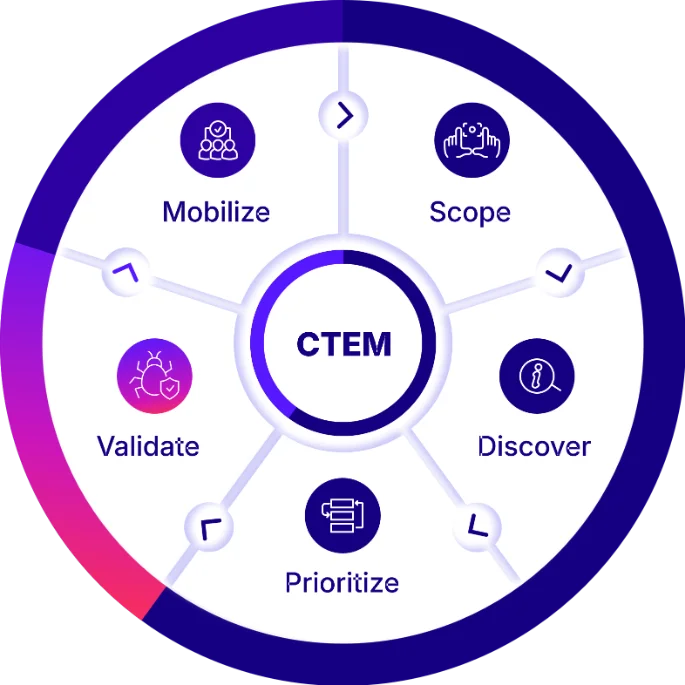
Stage 1 – Scoping
CTEM begins by defining what matters to the business. Security teams work with stakeholders to identify crown-jewel systems, critical business processes, and the digital perimeter that matters most for operations and revenue. Scoping is not a one-time exercise – it is revisited as business priorities evolve. A retail company, for instance, would scope its customer checkout pipeline differently before a holiday season than after one.
Stage 2 – Discovery
With scope defined, the program continuously enumerates all assets, identities, configurations, and data exposures within that perimeter. This goes beyond IP ranges and CVE counts. Discovery in CTEM encompasses external attack surface (internet-exposed assets), identity posture (over-privileged accounts, stale credentials), cloud configuration drift, third-party supply chain exposures, and shadow IT. The goal is an always-current inventory, not a quarterly spreadsheet.
Stage 3 – Prioritization
Raw discovery outputs thousands of findings. Prioritization distinguishes the exploitable from the theoretical. CTEM scoring incorporates exploitability (is there active in-the-wild exploitation?), asset criticality (does this exposure touch a scoped crown-jewel?), and existing controls (does a compensating control already reduce practical risk?). A critical-severity CVE on an isolated internal host scores far lower than a medium-severity misconfiguration on an internet-facing authentication service.
Stage 4 – Validation
Prioritization surfaces candidates; validation confirms reality. This stage leverages breach and attack simulation (BAS), automated red teaming, and adversarial path analysis to verify that a prioritized finding is genuinely exploitable end-to-end – not merely vulnerable in isolation. Many high-scored findings collapse at this stage because a compensating control, a network segment boundary, or a corrective patch already exists. Validation transforms a risk hypothesis into a confirmed exposure.
Stage 5 – Mobilization
Mobilization closes the operational loop. Validated exposures are routed to the correct remediation owner – not just "the security team" – with context, priority score, business justification, and measurable acceptance criteria. CTEM treats remediation as a program management problem, not a ticket dump. Metrics track mean time to remediate confirmed exposures, not CVSS scores in a backlog.
CTEM vs Traditional ASM: A Capability Upgrade
Attack Surface Management emerged as a discipline to solve a specific problem: organizations had lost track of what they owned. Shadow IT, cloud sprawl, M&A activity, and developer self-service left security teams blind to significant portions of their external footprint. ASM tools – crawlers, certificate transparency monitors, passive DNS analysis – gave teams an inventory of internet-facing assets for the first time.
CTEM absorbs ASM's discovery capabilities and extends them across four critical dimensions that traditional ASM cannot reach:
Dimension | Traditional ASM | CTEM (ASM+) |
Asset coverage | External perimeter only – internet-facing IPs, domains, certificates | External + internal assets, cloud configs, identities, data stores, third-party integrations |
Exposure type | CVEs and open ports on known/unknown assets | CVEs, misconfigurations, identity risks, business logic flaws, supply chain exposures |
Prioritization | CVSS score or asset severity – no business context | Exploitability + crown-jewel proximity + existing controls + active threat intelligence |
Validation | None – every finding assumed exploitable | Breach and Attack Simulation (BAS) and adversarial simulation confirm real exploitability before remediation resources are spent |
Remediation loop | Finding exported to ticketing system – no workflow ownership | Routed to named owners with business context, tracked to closure, feeds back into scoping |
Business alignment | Security-centric – findings not mapped to business risk | Scope-driven from business priorities; metrics expressed in business impact terms |
Temporal model | Periodic scans – state is a snapshot | Continuous – state is a live signal |
Capability comparison: Traditional ASM vs CTEM-integrated exposure management
The critical leap is validation. Traditional ASM creates noise: security teams drown in findings they cannot validate, and patch fatigue causes genuine critical exposures to be missed. CTEM's validation stage is the feature that converts ASM from an inventory tool into an actionable risk management program. Resources flow to confirmed, exploitable, business-impactful exposures – not to CVE counts.
WHAT ASM BRINGS TO CTEM
ASM tooling does not become obsolete under CTEM – it feeds Stage 2 (Discovery). External attack surface scanning, certificate transparency monitoring, passive DNS, and subdomain enumeration all remain valuable data sources. The distinction is that in CTEM these feeds are inputs to a prioritization and validation workflow, not terminal outputs. ASM becomes the eyes; CTEM becomes the judgment and the fist.
CTEM and XDR: Complementary Disciplines
Extended Detection and Response (XDR) and CTEM are frequently positioned as competing budget priorities or overlapping toolsets. This framing misunderstands what each discipline does and where it operates in the security lifecycle.
XDR is a detection and response platform. It ingests telemetry from endpoints, networks, identities, cloud environments, and email, correlates signals into unified detections; and accelerates incident investigation and containment. XDR operates on events that have already occurred – it answers "is something happening, and can we stop it?"
CTEM is a risk reduction program. It operates on the pre-breach attack surface – it answers "what could an adversary exploit, and can we eliminate or harden it before they try?"
Strategic positioning of CTEM ↔ XDR across the security lifecycle
CTEM – Proactive Exposure Reduction
Operates left of breach. Continuously reduces the attack surface by eliminating validated, high-priority exposures before adversaries exploit them. Output: a smaller, harder, better-understood attack surface.
XDR – Detection & Response
Operates at and right of breach. Detects adversarial activity across telemetry sources, correlates into actionable alerts, and supports investigation and containment. Output: faster detection and shorter dwell time.
The relationship becomes genuinely powerful when the two programs exchange intelligence bidirectionally:
CTEM informs XDR detection quality
CTEM's validated exposure inventory tells XDR exactly where the highest-value targets are – the pathways an attacker would most likely traverse to reach a crown-jewel system. XDR detection rules, alert thresholds, and threat hunting playbooks can be tuned to these specific paths. A validated exposure on an authentication service, for instance, should trigger enhanced monitoring of downstream access patterns on that service. CTEM converts generic detection coverage into adversary-path-aware detection coverage.
XDR informs CTEM scoping and prioritization
Active detections in XDR are real-time signal about which assets and vectors adversaries are currently probing. When XDR observes reconnaissance activity, brute force attempts, or successful initial access, those findings elevate the priority of corresponding exposures in the CTEM cycle. An exposure that was theoretically medium-priority becomes operationally critical the moment XDR confirms active adversary interest in the same attack vector.
XDR validates CTEM remediation effectiveness
CTEM mobilization closes findings in ticketing systems – but closure does not always mean the exposure is actually gone. XDR telemetry provides a ground-truth check: if remediation actions are effective, detections on the remediated attack path should decline or disappear. If detections persist after remediation is marked complete, CTEM must reopen the finding. This feedback loop prevents false closure.
ShieldNet 360 is a next-generation unified cybersecurity solution that brings together three core pillars: CTEM to continuously identify and prioritize exposures by business impact, Threat Prevention to block attacks before they occur, and Detection & Response (XDR) to detect and contain incidents in real time – all orchestrated by AI Agent, with no dedicated SOC team required. Purpose-built for small and mid-sized enterprises, ShieldNet 360 delivers full attack-lifecycle protection at a fraction of the operational cost.
Related Articles

Sep 18, 2026
What is Invoice Fraud and How can employees spot it?
Learn how invoice fraud works, how attackers fake supplier payment requests, the warning signs employees should check, and how to verify invoices safely.

Sep 17, 2026
What Is DLP for AI and Why do Businesses need t?
Learn what DLP for AI is, how it prevents employees from sharing sensitive business data with AI tools, and why businesses need AI data protection.

Sep 16, 2026
What is Payroll Phishing and How does it target HR?
Learn how payroll phishing targets HR teams, how fake salary and bank account requests work, the warning signs, and how employees can verify requests safely.

Protect your business with ShieldNet 360
Get started and learn how ShieldNet 360 can support your business.