
Apr 7, 2026
BlogEndpoint Malware Detection: What Antivirus Misses (SME Edition)
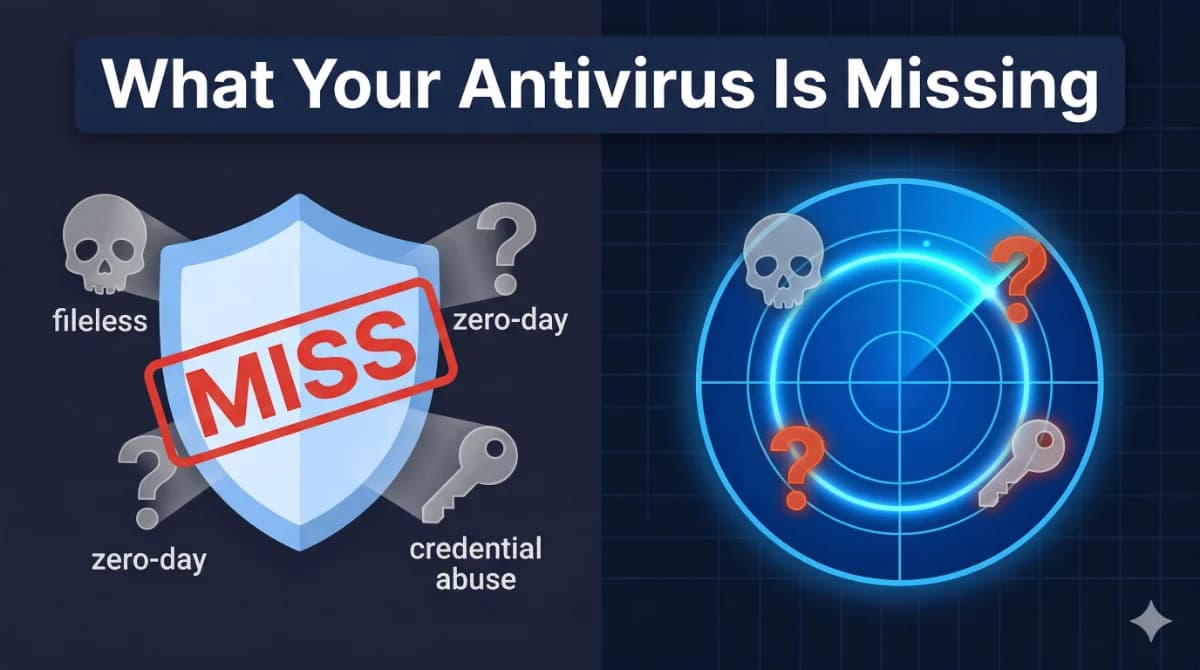
Your antivirus flagged nothing – but attackers have been inside your network for three days.
Endpoint malware detection goes beyond antivirus by using behavioral analysis, continuous monitoring, and automated response to catch threats that never match a known signature. Traditional antivirus blocks roughly 40–50% of modern attacks; the rest – file-less malware, living-off-the-land techniques, and credential abuse – slip straight through. SMEs need behavior-based detection to close that gap.
This guide explains exactly what antivirus misses, how behavioral and EDR-based detection work, and what to look for when choosing protection for a small or mid-sized business.
Why Does Antivirus Miss So Many Modern Threats?
Antivirus software was built for a different era. It works by comparing files against a database of known malware signatures – think of it as a list of "wanted" criminals. If the attacker isn't on the list, they walk straight in.
The problem: according to the CrowdStrike 2025 Global Threat Report, 79% of detections observed in 2024 were malware-free – meaning adversaries used stolen credentials, legitimate tools, and living-off-the-land techniques rather than deploying traditional malware. Antivirus has no signature to match against those attacks.
The specific categories that consistently evade traditional AV include:
- Fileless malware – executes entirely in memory, leaving no on-disk file for signature scanning to find
- Zero-day exploits – target vulnerabilities before any patch or signature exists
- Polymorphic malware – rewrites its own code on every infection, generating a unique signature each time
- Living-off-the-land (LotL) attacks – abuse legitimate tools like PowerShell, WMI, and macOS scripting to carry out attacks that look like normal admin activity
- Credential-based attacks – use stolen or phished passwords to log in as a real user; no malware is deployed at all
Most attacks today are fileless, zero-day exploits, or LotL attacks that use legitimate system tools to operate undetected – these don't show up as viruses, they aren't in virus databases, and antivirus doesn't stop them.
For SMEs, the stakes of a miss are severe. The average cost of data breaches in 2024 spiked 10% to $4.88 million globally, and smaller businesses face proportionally larger damage to cash flow and reputation.
What Is Behavioral Detection and How Does It Work?
Behavioral detection shifts the question from "does this file match a known threat?" to "is this process acting like a threat?"
Instead of scanning file hashes, behavioral engines monitor what software actually does at runtime:
- Which registry keys is it modifying?
- Is it spawning unexpected child processes?
- Is it attempting to read credential stores (e.g., LSASS)?
- Is it encrypting files in rapid succession?
- Is it calling out to an unusual external IP?
Behavioral monitoring continuously observes processes, file system activities, and system interactions – identifying patterns associated with malware such as unusual changes to existing files, modifications to automatic startup registry keys, and other alterations to the file system structure. For malware that doesn't fit any predefined pattern, anomaly detection can take action and revert previous malware actions.
This approach catches threats that have no signature – because behavior reveals intent regardless of how the malware is packaged.
Next-generation antivirus (NGAV) combines traditional signature scanning with behavioral analysis, machine learning, and cloud-based threat intelligence. Next-generation security systems go far beyond signature matching, using machine learning, artificial intelligence, and behavioral analysis to monitor how programs and processes behave in real time.
Endpoint Detection and Response (EDR) goes further still. EDR platforms continuously collect telemetry from every endpoint, correlate signals across devices, generate investigation-ready alerts mapped to frameworks like MITRE ATT&CK, and automate initial containment – such as isolating a compromised device from the network before an analyst even sees the alert.
What Is the Difference Between EPP, NGAV, and EDR?
SME owners and IT managers often encounter these three terms used interchangeably. They are not the same.
Layer | What It Does | Stops What |
|---|---|---|
Traditional AV (EPP) | Signature-based file scanning | Known malware with existing signatures |
NGAV (Next-Gen AV) | Signatures + behavior + ML + cloud intel | Known malware + most behavioral threats |
EDR | Continuous telemetry, behavioral analysis, automated response, forensics | Known + unknown threats; detects lateral movement and credential abuse in progress |
Antivirus and EDR are complementary: antivirus blocks known threats at the first layer; EDR detects, investigates, and responds to threats that evade signature-based defenses. For most SMEs, the right answer is not to choose one – it is to have both working in tandem.
The critical differentiator is response speed. The average adversary breakout time – the interval between initial compromise and lateral movement to a second host – fell to 48 minutes in 2024, with the fastest observed breakout taking just 51 seconds. At that pace, a detection system that waits for a human to review a log file will always be too slow.
Why Do SMEs Specifically Need Behavior-Based Endpoint Detection?
Enterprise organizations typically run a full Security Operations Center (SOC) with analysts monitoring alerts around the clock. Most SMEs do not have that luxury. This is exactly why behavior-based, automated detection matters more for smaller businesses – not less.
Signature-based detection misses zero-day or polymorphic malware and provides no behavioral analysis to detect abnormal activity or lateral movement. Modern attacks exploit legitimate tools, use living-off-the-land techniques, or move laterally once inside a network – all while bypassing antivirus entirely.
For an SME with no dedicated security team, undetected lateral movement can mean an attacker silently pivots from one compromised laptop to the server holding customer financial data – within minutes.
Key reasons SMEs are particularly exposed:
- No overnight monitoring – attackers know that evenings and weekends are the lowest-resistance windows for moving through a network
- Shared credentials – small teams often share admin passwords, giving an attacker who steals one credential access to everything
- Delayed patching – IT generalists often lack time for consistent patch cycles, leaving vulnerabilities open longer
- Cloud sprawl – SMEs running Microsoft 365, Google Workspace, AWS, and SaaS apps have a large attack surface with many identity entry points
Traditional AV waits for something bad to happen. Today's threat landscape demands tools that detect anomalies before damage is done.
Traditional Antivirus vs. Behavior-Based Detection: SME Comparison
Factor | Traditional Antivirus | Behavior-Based Detection (NGAV + EDR) |
|---|---|---|
Detection method | Signature matching against known malware database | Real-time behavioral analysis + ML + threat intel |
Fileless malware | ❌ Misses completely | ✅ Detected via memory and process analysis |
Zero-day attacks | ❌ No signature available yet | ✅ Behavioral anomalies flagged before patch exists |
Credential abuse | ❌ Looks like legitimate login | ✅ Abnormal access patterns trigger alerts |
Automated response | ❌ Quarantine only | ✅ Auto-isolates endpoint, stops lateral movement |
Forensic capability | ❌ None | ✅ Full attack timeline for investigation |
24/7 monitoring | ❌ Passive; waits for signature match | ✅ Continuous; AI works around the clock |
SME suitability | Limited; requires security expertise to investigate | High; automated alerts + guided response |
How ShieldNet Defense Delivers Behavioral Endpoint Detection for SMEs
ShieldNet Defense is built specifically for SMEs that need enterprise-grade behavioral detection without a security team to run it. Every plan includes AI Defense 24/7 with continuous monitoring and automated detection – not just passive signature scanning.
Key capabilities mapped to plan tier:
Feature | Basic | Pro | Ultimate |
|---|---|---|---|
AI Defense 24/7 | ✅ | ✅ | ✅ |
Core behavioral detections | ✅ | ✅ | ✅ |
Auto response (autopilot) | ❌ | ✅ | ✅ |
Malware Sandbox | ❌ | ✅ Built-in | ✅ Built-in |
Analysis & Investigation | ❌ | ✅ | ✅ |
Log retention | 7 days | 30 days | 180 days |
Custom playbook automation | ❌ | ❌ | ✅ |
24/7 Cybersecurity Engineer support | ❌ | ❌ | ✅ |
The Pro plan is where behavioral detection fully activates for self-serve SMEs: autopilot response automatically isolates a suspicious endpoint before a human even reviews the alert, and the built-in malware sandbox detonates suspicious files in a safe environment to observe behavior without risking your live environment. The Ultimate plan adds custom automation playbooks and round-the-clock engineer support – giving a small team the equivalent of a managed SOC.
Traditional security teams take 24–48 hours to contain an attack. ShieldNet Defense targets containment in under 20 minutes, from detection to resolution.
Start a free trial of ShieldNet Defense →
FAQ
What does endpoint detection do?
Endpoint detection monitors every device (laptop, server, workstation) for suspicious behavior – unusual process execution, unauthorized file changes, credential access attempts – and generates alerts or automated responses when something abnormal is detected. Modern solutions also isolate compromised devices to prevent lateral spread.
What's the difference between EPP and EDR?
EPP (Endpoint Protection Platform) focuses on prevention – blocking known threats via signatures and basic behavioral rules before they execute. EDR (Endpoint Detection and Response) focuses on detection and response after evasion – capturing full telemetry, investigating alerts, and containing incidents in real time. Best practice for SMEs is to run both together.
Why is endpoint security on my computer?
Endpoint security protects each individual device – the actual machine where an attacker lands first. Because most attacks begin at the endpoint (via phishing, a browser exploit, or a compromised credential), device-level monitoring with behavioral analysis is the earliest possible point of detection in the attack chain.
Is next-gen antivirus enough, or do I need EDR?
NGAV significantly improves on traditional antivirus with behavioral and ML-based detection, but it primarily focuses on prevention at the point of execution. EDR adds post-execution visibility, forensics, automated response, and the ability to detect attacks that are already in progress. For SMEs handling sensitive customer or financial data, combining NGAV with EDR – or choosing a platform that includes both – is the recommended baseline.
Related Articles

Oct 1, 2026
I paid a fake invoice. What should my business do?
Paid a fake invoice? Learn what your business should do immediately to contact the bank, preserve evidence, secure accounts, investigate the fraud, and reduce further losses.

Sep 29, 2026
I clicked a phishing link. What should I do now?
Sent confidential information to a fake email? Learn what to do immediately, how to report the incident, assess exposed data, and reduce further risk.

Sep 25, 2026
I clicked a phishing link. What should I do now?
Clicked a phishing link? Learn what to do immediately, whether you entered a password or downloaded a file, and how to reduce the risk to your account and business.

Protect your business with ShieldNet 360
Get started and learn how ShieldNet 360 can support your business.