
Apr 22, 2026
BlogMDR for small business: What it includes and what it should cost?
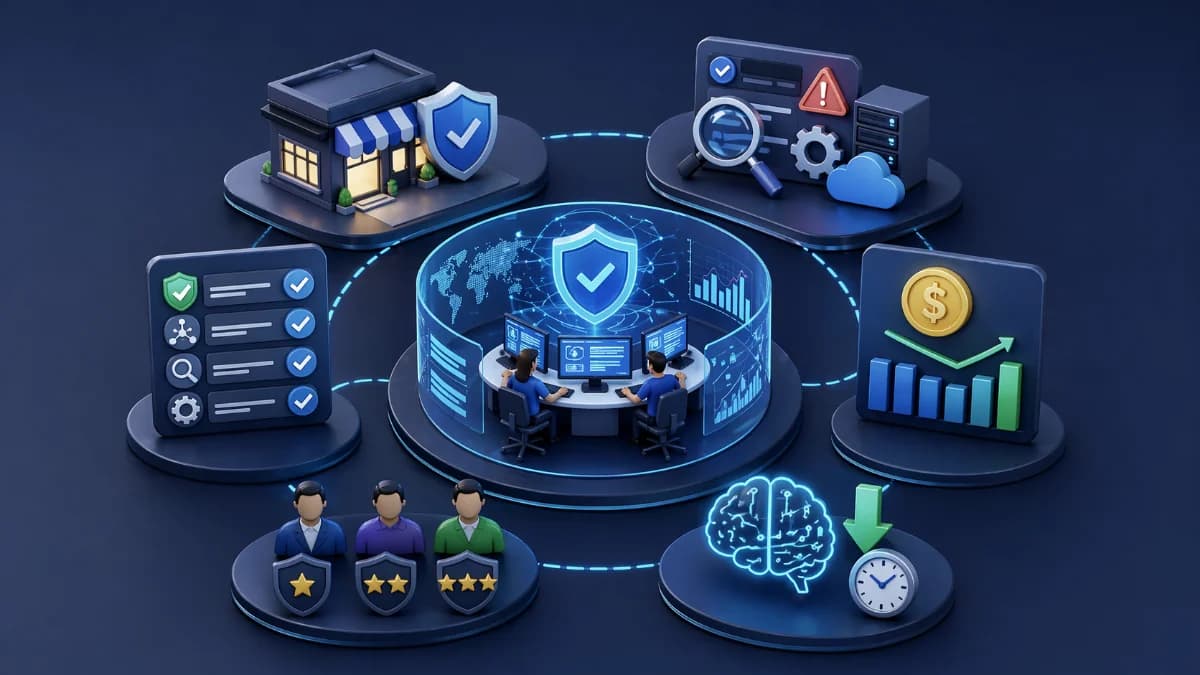
MDR for small business explained with managed detection and response pricing, MDR service scope, MDR provider comparison, and how AI reduces cost and response time.
MDR for small business means paying a managed detection and response provider to monitor your environment, investigate suspicious activity, and help you contain incidents without building a full in-house security team. The value is not just tools. It is coverage, triage, and response discipline, especially after hours. The confusing part is pricing: MDR service packages vary widely based on what is included, what systems are monitored, and whether the provider can take actions or only notify. This guide breaks MDR into the three outcomes that matter most, detect, triage, respond, then explains managed detection and response pricing in practical ranges and what drives cost up or down.
Why this topic matters
Small businesses are often targeted through the same channels as large companies, phishing, credential theft, and ransomware-like disruption, but they do not have the staffing to run a 24/7 SOC. That gap creates two predictable problems: incidents are discovered late and the first containment step is delayed. MDR exists to close that gap. However, many buyers choose an MDR provider based on branding or vague promises, then discover the provider mostly forwards alerts without ownership. That leads to the same operational risk, but with a new monthly bill.
A realistic scenario is a weekend email takeover that leads to invoice fraud attempts. Without coverage, you might not notice until Monday. With MDR, the provider should detect the suspicious login and mailbox rule creation, triage it into one incident, and help you contain it quickly. The difference is measurable: fewer fraudulent payments, less data exposure, and less downtime. This is why MDR for small business should be evaluated on response outcomes, not feature lists.
Key factors and features to consider
What MDR includes in practice: detect, triage, respond
A good MDR service has three deliverables. Detect means collecting the right telemetry from identity, email, endpoints, and critical cloud apps, then flagging suspicious patterns. Triage means grouping related alerts into one incident, assigning severity, and attaching evidence so you can understand what happened quickly. Respond means executing or guiding containment steps, such as session revocation, endpoint isolation, or email quarantine, and providing a clear action plan for recovery.
In practice, the differences between MDR providers show up most in triage and response. Many providers can detect, but fewer can consistently reduce alert noise and produce decision-ready incident narratives. Even fewer can take action in your environment without long approval delays. When evaluating MDR for small business, ask who owns the incident, what the first 15 minutes look like, and what actions the provider can perform versus only recommend.
Managed detection and response pricing: what drives the cost
Managed detection and response pricing is typically driven by coverage scope and operational responsibility. The biggest cost drivers are endpoint count, number of log sources, 24/7 coverage requirements, response authority, and retention or reporting needs. Pricing models may be per endpoint, per user, per workload, or tiered bundles. Costs also rise when you require support for complex environments such as multiple clouds, Kubernetes, or many SaaS applications.
A practical way to think about pricing is paying for two things: signal volume and human time. The more noisy alerts and the more complex the environment, the more analyst time the provider must allocate. That is where AI can reduce cost: if AI-driven correlation and false positive reduction lower noise and produce clearer incidents, the provider can operate with fewer manual touches. This can translate into lower pricing or higher coverage for the same spend.
Typical pricing ranges and what you should expect in each tier
Pricing varies widely by region and vendor positioning, so it is safest to use ranges and tie them to service scope. For small businesses, entry-level MDR service pricing is often positioned as a per-endpoint monthly fee or a minimum monthly spend. In many markets, buyers commonly see low hundreds to low thousands per month for small endpoint counts, and scaling into several thousands per month as endpoint and coverage complexity increases. The key is not the number alone but what is included in detect, triage, and respond.
At a lower tier, expect basic monitoring of endpoints and limited triage, often with business-hours coverage or slower SLAs. At a mid tier, expect 24/7 monitoring, better incident narratives, and some guided response steps. At a higher tier, expect stronger response orchestration, direct containment actions with pre-approved runbooks, and more compliance-ready reporting. If a provider promises 24/7 response at a very low price, ask how they keep false positives low and what actions they actually take. The service should be judged by time-to-first containment and clarity.
MDR provider evaluation: questions that reveal real capability
Decision-makers should evaluate MDR providers using scenario-based questions, not generic checklists. Ask the provider to walk through a realistic account takeover scenario step by step. Ask what signals they ingest, how they correlate alerts into one incident, and what actions they can take in the first 15 minutes. Ask what evidence they deliver for leadership and what changes they recommend to prevent recurrence.
Also ask about approvals and authority. Can they revoke sessions automatically for high-confidence incidents. Do they require you to approve every action, even low-risk ones. What is the after-hours escalation path if they cannot reach your on-call contact. These questions reveal whether the provider delivers outcomes or just notifications. For SMEs, speed and predictability matter more than perfect analysis.
How AI reduces cost and improves time
AI reduces cost primarily by reducing human workload in triage and evidence gathering. When AI groups alerts into incidents, attaches evidence, and writes a clear narrative, analysts spend less time stitching data together. False positive reduction improves because single anomalies are less likely to trigger escalations. Time to respond improves because safe actions can be triggered faster, either automatically or with rapid approval.
This is where an AI-first approach like ShieldNet Defense can fit. It can be positioned as a layer that turns multi-source signals into plain-language incidents and enables safe response steps with evidence and guardrails. In an MDR context, this can reduce the operational burden for both the provider and your internal team. The result is fewer pages, clearer decisions, and faster containment, which is what you are paying for.
Detailed comparisons or explanations
MDR vs MSSP vs internal SOC in plain terms
MDR is focused on detection and response outcomes, not just monitoring. An MSSP often focuses on managing tools and forwarding alerts, though there is overlap and some providers offer both. An internal SOC is the fully in-house model with staffing, tooling, and processes. For small businesses, internal SOC is usually expensive and hard to staff, and the risk is coverage gaps. MDR is attractive because it offers expertise and coverage without full hiring.
The important point is that not all MDR services deliver real response. Some function closer to alert forwarding with investigation notes. That can still help, but you must price it accordingly and ensure your internal team can execute containment quickly. The best model for many SMEs is hybrid: an AI-first workflow for incident grouping and evidence, plus human escalation for complex cases. This improves speed while controlling costs.
What a good 30-day MDR trial should look like
A good trial should include onboarding of key telemetry sources, a baseline period, and measurable outcomes. In the first week or two, the provider should confirm integrations and build an initial detection baseline. In weeks two to four, you should see incidents grouped clearly with evidence and recommended actions. The provider should also run at least one tabletop exercise to test escalation and approvals. The trial should end with a report of KPIs and tuning actions.
If the trial produces many alerts but few coherent incidents, triage quality is weak. If incidents are coherent but response is slow due to approvals or unclear ownership, the operating model needs adjustment. A credible MDR provider will propose changes to reduce noise and speed up containment. This is where AI-driven detection and response orchestration should show value by reducing time and effort.
Best practices and recommendations
- Buy outcomes, not branding: require detect, triage, and respond deliverables in writing
- Start with your top two incident types, then verify the provider can handle them end to end
- Require a minimum incident evidence package: timeline, affected accounts, affected assets, actions taken, and next steps
- Define response authority: what safe actions can be executed without approval, and what requires approval
- Evaluate pricing against scope: endpoint count, log sources, 24/7 coverage, and reporting needs
- Consider AI-first support such as ShieldNet Defense to reduce noise and speed up containment
To implement this as a buyer, run a structured 30-day evaluation. Use one scenario for account takeover and one for ransomware suspicion. Measure time to detect, time to first containment, and false positives. Ask for a weekly summary that is readable by leadership. If you see clarity improving and response becoming faster without disruption, the MDR service is doing its job. If you see alert floods and slow response, negotiate scope, authority, or consider a different MDR provider.
FAQ
What does MDR for small business typically include?
MDR for small business typically includes telemetry onboarding, continuous monitoring, incident triage, investigation support, and response guidance. Strong services also include 24/7 coverage, evidence packages, and some ability to execute containment actions. The biggest differences are in triage quality and response authority. Buyers should confirm exactly what the provider will do versus what they will advise you to do.
How should managed detection and response pricing be structured?
Pricing is commonly per endpoint or per user with a minimum monthly fee, plus add-ons for extra log sources, cloud complexity, or compliance reporting. The best structure is one that aligns cost to scope and outcomes. Ensure the contract specifies SLAs for critical incidents and what response actions are included. Avoid unclear pricing that hides limits on investigation depth or after-hours coverage.
What questions should we ask an MDR provider before signing?
Ask the provider to walk through your top incident scenario step by step. Ask what data they ingest, how they correlate signals, what their first 15 minutes look like, and what actions they can take without approvals. Ask how they reduce false positives and how often they tune detections. Also ask how they deliver executive summaries and evidence for audits or customer reviews.
Can AI meaningfully reduce MDR cost?
AI can reduce MDR cost by lowering analyst time spent on triage, correlation, and evidence gathering. If AI reduces noise and produces clearer incidents, the provider can cover more endpoints with the same analyst capacity. AI can also speed containment through safe automated actions. The buyer should demand proof through pilot metrics: fewer pages, higher alert-to-incident conversion, and faster time to first containment.
How does ShieldNet Defense relate to MDR for small business?
ShieldNet Defense can be positioned as an AI-first workflow layer that improves triage clarity and enables safe response actions with evidence and guardrails. In an MDR setup, it can reduce both provider workload and internal workload by turning signals into plain-language incidents. It can also support consistent evidence timelines for reporting and KPI tracking. The best evaluation is outcome-based: time to detect, time to first containment, and false positives.
Conclusion
MDR for small business should be evaluated as a service outcome: detect, triage, and respond, with measurable speed and clarity. Managed detection and response pricing varies because scope and responsibility vary, so buyers should tie price to telemetry coverage, 24/7 SLAs, response authority, and evidence quality. AI can reduce cost and time by improving correlation, reducing false positives, and enabling safe containment actions, which is why AI-first workflows can strengthen MDR value. If you approach MDR as a 30-day measurable trial with scenario-based evaluation, you can choose a provider that delivers predictable after-hours protection rather than just another stream of alerts.
Related Articles

Oct 9, 2026
I replied to a phishing email. Am I at risk?
Replied to a phishing email? Learn what risks you face, what attackers can learn from your reply, and what to do next to protect your account and business.

Oct 8, 2026
Real or Fake? How to verify a sharepoint file invitation
Received a SharePoint file invitation? Learn how to spot fake SharePoint emails, verify shared files safely, and protect your Microsoft 365 account from phishing.

Oct 1, 2026
I paid a fake invoice. What should my business do?
Paid a fake invoice? Learn what your business should do immediately to contact the bank, preserve evidence, secure accounts, investigate the fraud, and reduce further losses.