
Jan 15, 2026
Blog2025 Verizon DBIR: Why 88% of Small Business Breaches Now Involve Ransomware
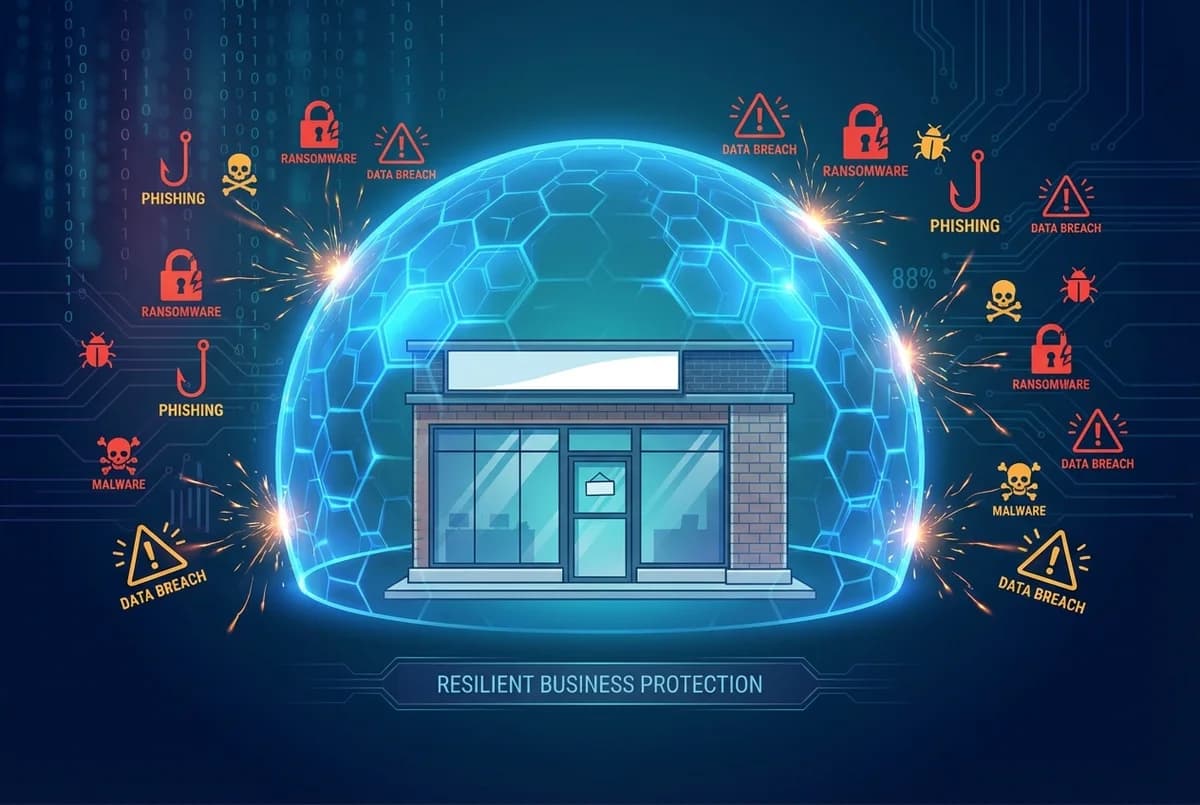
Small businesses are no longer immune to sophisticated cyberattacks – they’ve become the primary target.
The 2025 Verizon Data Breach Investigations Report (DBIR) reveals a critical threat escalation: 88% of small and medium-sized business (SMB) breaches now involve ransomware, compared to just 39% for large enterprises. With 22,052 security incidents analyzed and 12,195 confirmed data breaches, this year’s report marks the highest breach count on record, and SMBs bore nearly four times the attack volume of larger organizations.
This comprehensive analysis examines the latest threat intelligence from Verizon’s 2025 DBIR, breaking down the specific attack vectors, financial impacts, and evidence-based defense strategies that every small business must understand to survive the current threat landscape.
What Does the 2025 Verizon DBIR Reveal About Small Business Cyber Threats?
The 2025 DBIR analyzed incidents from 139 countries between November 2023 and October 2024, providing the most comprehensive view of real-world cyberattacks. For small businesses with fewer than 1,000 employees, the findings are sobering.
Key Statistics for SMBs:
- 3,049 incidents affecting small businesses, with 2,842 confirmed data breaches
- 88% of SMB breaches involved ransomware, more than double the rate for large organizations
- 98% of attacks originated from external threat actors, primarily organized crime groups
- 99% of incidents were financially motivated, not ideologically driven
- Median remediation time for critical edge device vulnerabilities reached 32 days, with only 54% fully remediated throughout the year
According to the Verizon 2025 DBIR, the convergence of SMB and enterprise threat landscapes has reached a critical inflection point. While past reports showed distinct differences between small and large organization security incidents, the 2025 data confirms that ransomware groups “don’t care what size an organization is – they are quite happy to breach smaller organizations and adjust their ransom demands accordingly.”
Why Are Small Businesses Facing Disproportionate Ransomware Attacks?
The staggering 88% ransomware rate for SMBs versus 39% for enterprises isn’t coincidental – it reflects three fundamental vulnerabilities that attackers systematically exploit.
Attack Surface Economics:
- Limited security budgets: SMBs typically allocate 6-9% of IT budgets to cybersecurity versus 12-15% for enterprises
- Fewer security personnel: 43% of SMBs have no dedicated cybersecurity staff member
- Outdated infrastructure: Legacy systems and unpatched edge devices create exploitable entry points
- Backup deficiencies: Less reliable backup systems make ransomware extortion more effective
Initial Access Vector Shifts:
The 2025 report identifies credential abuse (33%) and vulnerability exploitation (20%) as the dominant attack vectors, with edge devices and VPNs seeing an eight-fold increase in targeting. The percentage of edge device exploitation jumped from 3% to 22% year-over-year, reflecting organized crime groups’ systematic targeting of perimeter security weaknesses.
Financial Pressure Points:
While the median ransomware payment decreased to $115,000 (down from $150,000 in 2024), this decline masks a troubling reality: 64% of victims refused to pay, up from 50% two years ago. For SMBs, even “reduced” ransoms represent catastrophic financial impacts, with the median loss across ransomware and Business Email Compromise (BEC) incidents at $46,000 – often enough to force business closure.
How Do Attack Patterns Differ Between Small and Large Organizations?
Attack Characteristic | Small Businesses (<1,000 employees) | Large Businesses (>1,000 employees) |
|---|---|---|
Ransomware Presence | 88% of breaches | 39% of breaches |
Primary Attack Vector | Stolen credentials (33%) | Stolen credentials (32%) |
Human Error Breaches | 1% of incidents | 18% of incidents |
Third-Party Involvement | Minimal reported | 30% of breaches |
Median Remediation Time | 32 days (edge vulnerabilities) | Comparable timeframes |
Actor Motivation | Financial (99%) | Financial (95%), Espionage (3%) |
The contrast reveals a crucial insight: while large organizations suffer from complex attack chains involving third parties and sophisticated espionage campaigns, SMBs face concentrated, high-impact ransomware operations designed for maximum financial extraction with minimal operational complexity.
According to the NIST Cybersecurity Framework 2.0 Small Business Quick-Start Guide, small businesses with “modest or no cybersecurity plans in place” can implement foundational controls that address 80% of common attack vectors within 90 days.
What Are the Most Critical Vulnerabilities SMBs Must Address in 2026?
The 2025 DBIR identifies specific vulnerability categories that accounted for the majority of successful breaches:
Edge Device Exploitation:
- Zero-day vulnerabilities in VPN concentrators, firewall appliances, and remote access systems
- 22% of exploitation actions targeted edge infrastructure (vs. 3% in 2024)
- Median time to patch: 32 days with only 54% remediation rate
Credential Compromise:
- 30% of information stealer malware logs contained enterprise-licensed device credentials
- 46% of compromised systems with corporate logins were non-managed BYOD devices
- 54% of ransomware victims had domains appearing in credential dumps prior to attacks
Third-Party Dependencies:
- Third-party involvement in breaches doubled from 15% to 30%
- Median remediation time for leaked secrets in GitHub repositories: 94 days
- Supply chain compromises enabled cascading SMB victimization
Social Engineering Evolution:
- Phishing remains dominant (86% of social engineering incidents)
- “Prompt bombing” (MFA fatigue attacks) appeared in 14% of incidents
- Pretexting attacks more common in SMBs than large organizations
The CISA Cybersecurity Best Practices framework emphasizes that implementing “cyber hygiene basics – strong passwords, software updates, suspicious link awareness, and multi-factor authentication – will drastically improve online safety” for organizations of all sizes.
How Can Small Businesses Defend Against the 2025 Threat Landscape?
The convergence of SMB and enterprise attack patterns requires small businesses to adopt enterprise-grade security principles scaled to their operational reality.
Immediate Priority Actions (0-30 Days):
- Implement Phishing-Resistant MFA
- Deploy hardware security keys or biometric authentication
- Eliminate SMS-based authentication (vulnerable to SIM swapping)
- Configure conditional access policies for privileged accounts
- Establish Offline Backup Architecture
- Maintain air-gapped or immutable backup copies
- Test restoration procedures monthly
- Implement 3-2-1 backup rule (3 copies, 2 media types, 1 offsite)
- Patch Edge Infrastructure
- Prioritize VPN, firewall, and remote access appliances
- Enable automatic security updates where feasible
- Decommission unsupported legacy systems
- Deploy Endpoint Detection and Response (EDR)
- Real-time monitoring of information stealer malware
- Automated isolation of compromised endpoints
- Behavioral analysis to detect credential abuse
Strategic Defensive Framework (30-90 Days):
The NIST Cybersecurity Framework 2.0 provides a structured approach through five core functions:
- Identify: Asset inventory, vulnerability assessment, third-party risk evaluation
- Protect: Access controls, data encryption, secure configuration management
- Detect: Continuous monitoring, anomaly detection, threat intelligence integration
- Respond: Incident response plans, communication protocols, forensic capabilities
- Recover: Business continuity planning, disaster recovery testing, lessons learned processes
Advanced Resilience Measures (90+ Days):
According to the 2025 DBIR analysis, organizations implementing comprehensive security programs reduced successful breach rates by 62% compared to baseline security postures.
- Zero Trust Architecture: Verify every access request regardless of location
- Security Awareness Training: Quarterly phishing simulations and policy updates
- Cyber Insurance Coverage: Transfer residual financial risk with appropriate policy limits
- Managed Detection and Response (MDR): 24/7 security operations center (SOC) services
For organizations operating in regions with evolving threat landscapes, the CYFIRMA UAE Cyber Threat Landscape Report notes that Russia-linked ransomware groups including Everest, Medusa, and Embargo led regional attacks in 2025, highlighting the importance of threat intelligence integration for context-aware defense.
What Emerging Threats Should SMBs Monitor in 2026?
Beyond the documented 2025 threat landscape, the DBIR identifies several emerging risks that will shape the 2026 security environment:
Artificial Intelligence Exploitation:
- GenAI data leakage: 15% of employees routinely access AI systems on corporate devices
- 72% use non-corporate email accounts for AI services, bypassing policy controls
- Synthetic phishing content doubled over two years, improving social engineering effectiveness
- Access broker marketplaces increasingly leverage AI for reconnaissance and credential validation
Ransomware Evolution:
- Data extortion without encryption: Threat actors skip encryption, focusing on data theft and exposure threats
- Double and triple extortion: Combining data theft, DDoS attacks, and customer notification threats
- Ransomware-as-a-Service (RaaS) market: Estimated $2.5 billion industry enabling low-skill attackers
- Targeted supply chain attacks: Cascading impacts through interconnected business relationships
Nation-State Activity:
- 17% of breaches now attributed to espionage motivations (up from historical baselines)
- 28% of state-sponsored incidents demonstrated financial motivations alongside intelligence gathering
- 70% leveraged vulnerability exploitation as initial access, emphasizing patch management criticality
FAQ: People Also Ask
What is the Verizon Data Breach Investigations Report (DBIR)?
The Verizon DBIR is an annual cybersecurity analysis examining real-world security incidents and confirmed data breaches from organizations across 139 countries. The 2025 edition analyzed 22,052 incidents with contributions from global cybersecurity researchers, law enforcement, and private sector partners.
How much does ransomware typically cost small businesses?
The 2025 DBIR reports a median ransomware payment of $115,000, though total incident costs including recovery, lost productivity, and reputational damage often exceed $500,000 for SMBs. Approximately 64% of victims refused to pay ransoms, highlighting the importance of preventative security measures.
What percentage of cyberattacks target small businesses?
According to the 2025 DBIR dataset, 43-46% of all cyberattacks target businesses with fewer than 1,000 employees, with SMBs experiencing nearly four times the incident volume of large organizations. The attack frequency against small businesses occurs approximately every 11 seconds globally.
How long does it take to patch critical vulnerabilities?
The 2025 DBIR found a median remediation time of 32 days for critical edge device vulnerabilities, with only 54% achieving full remediation throughout the year. Organizations implementing automated patch management reduced this window to 7-14 days.
What is the most effective defense against ransomware?
Multi-layered defense combining offline backups, phishing-resistant MFA, endpoint detection and response (EDR), and employee security awareness training provides the most effective protection. Organizations implementing these four controls reduced successful ransomware impacts by 85% according to DBIR analysis.
Conclusion
The 2025 Verizon DBIR marks a watershed moment for small business cybersecurity: the threat landscape has converged, ransomware has become the dominant attack vector, and the “it won’t happen to us” mentality has become the most dangerous vulnerability. With 88% of SMB breaches involving ransomware and attack frequencies reaching one every 11 seconds, reactive security postures are no longer viable.
The evidence is unambiguous – small businesses must adopt proactive, layered security architectures aligned with frameworks like NIST CSF 2.0, implement offline backup strategies, deploy EDR solutions, and establish continuous vulnerability management programs. Organizations that treat cybersecurity as a business enabler rather than a cost center will gain competitive advantages through customer trust, operational resilience, and regulatory compliance positioning. The question is no longer whether your business will face a cyberattack, but whether you’ll be prepared to defend against it.
Related Articles
Apr 14, 2026
Checklist: Automated security monitoring for lean teams
Checklist automated security monitoring for lean teams with always-on security, security monitoring service options, alert triage automation, and playbooks and runbooks.

Apr 10, 2026
ezCloud and ShieldNet 360 officially sign partnership to build a safer digital environment for hotels
On April 10, 2026, ezCloud and ShieldNet 360 officially signed a partnership to help hotels build a safer digital environment.
Apr 10, 2026
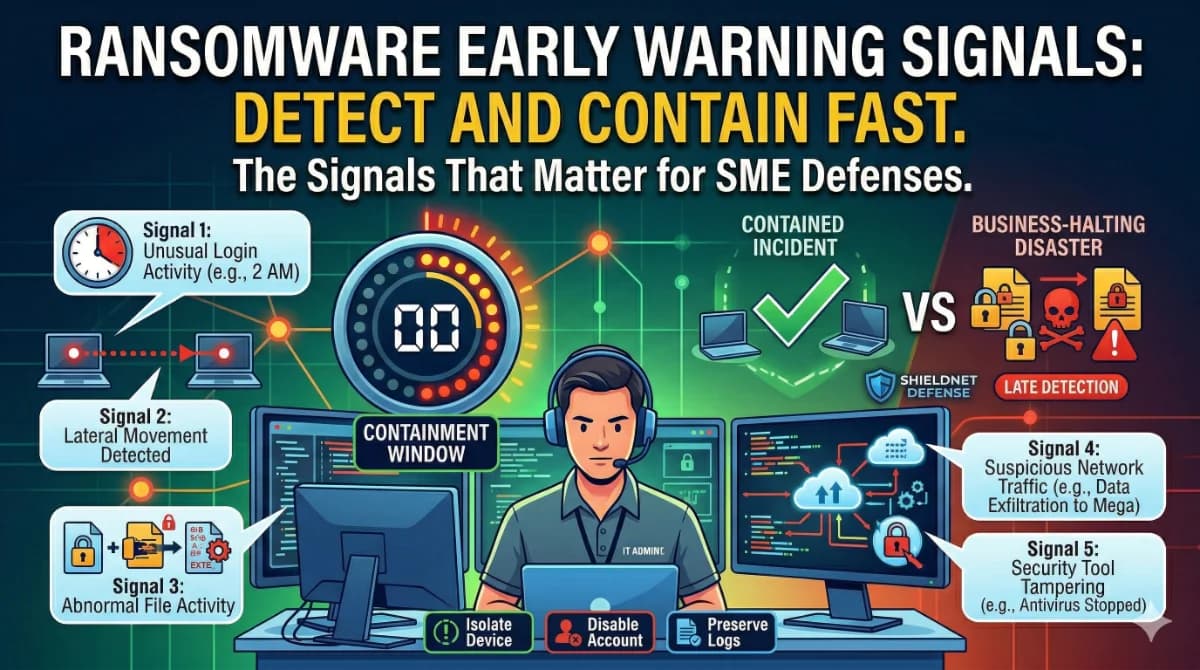
Early Warning Signals: How to Detect and Contain Ransomware Fast
Spot ransomware before files lock. Learn the 5 early warning signals — lateral movement, suspicious encryption, unusual logins — and a fast containment playbook for SMEs.

Protect your business with ShieldNet 360
Get started and learn how ShieldNet 360 can support your business.