
Mar 9, 2026
BlogSecurity certification benefits: 7 proven ways in 2026
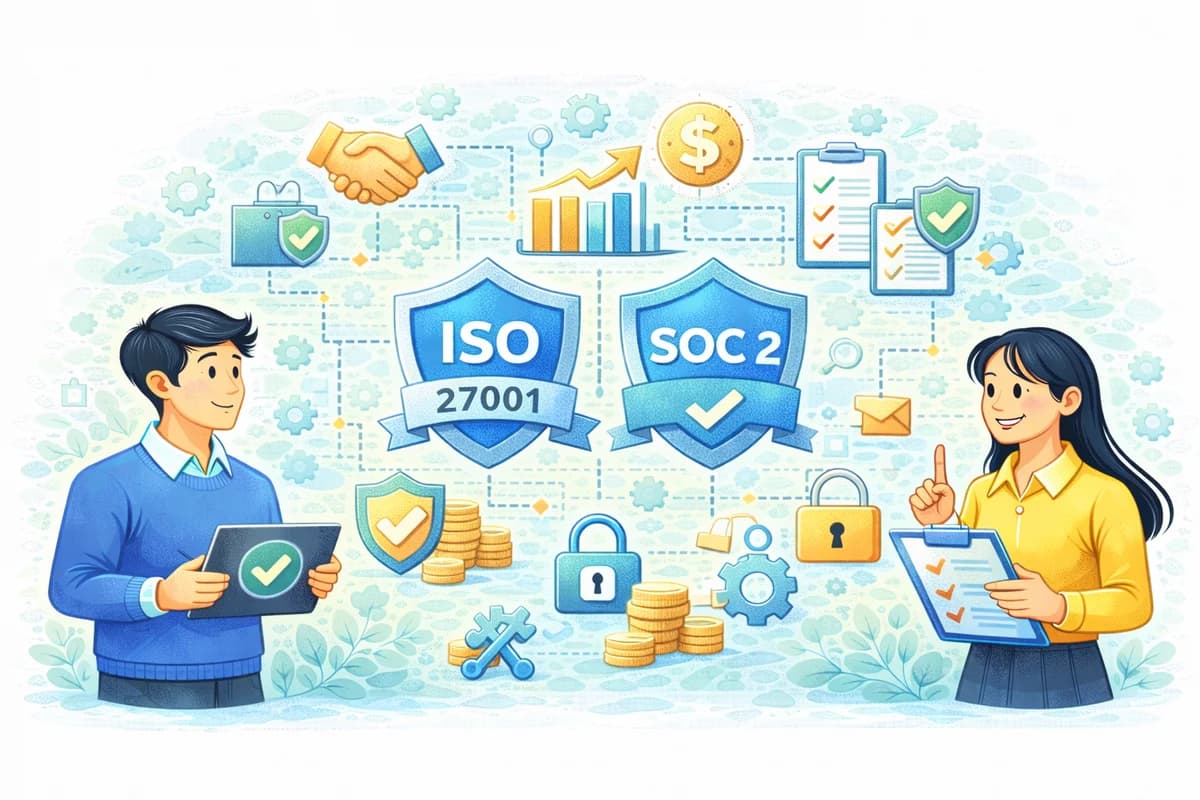
Security certification benefits for SMEs in 2026: ISO 27001 benefits, SOC 2 benefits, compliance trust, sales enablement, and certification ROI to reduce risk.
Security certifications are often misunderstood as “extra paperwork,” but for many SMEs they are a business growth tool and a risk reduction tool at the same time. The right certification can shorten customer security reviews, unlock enterprise procurement, and create repeatable security routines that reduce incidents. This artible will explain security certification benefits in practical terms, comparing ISO 27001 benefits and SOC 2 benefits, and showing how compliance trust translates into sales enablement and measurable certification ROI. This guide is written for SME leaders who want real outcomes, not vague promises.
Why this topic matters
Security certification benefits matter because buyers are becoming more cautious and procurement teams are asking for proof, not promises. Even if your product is great, a long security questionnaire cycle can slow deals or block them completely, especially in regulated or data-sensitive industries. Certifications also protect the business internally by forcing clarity: who owns controls, how changes are approved, and how incidents are handled. For SMEs, the biggest advantage is predictability - security becomes a routine instead of a scramble.
A realistic scenario is a 70-person B2B SaaS vendor trying to sell to banks, large retailers, or enterprise platforms. The security team is small, and every deal triggers a new questionnaire with similar questions about access, backups, and incident response. Without certification, sales and engineering spend weeks answering repeatedly, and buyers still hesitate because answers are hard to verify. With a certification, the company can point to a recognized framework, provide consistent evidence, and move the conversation toward business value. This is where sales enablement becomes a direct outcome of compliance trust.
Key factors and features to consider
ISO 27001 benefits versus SOC 2 benefits in one sentence
ISO 27001 benefits are strongest when you need a globally recognized security management system that proves you run security as a process, not a set of tools. SOC 2 benefits are strongest when customers – especially in the US – expect an assurance report that evaluates controls over a defined period. Many SMEs choose one based on customer geography and procurement expectations, then expand later. The key is aligning certification choice with your go-to-market reality, not with what sounds impressive.
Compliance trust is built through repeatable operations
Compliance trust is not created by a logo; it is created by repeatable execution that produces evidence. Certifications force you to define scope, assign owners, and prove routines like access reviews, change approvals, and backup tests. For SMEs, this reduces the “single point of failure” risk where only one person knows how security works. When operations are repeatable, trust rises with customers and internal stakeholders.
Sales enablement means faster, more consistent deal cycles
Sales enablement is a real security certification benefit when it reduces security review friction. Instead of rewriting answers for every buyer, you standardize responses and provide structured artifacts that procurement teams recognize. Your sales team can handle objections faster because certification gives a credible baseline. Over time, this creates a compounding effect: fewer stalled deals, fewer escalations to engineering, and clearer messaging across marketing, sales, and security.
Certification ROI is measurable when you track the right metrics
Certification ROI is not only about revenue uplift; it also includes cost savings from fewer incidents and fewer duplicated reviews. Practical ROI measures include reduced questionnaire hours, faster time-to-close for enterprise deals, reduced downtime from incidents, and lower rework due to better change control. SMEs should baseline these costs before certification and track them afterward to demonstrate value. When you measure the right things, security certification benefits become visible in business metrics.
Scope and readiness: SMEs must avoid overcommitting
The biggest certification mistake for SMEs is overcommitting on scope and controls that they cannot sustain. A right-sized approach focuses on core systems, high-impact controls, and evidence routines that a lean team can maintain monthly. This is especially important for ISO 27001 benefits, because auditors check that the system operates continuously, not just during audit week. Sustainable scope protects certification ROI and prevents burnout.
Detailed comparisons or explanations
How ISO 27001 benefits show up in day-to-day business
ISO 27001 benefits often appear as operational clarity: consistent access management, structured risk treatment, and a disciplined incident response workflow. These routines reduce incidents, shorten investigations, and make leadership reporting easier. For SMEs, ISO 27001 also supports international credibility, because it is widely recognized across regions and industries. The main tradeoff is that it requires ongoing discipline, so the organization must commit to maintaining routines, not just passing an audit.
A mini example is supplier and access control. Under ISO 27001-style practices, you routinely review who has access to sensitive data, record changes, and remove access when roles change. This reduces the risk of “silent exposure,” where old accounts remain active and become an easy target. Over time, these practices directly reduce risk and operational firefighting, which is a real form of certification ROI.
How SOC 2 benefits translate into procurement readiness
SOC 2 benefits are often strongest for procurement readiness in markets where customers expect a formal assurance report. The report format helps buyers compare vendors and reduces the amount of custom verification required. For SMEs, this can be a shortcut to compliance trust because it answers common questions about controls and monitoring over a period of time. The tradeoff is that SOC 2 can become expensive if scope is too broad or if evidence collection is not designed as a routine.
A practical example is enterprise onboarding. When a buyer asks for proof of access controls, logging, and incident handling, a SOC 2 report can reduce back-and-forth by providing a standardized assurance artifact. This supports sales enablement because your team spends less time explaining basic controls and more time on product value. For many SMEs, that time savings alone becomes meaningful certification ROI within a year.
Choosing the right path: one certification, or a phased approach
SMEs do not need every certification at once. A phased approach can deliver most security certification benefits with less risk: start with the certification that matches your target buyers, then expand if deal requirements demand it. For example, a global SaaS product may prioritize ISO 27001 benefits first, then add SOC 2 benefits when US enterprise demand grows. The success factor is ensuring the operational system - ownership, evidence, and routines: comes first, because certifications are easier when operations are stable.
This phased approach also prevents “certificate chasing,” where teams pursue certifications without linking them to procurement readiness or reduced risk. The real win is building a repeatable security program that produces evidence and trust automatically. When certification is aligned with strategy, it becomes a growth lever rather than a distraction.
Best practices and recommendations
- Map your top customer requirements and choose the certification that best matches buyer expectations
- Right-size scope to core systems and high-impact controls you can maintain monthly
- Build evidence routines: access reviews, change approvals, backup tests, and incident summaries
- Create sales enablement assets: standardized security answers, one-page control summaries, and an escalation path
- Track certification ROI: questionnaire hours saved, enterprise deal cycle time, and incident-related downtime reduction
- Use a phased plan: start with one certification, then expand based on deal demand
To apply this checklist, begin by collecting 10 recent customer security questions and grouping them into themes like access, backups, and incident response. Then choose a certification that covers those themes in a way your buyers recognize, which strengthens compliance trust quickly. Next, design monthly evidence habits so you do not scramble before audits, and translate those controls into sales enablement language that procurement teams can understand. Finally, measure certification ROI using time saved and deals accelerated, so leadership sees the business value clearly.
A realistic 90-day preparation roadmap for SMEs
In the first 30 days, define scope, assign control owners, and baseline your current practices and gaps. In days 31–60, implement the highest-impact routines, such as access reviews and backup restore tests, and build a clean evidence structure. In days 61–90, run an internal readiness check, produce sales enablement materials, and finalize the audit or assessment plan. This roadmap keeps effort focused on operational change, which is the foundation of security certification benefits.
FAQ
Are security certification benefits worth it for small businesses?
Security certification benefits can be worth it when you sell to larger customers, handle sensitive data, or operate in regulated industries where procurement demands proof. They can also be worth it as a risk-reduction tool because they force repeatable controls that reduce incidents. For very small businesses with minimal data exposure and purely local customers, a lighter readiness approach may be sufficient until demand increases. The key is aligning certification to revenue and risk realities.
Which delivers more value: ISO 27001 benefits or SOC 2 benefits?
The higher value depends on your customer base and geography. ISO 27001 benefits are often stronger for global credibility and building a structured management system, while SOC 2 benefits are often stronger for procurement readiness in markets that expect a formal assurance report. Many SMEs choose one as a starting point and later add the other if customer requirements expand. The best choice is the one that reduces friction in your sales pipeline the fastest.
How do certifications improve sales enablement in practice?
Certifications improve sales enablement by turning security into a standardized story with recognized evidence. Your sales team can answer procurement questions faster, reduce repeated questionnaires, and provide consistent artifacts that reduce buyer uncertainty. Engineering time is also protected because fewer deals require custom explanations and one-off evidence gathering. Over time, this creates a repeatable process for winning enterprise trust.
How can SMEs calculate certification ROI realistically?
SMEs can calculate certification ROI by tracking hours spent on questionnaires before and after certification, changes in enterprise deal cycle length, and the number of deals won or saved due to procurement readiness. Add operational metrics like reduced downtime from incidents and fewer emergency engineering sprints caused by security failures. The goal is not to claim perfect attribution, but to show credible ranges and trends. When tracked quarterly, certification ROI becomes a defensible business metric.
What is the biggest mistake SMEs make when pursuing certifications?
The biggest mistake is choosing a certification for prestige instead of for buyer requirements and operational capacity. Over-scoping leads to evidence burdens that a small team cannot sustain, which creates burnout and audit risk. A right-sized approach focuses on high-impact controls and stable routines first, then expands scope as the organization grows. This ensures security certification benefits remain sustainable and aligned with business goals.
Conclusion
Security certification benefits are real for SMEs when certification is treated as an operating system: clear scope, consistent evidence routines, and repeatable controls that create compliance trust. ISO 27001 benefits and SOC 2 benefits both support procurement readiness and sales enablement, but the best choice depends on your buyers and markets. The strongest certification ROI comes from reduced review effort, faster enterprise deals, and fewer costly incidents due to better operational discipline. If you want a practical next step, map your buyer requirements, choose one right-sized certification path, and build monthly evidence habits that turn certification into a long-term business advantage.
Related Articles

Oct 22, 2026
Real or Fake? HR Asking You to Review Payroll
Got an email from HR asking you to review payroll? Learn how to identify fake payroll emails, verify HR requests, and protect your salary and bank details.

Oct 9, 2026
I replied to a phishing email. Am I at risk?
Replied to a phishing email? Learn what risks you face, what attackers can learn from your reply, and what to do next to protect your account and business.
Oct 8, 2026
Real or Fake? How to verify a sharepoint file invitation
Received a SharePoint file invitation? Learn how to spot fake SharePoint emails, verify shared files safely, and protect your Microsoft 365 account from phishing.

Protect your business with ShieldNet 360
Get started and learn how ShieldNet 360 can support your business.