
Dec 26, 2025
BlogBreach Notification Requirements: 2025 Compliance Guide
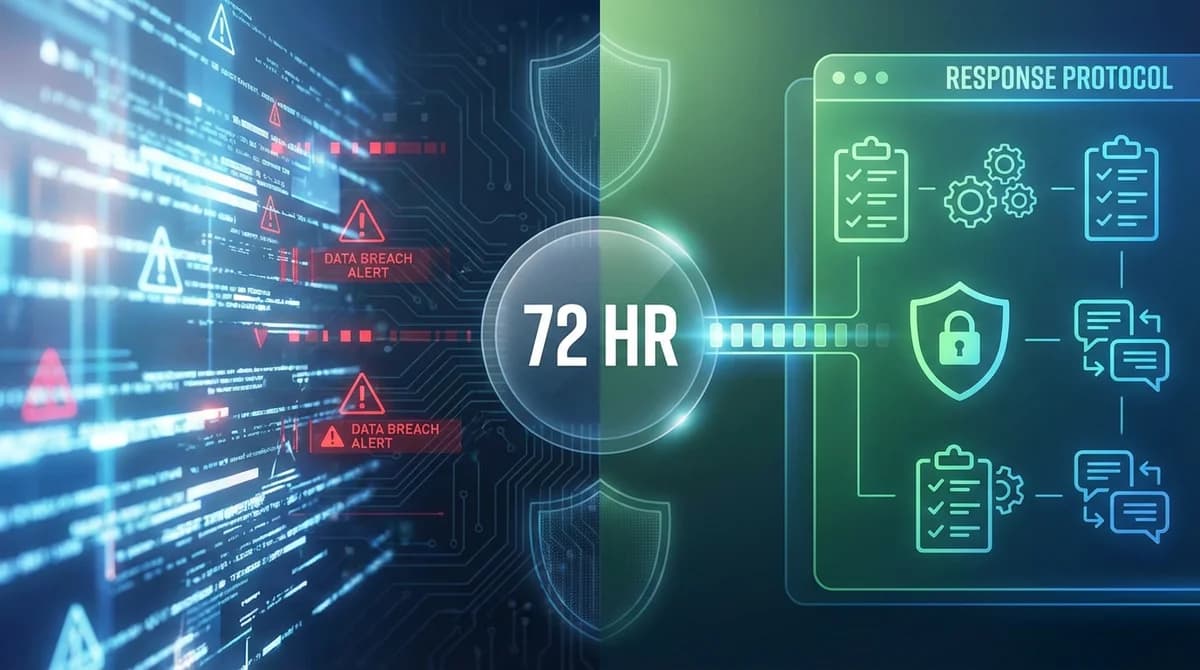
When a data breach strikes your organization, the clock starts ticking immediately. Breach notification requirements mandate that businesses must notify affected parties within strict timeframes – often 72 hours – while maintaining compliance with evolving global regulations including NIST SP 800-61r3, GDPR, and regional laws. Understanding these requirements isn’t optional; it’s the difference between controlled incident response and regulatory penalties that can reach millions of dollars.
In today’s interconnected digital ecosystem, breach notification extends far beyond a simple email to affected users. It encompasses legal obligations, technical documentation, stakeholder communications, and strategic recovery planning. Whether you’re operating in the United Arab Emirates under the PDPL, managing data in Vietnam under Decree 13/2023, or serving global markets, your breach response framework must align with multiple jurisdictional requirements simultaneously.
What Are Breach Notification Requirements?
Breach Notification Requirements are mandatory legal and regulatory obligations that compel organizations to inform specific parties when unauthorized access, disclosure, or loss of personal data occurs. These requirements exist at federal, state, and international levels, creating a complex web of compliance obligations for modern enterprises.
The Foundation: NIST SP 800-61r3 Framework
The NIST Special Publication 800-61 Revision 3, released in April 2025, fundamentally restructured incident response thinking. Unlike previous models that treated incident response as a circular, isolated process, NIST now integrates breach notification into the broader Cybersecurity Framework (CSF) 2.0 across all six core functions:
- Govern (GV): Establish cybersecurity risk management strategy
- Identify (ID): Understand current cybersecurity risks
- Protect (PR): Implement safeguards to manage risks
- Detect (DE): Find and analyze potential attacks
- Respond (RS): Take action on detected incidents
- Recover (RC): Restore affected assets and operations
This evolution reflects that modern incidents occur frequently, cause extensive damage, and require weeks or months of recovery – not the days-long containment cycles of the past.
Key Regulatory Frameworks Globally
Different jurisdictions impose varying notification standards:
United States:
- All 50 states plus DC, Puerto Rico, and the Virgin Islands have breach notification laws
- FTC guidelines recommend immediate law enforcement notification
- HIPAA Breach Notification Rule mandates 60-day notification for health data
- Financial sector regulated by state and federal banking authorities
European Union:
- GDPR Article 33 requires notification within 72 hours to supervisory authorities
- Article 34 mandates individual notification “without undue delay” for high-risk breaches
Asia-Pacific Region:
- Vietnam Decree 13/2023/ND-CP: Requires notification to Authority of Personal Data Protection (A05) within 72 hours of breach discovery
- UAE PDPL (Federal Law No. 45 of 2021): Mandates notification within 72 hours to the Data Office
- Singapore PDPA: “As soon as practicable” with specific assessments
Why Breach Notification Requirements Matter
Legal and Financial Consequences
The stakes for non-compliance have escalated dramatically:
Regulatory Penalties:
- GDPR violations can reach €20 million or 4% of global annual revenue, whichever is higher
- California CCPA fines range from $2,500 to $7,500 per violation
- Vietnam’s Decree 13 imposes fines up to VND 100 million (approximately $4,000 USD)
- UAE PDPL penalties can exceed AED 3 million ($816,000 USD)
Civil Liability:
Organizations face class action lawsuits from affected individuals. The average cost of a data breach globally reached $4.45 million in 2023 according to IBM Security, with notification and communication costs representing a significant portion.
Reputational and Operational Impact
Trust Erosion:
60% of small businesses close within six months of a significant cyber incident. Transparent, rapid notification can preserve customer relationships, while delayed or inadequate communication amplifies reputational damage.
Operational Disruption:
According to the FTC Data Breach Response Guide, organizations that maintain pre-established breach response protocols resume operations 40% faster than those without documented procedures.
How to Implement Breach Notification Requirements: The NIST-Aligned Framework
Phase 1: Preparation (Before the Breach)
Establish Incident Response Policies
Your Breach notification readiness begins long before an incident occurs. NIST SP 800-61r3 emphasizes that preparation activities span three core functions:
1. Governance (GV)
- Draft comprehensive incident response policies that clearly define:
- Breach definitions specific to your data types and regulatory context
- Roles and authorities (who can authorize notifications, shut down systems, engage external counsel)
- Notification thresholds (what triggers mandatory reporting)
- Performance metrics for response speed and effectiveness
2. Asset Inventory (ID.AM)
Maintain real-time, automatically updated inventories of:
- Hardware and software across all environments (cloud, on-premises, hybrid)
- Data classifications with logical and physical locations
- Network communication flows to detect anomalous activity
- Third-party services and their data access privileges
3. Protection Controls (PR)
Implement technical safeguards that reduce breach likelihood:
- Encryption for data at rest and in transit
- Access controls with least-privilege principles
- Network segmentation to contain breaches
- Vulnerability management programs
Build Your Breach Response Team
NIST identifies critical roles beyond traditional IT security:
Role | Responsibilities | Breach Notification Duties |
Incident Handlers | Verify incidents, collect evidence, contain damage | Determine breach scope, assess notification requirements |
Legal Counsel | Review regulatory obligations, manage litigation risk | Advise on notification timing, content, and recipients |
Communications | Manage media relations, stakeholder engagement | Draft notification content, coordinate public statements |
Leadership | Allocate resources, authorize critical decisions | Approve notification strategies, engage regulatory authorities |
HR | Handle insider threat investigations, employee relations | Manage workforce notifications, support affected employees |
Develop Playbooks and Templates
Create actionable, scenario-specific playbooks following the CISA Cybersecurity Incident & Vulnerability Response Playbooks model:
- Ransomware Response Playbook: Includes notification procedures for encrypted data
- Phishing/Credential Theft Playbook: Addresses account compromise notifications
- Insider Threat Playbook: Covers employee-caused breaches with legal considerations
- Third-Party/Supply Chain Breach Playbook: Defines vendor notification protocols
Pre-approved notification templates should include:
- Initial notification (within 72 hours if required)
- Updated notification (as investigation reveals new information)
- Final notification (post-incident summary with remediation steps)
Phase 2: Detection & Analysis (During the Breach)
Rapid Breach Identification
The 72-hour notification clock starts when you become aware of the breach – not when it occurred. Sophisticated detection mechanisms are essential:
Continuous Monitoring:
- SIEM platforms aggregate logs from all systems
- User and Entity Behavior Analytics (UEBA) detect anomalies
- Endpoint Detection and Response (EDR) identifies compromised devices
- Cloud Access Security Brokers (CASB) monitor cloud data access
Threshold Analysis:
Not every security incident constitutes a notifiable breach. Assess:
- Data types involved: Personal identifiable information (PII), protected health information (PHI), financial data, or intellectual property
- Number of records: Many jurisdictions have numerical thresholds
- Risk of harm: Likelihood that exposed data could cause identity theft, fraud, or discrimination
Evidence Preservation and Documentation
From the moment of detection, documentation becomes legally critical:
Forensic Data Collection:
- Capture system images before remediation activities alter evidence
- Preserve logs from all potentially affected systems
- Document timelines with precision to minute-level detail
- Chain of custody for all evidence following law enforcement standards
Incident Documentation Template:
INCIDENT IDENTIFICATION
- Date/Time Detected: [YYYY-MM-DD HH:MM UTC]
- Detection Method: [System alert / User report / Third-party notification]
- Initial Severity Assessment: [Critical / High / Medium / Low]
BREACH SCOPE ASSESSMENT
- Affected Systems: [List all compromised assets]
- Data Types Involved: [PII / PHI / Financial / IP / Other]
- Estimated Records Affected: [Number range]
- Geographic Jurisdictions: [List all relevant locations]
NOTIFICATION OBLIGATIONS
- Regulatory Bodies: [List all agencies requiring notification]
- Affected Individuals: [Estimated count]
- Third Parties: [Credit bureaus, business partners, service providers]
- Notification Deadlines: [Calculate from detection timestamp]
Phase 3: Notification (Responding to the Breach)
The 72-Hour Rule: Regional Variations
While “72 hours” has become shorthand for breach notification timelines, actual requirements vary:
Vietnam (Decree 13/2023/ND-CP):
- Controllers and processors must notify the Authority of Personal Data Protection (A05) within 72 hours of discovering violations
- Staged notification permitted if complete information isn’t immediately available
- Late notification requires documented justification for the delay
- Source: DLA Piper Vietnam Analysis
United Arab Emirates (Federal PDPL):
- Controllers must notify the Data Office “immediately upon becoming aware” of breaches causing harm
- 72-hour guidance aligns with ADGM and DIFC free zone requirements
- Notification must include nature, scope, affected data, and remediation steps
- Source: KPMG UAE PDPL Guide
GDPR (European Union):
- 72 hours to supervisory authority from awareness (extendable with justification)
- Individual notification “without undue delay” when high risk exists
- Three-phase notification permitted: initial, supplemental, final
United States (State Laws):
- Timelines range from “most expedient time possible” to specific day counts (e.g., California’s “without unreasonable delay”)
- Federal sector-specific laws (HIPAA: 60 days; GLBA: varies by regulator)
What to Include in Breach Notifications
The FTC recommends notifications contain eight critical elements:
1. Breach Description and Timeline
- How it happened: Attack vector without revealing security vulnerabilities
- When discovered: Specific date/time
- Duration of exposure: Estimated timeframe data was at risk
2. Types of Information Compromised
- Specific data elements: Names, SSNs, credit card numbers, health records
- Data categories: Personal identifiers, financial, health, employment
- Sensitivity assessment: Likelihood of misuse
3. Number of Affected Individuals
- Exact count if known, or reasonable estimate with explanation
4. Root Cause Analysis
- Attack methodology: Phishing, ransomware, insider threat, system vulnerability
- Attribution: If known and appropriate to disclose
5. Immediate Response Actions Taken
- Containment measures: Systems isolated, credentials reset, patches applied
- Law enforcement engagement: Which agencies involved
- Third-party notifications: Credit bureaus, business partners
6. Ongoing Protection Measures
- Security enhancements: New controls implemented
- Monitoring services: Credit monitoring, identity theft protection offered
- Duration of support: Typically, 12-24 months
7. Contact Information
- Dedicated hotline: Toll-free number staffed with trained responders
- Email address: Secure communication channel
- Response timeline: Expected timeframe for inquiry responses
8. Recommended Individual Actions
Customize based on data types compromised:
For Social Security Number Breaches:
- Place fraud alerts with credit bureaus
- Consider credit freeze
- File taxes early to prevent tax identity theft
- Monitor credit reports at AnnualCreditReport.com
- Report suspicious activity to IdentityTheft.gov
For Financial Account Breaches:
- Monitor account statements for unauthorized transactions
- Change passwords and enable multi-factor authentication
- Set up transaction alerts
- Review credit card agreements for liability limits
For Healthcare Data Breaches:
- Review Explanation of Benefits (EOB) statements
- Monitor health insurance claims
- Request medical record copies to verify accuracy
- Report medical identity theft to providers
Multi-Channel Notification Strategy
Don’t rely on a single communication method:
Primary Channels:
- Written notices (postal mail for high-severity breaches)
- Email notifications (with authentication to prevent phishing exploitation)
- Website disclosure (prominent homepage banner linking to detailed information)
Supplementary Channels:
- Media notification (for large-scale breaches affecting 500+ in specific jurisdictions)
- Social media updates (official company accounts only)
- Call center support (trained staff prepared for high call volumes)
Frequency:
- Initial notification: Within legal timeframe
- Progress updates: Every 2-4 weeks during ongoing investigation
- Final notification: Post-incident report with lessons learned (if appropriate)
Phase 4: Recovery & Lessons Learned
Post-Notification Activities
Regulatory Follow-Up:
- Agency responses: Prepare for information requests, audits, or investigations
- Documentation preservation: Maintain all incident records per retention requirements (typically 5-7 years)
- Remediation verification: Demonstrate implemented security improvements
Individual Support:
- Service provisioning: Activate credit monitoring, identity restoration services
- Inquiry management: Track and respond to victim questions within committed timeframes
- Ongoing communication: Periodic updates on security posture improvements
Continuous Improvement: ID.IM Category
NIST SP 800-61r3 elevates lessons learned to a continuous function, not a post-incident checklist:
After-Action Review Framework:
1. INCIDENT TIMELINE RECONSTRUCTION
- Detailed chronology from initial compromise to recovery
- Decision points and rationale
- Notification effectiveness assessment
2. RESPONSE EFFECTIVENESS ANALYSIS
- What worked well?
- What gaps existed in detection, response, or notification?
- Were notification templates effective and compliant?
3. PROCESS IMPROVEMENTS
- Policy updates required
- Technology gaps identified
- Training needs discovered
4. STAKEHOLDER FEEDBACK
- Regulatory agency comments
- Affected individual responses
- Media coverage analysis
5. IMPLEMENTATION TRACKING
- Assign improvement owners
- Set completion deadlines
- Measure effectiveness
Feed Lessons Into All Functions:
- Govern: Update policies based on regulatory feedback
- Identify: Improve asset inventory accuracy
- Protect: Enhance controls that failed
- Detect: Reduce mean time to detection (MTTD)
- Respond: Refine notification procedures
- Recover: Accelerate restoration processes
Breach Notification Checklist: Your 72-Hour Action Plan
Hour 0-2: Immediate Containment
- [ ] Activate incident response team (page all key personnel)
- [ ] Isolate affected systems (disconnect from network without powering off)
- [ ] Preserve forensic evidence (capture system images, secure logs)
- [ ] Document detection timestamp (this starts your notification clock)
- [ ] Assess initial scope (which systems, what data, how many records)
Hour 2-24: Investigation & Assessment
- [ ] Engage forensic investigators (internal or third-party)
- [ ] Consult legal counsel (determine notification obligations)
- [ ] Identify affected jurisdictions (map data subjects to locations)
- [ ] Calculate notification deadlines (by jurisdiction)
- [ ] Assess notification requirements (authorities, individuals, third parties)
- [ ] Begin documentation (incident timeline, evidence log)
- [ ] Notify law enforcement (if criminal activity suspected)
Hour 24-48: Notification Preparation
- [ ] Draft regulatory notifications (to data protection authorities)
- [ ] Prepare individual notification content (emails, letters, website disclosure)
- [ ] Customize by data type (financial vs. health vs. personal data)
- [ ] Set up support infrastructure (hotline, email, FAQ webpage)
- [ ] Coordinate with third parties (credit bureaus, service providers)
- [ ] Review legal compliance (final counsel approval)
Hour 48-72: Execute Notifications
- [ ] Submit regulatory notifications (via official portals/methods)
- [ ] Send individual notifications (prioritize high-risk individuals first)
- [ ] Post website disclosure (prominent placement)
- [ ] Issue media statement (if applicable)
- [ ] Activate support channels (monitor hotline, email, social media)
- [ ] Log all notifications (sent timestamps, delivery confirmations)
Post-72 Hours: Ongoing Response
- [ ] Monitor response effectiveness (inquiry volumes, media coverage)
- [ ] Provide progress updates (if investigation ongoing)
- [ ] Activate victim services (credit monitoring, identity protection)
- [ ] Respond to agency inquiries (additional information requests)
- [ ] Document lessons learned (continuous improvement)
Frequently Asked Questions About Breach Notification Requirements
Do I need to notify authorities if no personal data was accessed?
Generally, no, but document your assessment. Regulatory notifications typically require evidence that personal data was actually or imminently compromised. If your investigation conclusively shows no personal information was accessed (e.g., encrypted backup tapes were stolen, but keys weren’t compromised), notification may not be required. However, maintain detailed documentation of your risk assessment, as authorities may request justification for non-notification.
Can I delay notification if law enforcement requests it?
Yes, in limited circumstances. Law enforcement may request brief delays to avoid interfering with criminal investigations. However, delays must be explicitly documented, typically limited to 30 days or less, and don’teliminate your obligation – only postpone it. The FTC recommends written confirmation from law enforcement and continuing to notify other required parties unless they also request delays.
What if I can’t determine the exact number of affected individuals within 72 hours?
Provide a reasonable, good faith estimate and explain your methodology. Most regulations including GDPR and Vietnam’s Decree 13 permit staged notifications – an initial report within 72 hours containing available information, followed by supplemental reports as your investigation progresses. Clearly indicate in your initial notification that additional information will be provided as it becomes available.
Key Takeaways: Your Breach Notification Compliance Strategy
Prepare Before Crisis Strikes:
Modern breach notification isn’t a reactive checklist – it’s an integrated component of enterprise risk management. Organizations that invest in preparation activities (documented policies, trained teams, tested playbooks, pre-approved templates) consistently outperform those scrambling during incidents.
Understand Regional Variations:
The 72-hour standard has global recognition, but jurisdiction-specific nuances matter immensely. Operating in Vietnam requires A05 notification under Decree 13; UAE businesses must engage the Data Office under Federal PDPL; U.S. companies face state-by-state requirements. A compliance matrix mapping your operational footprint to notification obligations is essential.
Embrace the NIST Evolution:
The shift from isolated incident response to integrated cybersecurity risk management represents maturity in the field. Breach notification effectiveness depends on continuous improvement across all six CSF 2.0 functions – not just the Respond function alone.
Transparency Builds Trust:
Organizations that communicate quickly, honestly, and comprehensively during breaches preserve stakeholder relationships better than those that minimize, delay, or obfuscate. Your notification content demonstratescorporate values during crisis; choose transparency over defensiveness.
Documentation Protects Your Organization:
Every decision during breach response should be documented with contemporaneous notes. This record serves multiple purposes: regulatory audit defense, litigation protection, lessons learned material, and demonstration of good-faith compliance efforts.
Ready to Strengthen Your Breach Response Capabilities?
ShieldNet 360 specializes in helping small and medium businesses develop NIST-aligned breach notification frameworks tailored to your industry, geography, and risk profile. Our 24/7 security operations centermonitors breaches continuously, while our incident response team stands ready to activate within minutes of detection.
Don’t wait until a breach notification deadline is already looming. Contact ShieldNet 360 today to conduct a breach preparedness assessment and ensure your organization can meet the 72-hour challenge with confidence.
Related Articles

Oct 9, 2026
I replied to a phishing email. Am I at risk?
Replied to a phishing email? Learn what risks you face, what attackers can learn from your reply, and what to do next to protect your account and business.
Oct 8, 2026
Real or Fake? How to verify a sharepoint file invitation
Received a SharePoint file invitation? Learn how to spot fake SharePoint emails, verify shared files safely, and protect your Microsoft 365 account from phishing.

Oct 1, 2026
I paid a fake invoice. What should my business do?
Paid a fake invoice? Learn what your business should do immediately to contact the bank, preserve evidence, secure accounts, investigate the fraud, and reduce further losses.

Protect your business with ShieldNet 360
Get started and learn how ShieldNet 360 can support your business.