
Dec 26, 2025
Blog7 Security Orchestration Basics Every SOC Team Must Know in 2025
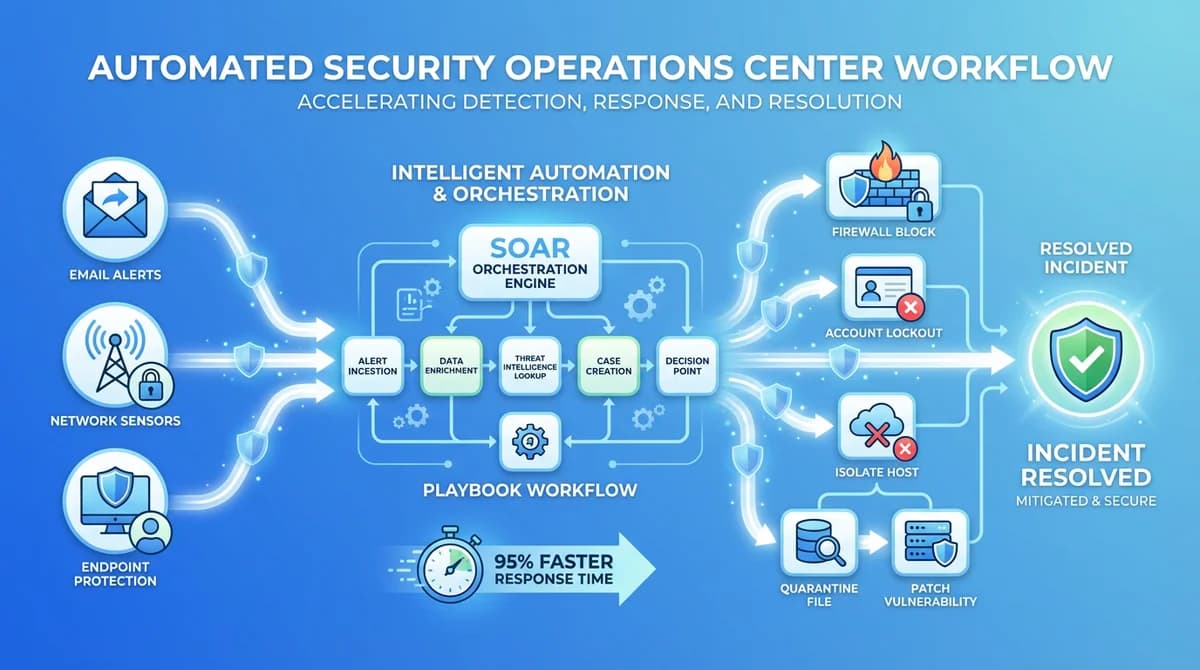
Security operations centers face an overwhelming challenge: processing thousands of alerts daily while threat actors exploit the 200-day average detection window.
Security Orchestration, Automation, and Response (SOAR) is a cybersecurity platform that integrates disparate security tools into unified workflows, automates repetitive incident response tasks, and reduces mean time to respond (MTTR) by up to 95% through predefined playbooks that coordinate threat detection, analysis, and remediation across an organization’s entire security infrastructure.
According to NIST SP 800-61r3, modern incident response requires continuous improvement and integration across all cybersecurity risk management functions – exactly what SOAR platforms deliver. The U.S. Cybersecurity and Infrastructure Security Agency (CISA) released new guidance in May 2025 emphasizing that SOAR implementation enhances visibility into network activities and enables swift, automated responses to cyber threats.
What Is Security Orchestration and Why Do Organizations Need It?
Security orchestration is the machine-based coordination of interdependent security actions across an organization’s complex infrastructure, connecting tools from multiple vendors into streamlined workflows.
Gartner defines SOAR as technologies that enable organizations to collect security inputs monitored by operations teams, combining three primary capabilities: threat and vulnerability management (orchestration), security incident response, and security operations automation. This integration addresses a critical gap – security teams manually juggle between 25+ disconnected tools when investigating a single phishing incident, according to IBM’s analysis.
Organizations need security orchestration because:
- Alert Fatigue Prevention: SOC teams receive 10,000+ alerts daily; SOAR filters false positives and prioritizes genuine threats automatically
- Talent Shortage Mitigation: With 3.4 million unfilled cybersecurity positions globally, automation handles tier-1 tasks, freeing analysts for complex investigations
- Regulatory Compliance: NIST, CISA, and ISO frameworks mandate documented, repeatable incident response processes that SOAR playbooks provide by default
- Cost Reduction: IBM’s 2024 Cost of a Data Breach report shows breaches resolved in under 200 days cost $1.02 million less – SOAR accelerates resolution
The distinction between orchestration and automation matters: automation handles single, repetitive tasks (like blocking an IP), while orchestration connects multiple automated tasks into end-to-end workflows (detect phishing → enrich indicators → isolate endpoint → notify user → update threat intelligence).
How Does Security Orchestration Work in Modern SOC Operations?
SOAR platforms operate through three integrated layers: data ingestion, orchestration engine, and response execution, processing security events from detection to resolution without manual intervention.
According to NIST’s incident response framework, effective incident response requires coordination across six functions: Govern, Identify, Protect, Detect, Respond, and Recover. SOAR platforms map directly to these functions through:
1. Data Ingestion Layer
SOAR platforms ingest alerts from:
- SIEM systems (Splunk, QRadar, ArcSight)
- Endpoint detection tools (CrowdStrike Falcon, Microsoft Defender)
- Network security (Palo Alto Networks firewalls, Cisco Secure)
- Threat intelligence feeds (MISP, ThreatConnect, Anomali)
- Cloud security (AWS GuardDuty, Azure Sentinel)
- Vulnerability scanners (Tenable, Qualys)
2. Orchestration Engine
The platform’s core processes events through:
- Alert Aggregation: Deduplicates identical alerts from multiple sources
- Enrichment: Queries threat intelligence, VirusTotal, WHOIS databases for context
- Correlation: Links related events (same IP across firewall, SIEM, EDR)
- Prioritization: Scores incidents using risk matrices and business impact
- Playbook Selection: Matches incident type to pre-built or custom response workflows
3. Response Execution
SOAR executes coordinated actions across tools:
- Containment: Isolates infected endpoints via EDR APIs
- Investigation: Collects forensic data, memory dumps, network captures
- Remediation: Blocks malicious IPs at firewall, quarantines files, resets credentials
- Documentation: Auto-generates incident tickets in ServiceNow, Jira
- Notification: Alerts stakeholders via email, Slack, PagerDuty
IBM notes that SOAR platforms use APIs, prebuilt plugins, and custom integrations to connect 200+ security tools. For example, when an EDR detects suspicious laptop activity, the SOAR automatically opens a ticket, enriches the alert with threat intelligence, triggers network detection tools to quarantine the endpoint, prompts antivirus scans, and escalates to analysts if needed – all within seconds.
What Are the Core Components of SOAR Platform Architecture?
Every SOAR solution comprises five essential components: case management dashboard, playbook builder, integration framework, analytics engine, and collaboration module.
Case Management Dashboard
The centralized console displays:
- Real-time incident queue with severity rankings
- Visual timelines showing investigation progression
- Metrics: MTTD (mean time to detect), MTTR, false positive rates
- Audit trails documenting every action and decision
- Customizable widgets for executives, analysts, managers
According to Palo Alto Networks, leading platforms like Cortex XSOAR provide intuitive drag-and-drop interfaces that less experienced analysts can navigate effectively.
Playbook Builder
Playbooks define if-then logic for incident types:
- Visual workflow designers with drag-and-drop task nodes
- Pre-built templates: phishing response, malware containment, data breach
- Conditional branching based on enrichment results
- Human approval gates for high-impact actions (network isolation)
- Version control and testing sandboxes
Integration Framework
Connectivity methods include:
- REST APIs: Standard for cloud-native tools (AWS, Office 365)
- Webhooks: Real-time event notifications
- SYSLOG/CEF: Log forwarding from legacy systems
- Python SDKs: Custom integration development
- Pre-built Connectors: 500+ vendor integrations (Splunk, ServiceNow, Cisco)
Analytics Engine
Intelligence features:
- Machine learning for anomaly detection and false positive reduction
- Behavioral analytics identifying insider threats
- Trend analysis across incident history
- Automated IOC (indicator of compromise) scoring
- Threat actor attribution using MITRE ATT&CK mapping
Collaboration Module
Team coordination tools:
- War room chat for active incidents
- Evidence sharing (screenshots, logs, PCAP files)
- Role-based access control (RBAC)
- Stakeholder notification templates
- Integration with Slack, Microsoft Teams, Zoom
CISA’s implementation guidance emphasizes that organizations should prioritize platforms offering flexible deployment (on-premises, cloud, hybrid) and horizontal scalability to accommodate growing data volumes.
What Is the Difference Between SOAR, SIEM, and XDR?
SOAR orchestrates security tools and automates responses; SIEM aggregates and analyzes log data for threat detection, and XDR extends detection capabilities across multiple layers – organizations typically deploy all three in complementary roles.
Feature | SOAR | SIEM | XDR |
Primary Function | Orchestrate tools, automate workflows | Collect logs, correlate events, generate alerts | Detect threats across endpoints, networks, cloud |
Data Scope | Alerts from all security tools | Log files, event data | Telemetry from integrated security stack |
Response Capability | Automated multi-tool workflows | Alert generation only | Automated detection-specific responses |
Integration Breadth | 200+ third-party tools | Primarily log sources | Vendor ecosystem (single or multi-vendor) |
Use Case Example | Phishing incident full lifecycle automation | Anomaly detection via log correlation | Ransomware detection and endpoint isolation |
Analyst Role | Strategic investigation and playbook tuning | Alert triage and query-based hunting | Rapid incident validation and containment |
IBM explains that SIEM arose as a compliance reporting tool that evolved into threat detection, while SOAR emerged to add orchestration, automation, and console functions that SIEMs lack. According to Fortinet, SIEM sends alerts to analysts, but SOAR takes the investigation path further through automated playbooks – reducing manual triage from hours to seconds.
XDR platforms like Microsoft Defender XDR or Palo Alto Cortex XDR provide pre-integrated detection capabilities across endpoints, networks, email, and cloud, often with built-in response automation. However, Palo Alto Networks notes XDRs handle detection-layer automation, while SOARs orchestrate responses spanning the entire security infrastructure, including non-security tools (IT ticketing, HR systems, legal notification platforms).
Integration example: SIEM detects suspicious login → alerts SOAR → SOAR queries XDR for endpoint context → automates user verification via ServiceNow → blocks account if confirmed malicious → updates threat intelligence feeds.
What Common Use Cases Demonstrate SOAR’s Practical Value?
Security orchestration delivers measurable ROI across six high-impact scenarios: phishing triage, malware containment, insider threat investigation, vulnerability management, cloud security incidents, and compliance reporting.
Phishing Response Automation
Workflow steps:
- Email security gateway (Proofpoint, Mimecast) flags suspicious email → sends to SOAR
- SOAR extracts URLs, sender info, attachments → submits to VirusTotal, URLscan
- If malicious: quarantines email across Office 365, sends phishing awareness to affected users, blocks sender domain at firewall
- If suspicious: creates investigation ticket, notifies SOC analyst with enriched context
- Updates phishing IOC database for future auto-blocking
Result: Reduces phishing response time from 45 minutes (manual) to 90 seconds (automated)
Endpoint Malware Containment
When EDR (CrowdStrike, SentinelOne) detects malware:
- SOAR isolates infected endpoint from network via EDR API
- Retrieves file hash → checks threat intelligence feeds for known malware
- If known, auto-deletes file, runs full scan, reimages system if needed
- If unknown: submits to sandbox (Cuckoo, Joe Sandbox) for detonation analysis
- Distributes new IOCs to all EDR agents, firewall, email gateway
- Notifies user and IT help desk via ServiceNow ticket
Result: Malware containment within 2 minutes vs. 6+ hours manually
Insider Threat Investigation
Triggered by anomalies (unusual data exfiltration, off-hours access):
- SOAR correlates logs across SIEM, DLP (data loss prevention), IAM (identity management)
- Retrieves user activity history, recent access changes, manager information
- Checks against HR database for termination notices or disciplinary actions
- If high-risk: disables account, alerts security and HR leadership
- If medium-risk: enables enhanced monitoring, flags for analyst review
- Documents timeline and evidence chain for potential forensics
Result: Reduces insider threat investigation time by 70%
According to IBM, organizations using SOAR identify breaches 54 days faster than those without, translating to $1.02 million in cost savings. CISA’s guidance highlights that SOAR’s automated playbooks ensure consistent application of best practices across incident types, reducing human error during high-pressure situations.
How Should Organizations Evaluate and Implement SOAR Solutions?
Successful SOAR implementation requires assessing organizational maturity, defining clear use cases, selecting platforms with robust integration capabilities, and following a phased deployment approach.
Pre-Implementation Assessment
Organizations must evaluate:
- Security Maturity: Do documented incident response procedures exist?
- Tool Inventory: Which security tools currently generate alerts? (List 10-20 key systems)
- Pain Points: What consumes the most analyst time? (Phishing triage, false positives, manual enrichment?)
- Team Skills: Do analysts have API/scripting knowledge for playbook customization?
- Budget: Account for licensing, professional services, ongoing maintenance
According to NIST SP 800-61r3, incident response policies should define roles, responsibilities, and authorities – prerequisites for effective SOAR deployment.
Platform Selection Criteria
Palo Alto Networks recommends evaluating:
Integration Breadth:
- Out-of-the-box connectors for existing security stack
- Custom integration support (SDK, API documentation)
- Community marketplace for third-party playbooks
Usability:
- Drag-and-drop playbook builder
- Real-time playbook execution monitoring
- Pre-built templates for common use cases (phishing, ransomware)
Scalability:
- Multi-tenant architecture for MSPs or large enterprises
- Horizontal scaling to handle 100,000+ alerts/day
- High availability and disaster recovery options
Threat Intelligence:
- Native TIP (threat intelligence platform) capabilities
- STIX/TAXII feed ingestion
- Automated IOC enrichment and scoring
Compliance Support:
- Audit trail generation
- Report templates (PCI-DSS, HIPAA, GDPR)
- Evidence preservation for forensics
Phased Implementation Roadmap
Phase 1: Quick Wins (Months 1-2)
- Deploy SOAR with SIEM and top 3 alert-generating tools
- Implement 2-3 high-volume playbooks (phishing auto-triage, IP reputation checks)
- Measure baseline metrics: alerts/day, average triage time, false positive rate
Phase 2: Expansion (Months 3-6)
- Integrate EDR, firewall, threat intelligence feeds
- Build custom playbooks for organization-specific threats
- Enable analyst self-service playbook modifications
- Conduct tabletop exercises testing automated response workflows
Phase 3: Optimization (Months 7-12)
- Integrate non-security tools (ServiceNow, Jira, HR systems)
- Implement machine learning for anomaly detection
- Establish metrics dashboards for executive reporting
- Create continuous improvement process: monthly playbook reviews
CISA’s practitioner guidance emphasizes starting with a narrow scope – automating the single most time-consuming manual task – then expanding incrementally as teams gain confidence.
Common Implementation Pitfalls
- Over-automation: Automating containment actions without human approval gates risks disrupting business operations
- Integration Overload: Connecting 50+ tools on day one creates complexity; prioritize alert sources
- Playbook Rigidity: Overly prescriptive playbooks fail when attackers deviate from expected patterns
- Insufficient Training: Analysts must understand playbook logic to troubleshoot failures
- Neglecting Maintenance: Playbooks require quarterly reviews as threats and tools evolve
IBM recommends starting with fully manual playbooks, then gradually enabling automation for low-risk tasks, reserving high-impact actions (network isolation, account deletion) for analyst approval until confidence builds.
FAQ: People Also Ask
What is the difference between SOAR and security automation?
Security automation executes individual repetitive tasks like blocking IPs or quarantining files, while SOAR orchestrates multiple automated tasks across different security tools into complete incident response workflows – automation is a component within SOAR’s broader orchestration capabilities.
How long does SOAR implementation take?
Initial SOAR deployment typically requires 2-4 months for basic functionality with 3-5 integrated tools, expanding to 6-12 months for comprehensive implementation across the entire security stack, depending on organizational complexity, existing documentation, and analyst skill levels.
Can SOAR replace security analysts?
No – SOAR platforms handle repetitive tier-1 tasks (alert enrichment, IOC lookups, ticket creation), freeing analysts for tier-2/3 work requiring human judgment: complex threat hunting, adversary behavior analysis, incident impact assessment, and strategic security program improvements.
What is the ROI of implementing SOAR?
Organizations typically see 90-95% reduction in alert triage time, 50-70% decrease in false positives, and $1.02 million average cost savings through faster breach resolution (under 200 days), according to IBM’s 2024 Cost of a Data Breach report.
Do SOAR platforms work with cloud security tools?
Yes – modern SOAR solutions integrate with AWS GuardDuty, Azure Sentinel, Google Chronicle, and multi-cloud security platforms through REST APIs, providing unified orchestration across hybrid cloud, on-premises, and SaaS environments.
Conclusion
Security orchestration transforms reactive security operations into proactive, automated defense systems. By integrating disparate tools, automating tier-1 analyst tasks, and enabling consistent incident response through playbooks, SOAR platforms address the talent shortage, alert fatigue, and slow response times plaguing modern SOC teams. Organizations implementing SOAR report 95% faster triage, million-dollar cost savings, and analyst capacity to focus on strategic threat hunting rather than manual alert processing.
Related Articles

Oct 9, 2026
I replied to a phishing email. Am I at risk?
Replied to a phishing email? Learn what risks you face, what attackers can learn from your reply, and what to do next to protect your account and business.

Oct 8, 2026
Real or Fake? How to verify a sharepoint file invitation
Received a SharePoint file invitation? Learn how to spot fake SharePoint emails, verify shared files safely, and protect your Microsoft 365 account from phishing.

Oct 1, 2026
I paid a fake invoice. What should my business do?
Paid a fake invoice? Learn what your business should do immediately to contact the bank, preserve evidence, secure accounts, investigate the fraud, and reduce further losses.

Protect your business with ShieldNet 360
Get started and learn how ShieldNet 360 can support your business.