
Mar 24, 2026
BlogPractical guide 24/7 security monitoring for small business
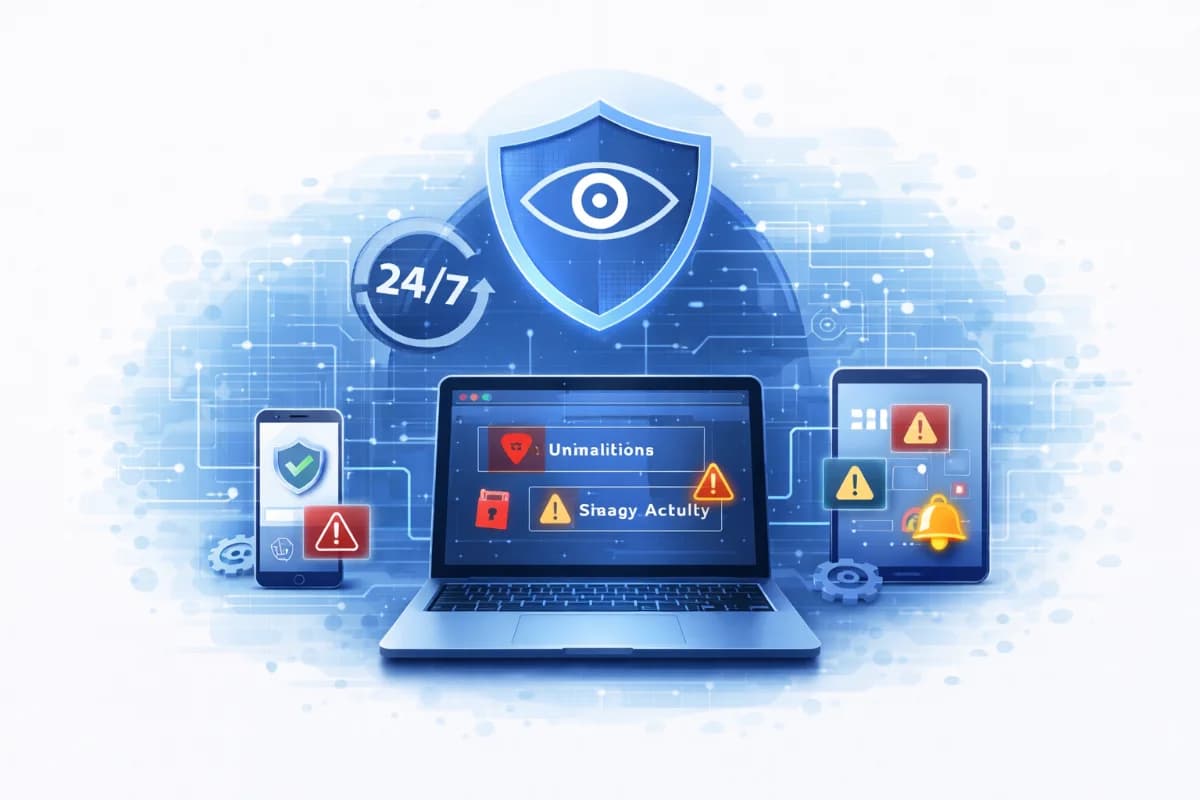
24/7 security monitoring for small business defines good monitoring for lean teams, with plain-language alerts, continuous security monitoring, and automation.
If your team is small and nobody is on a night shift, 24/7 security monitoring for small business is the most practical way to reduce “overnight blind spots.” Good monitoring is not about collecting every log; it is about continuously spotting high-risk signals, explaining them in plain language, and triggering safe, automated actions before an incident spreads. Many small companies already use cloud email, endpoints, and SaaS apps, but they still miss early warning signs because alerts are noisy and hard to interpret.
Why this topic matters
SMEs face the same threat landscape as large enterprises phishing, account takeover, ransomware, and data exposure but they rarely have the budget or staffing to run a traditional security operations center. A classic SOC relies on analysts monitoring alerts around the clock, escalating incidents, and coordinating response. For a small business, that usually means one or two people trying to do security on top of everything else, which creates alert fatigue and slow response. Attackers exploit that gap, especially at night and on weekends when nobody is watching.
A realistic scenario is a finance email compromise that starts late Friday. An attacker logs in, creates forwarding rules, searches invoices, and attempts payment fraud. If alerts are not triaged quickly, the attacker has hours to act. AI SOC for SMEs matters because it compresses that window by detecting suspicious behavior, analyzing context, investigating related activity, and recommending or executing response steps before the incident becomes a business crisis. This is the practical reason “night shifts” are being replaced: not because humans are unnecessary, but because automation and AI can cover the first response loop reliably when people are offline.
Key factors and features to consider
Virtual SOC: outcomes without building a full team
A virtual SOC is a model where SOC outcomes are delivered without an in-house 24/7 analyst team. For SMEs, a virtual SOC typically combines technology-driven detection with standardized workflows and escalation paths, sometimes supported by external experts for complex cases. The key point is outcome-based coverage: you still get triage, investigation, and response guidance even if you do not employ full-time analysts. A well-run virtual SOC also produces consistent evidence and incident records, which helps with customer security reviews and compliance requirements.
SOC automation: turning scattered alerts into one incident
SOC automation is the capability to collect alerts from multiple systems, correlate them, enrich them with context, and group them into a single incident. SMEs often have alerts across email, endpoints, identity systems, and cloud services, but those alerts appear in different dashboards and lack a shared narrative. SOC automation reduces noise by stitching signals together and prioritizing incidents based on risk. For a small business, the practical value is fewer “false emergencies” and faster decisions on the few incidents that actually matter.
SOC for small business: plain-language incidents and guided actions
SOC for small business must be designed for generalists, not for specialist analysts. That means incidents should be described in plain language: what happened, why it matters, what data or systems are at risk, and what actions are recommended. When the incident is understandable, response becomes faster and more consistent. A strong AI SOC for SMEs also supports safe automation – actions that reduce risk without breaking operations – such as revoking suspicious sessions, forcing re-authentication, or quarantining malicious emails.
The detect→analyze→investigate→response loop
SOC outcomes can be explained as a loop with four steps: detect, analyze, investigate, and response. Detect means spotting signals that suggest compromise or policy violation. Analyze means determining severity by adding context like user role, asset criticality, and known patterns. Investigate means connecting related events to scope the incident and confirm what changed. Response means containment and recovery actions, plus documentation and follow-up tasks to prevent recurrence. AI SOC for
SMEs focuses on making this loop fast and repeatable, because speed and consistency are what reduce business impact.
Evidence and accountability: proving what happened
SMEs increasingly need to prove their security posture to customers and partners. An AI SOC for SMEs should generate evidence automatically: incident timelines, actions taken, approvals, and supporting logs. This reduces the burden on small teams and makes audits and customer questionnaires easier. Evidence also supports continuous improvement, because you can review what happened and adjust playbooks and controls based on real incidents.
Detailed comparisons or explanations
Traditional in-house SOC vs AI SOC for SMEs
A traditional in-house SOC involves hiring analysts, building monitoring infrastructure, running shifts, and maintaining processes for escalation and incident handling. For most SMEs, this is expensive and operationally heavy, and it can still fail if analysts are overwhelmed by alert noise. AI SOC for SMEs aims to deliver similar outcomes with fewer people by using correlation, enrichment, and automation to reduce manual work. Humans still matter, especially for complex investigations, but the routine triage and first response loop can be handled more consistently through automation.
An SME-friendly comparison is response speed. In-house SOC coverage is strong if you truly staff it 24/7, but many SMEs cannot. Without 24/7 coverage, response may be delayed until business hours, which increases downtime impact. AI SOC for SMEs can provide after-hours detection and initial containment steps, reducing the attacker’s time window. This is why many organizations view it as a replacement for night shifts: it provides reliable first-line coverage when humans are not available.
How virtual SOC and SOC automation work together
A virtual SOC model needs SOC automation to be effective at SME scale. Automation collects signals, builds incidents, and prioritizes them, while the virtual SOC workflow defines who is notified, what actions are taken, and when escalation occurs. In practical terms, automation turns raw data into an incident story, and the virtual SOC process ensures that story results in action. SMEs benefit because the incident is routed to the right person with clear steps, instead of being lost in alert noise.
For example, a suspicious sign-in alone may not be urgent, but combined with mailbox rule creation and unusual file downloads it becomes a clear account takeover incident. SOC automation groups these signals and flags severity. The virtual SOC process then triggers response steps, such as revoking sessions and checking whether sensitive data was accessed. This combination is the operational heart of AI SOC for SMEs: fewer alerts, more coherent incidents, and faster containment.
Mapping the SOC loop to a ShieldNet-style workflow
A practical workflow like ShieldNet Defense can be understood as four connected stages aligned to SOC outcomes. Detection collects signals from endpoints, cloud, SaaS, and identity activity and flags suspicious patterns. Analysis converts logs into plain-language insights and severity, so a small business can understand what is happening without reading raw events. Investigation links related events into a single incident, showing scope, timeline, affected accounts, and likely attack path. Response then executes or guides safe actions, documents the incident, and creates follow-up tasks like access reviews, rule changes, and preventive improvements.
This mapping matters because SMEs do not want “more alerts.” They want fewer, clearer incidents and a reliable path from alert to action. A ShieldNet-style approach emphasizes clear alerts, evidence, and guided response so teams can move fast. It also supports continuous improvement by showing patterns across incidents, such as repeated credential attacks or risky sharing behavior. In practice, that is what makes AI SOC for SMEs feel like having a real SOC without hiring a full night shift.
Best practices and recommendations
· Start by defining your top incident types: account takeover, ransomware risk, data exposure, and malware on endpoints
· Choose SOC automation that can correlate alerts across identity, email, endpoints, and cloud services into one incident
· Require plain-language incidents with clear severity, impact summary, and recommended actions for SOC for small business teams
· Implement safe response automation first: session revocation, forced re-authentication, email quarantine, and evidence capture
· Maintain playbooks and escalation rules so the virtual SOC model remains consistent and measurable
· Review monthly metrics: time-to-triage, time-to-contain, false positives, and after-hours incident coverage
To apply these recommendations, SMEs should start with a small number of workflows that cover the most common and most damaging outcomes. Build playbooks that specify the first 30 minutes of action and the evidence to collect, then configure SOC automation to gather that evidence automatically. Keep high-impact actions behind approvals until you have confidence in detection accuracy. Over time, tune rules and playbooks based on real incident outcomes so the AI SOC for SMEs improves rather than becoming another noisy alert system.
· Safe automation examples: collect logs, group alerts into incidents, tag severity, revoke sessions, force re-authentication, quarantine suspicious messages
· High-risk actions requiring approval: disable critical accounts, block broad domains, isolate key servers, revoke wide vendor access
· Evidence artifacts to keep: incident timeline, affected accounts and systems, actions taken, approvals, and remediation tasks
These lists help SMEs implement AI SOC outcomes without causing business disruption. Safe automation reduces repetitive work and shortens the attacker’s time window, especially after hours. Approval gates prevent accidental outages when detections are still being tuned. Evidence artifacts support compliance and customer trust because you can demonstrate what happened and what you did in a consistent, reviewable format.
FAQ
Is AI SOC for SMEs the same as a virtual SOC?
AI SOC for SMEs and a virtual SOC are related but not identical. A virtual SOC describes the delivery model – SOC outcomes delivered without building a full in-house team – while AI SOC for SMEs describes how those outcomes are achieved using correlation, automation, and AI-driven analysis. Many virtual SOC offerings use SOC automation and AI to scale triage and investigation. SMEs should evaluate both the technology workflow and the service escalation model if external experts are involved.
What does SOC automation actually automate?
SOC automation typically automates the repetitive parts of incident handling: collecting alerts, correlating them into incidents, enriching with context, routing to owners, and recording evidence. It can also automate safe response actions like revoking sessions or quarantining malicious emails. The most effective automation reduces manual copy-paste work and reduces time-to-triage. SMEs should focus on
automation that improves clarity and speed, not automation that blindly blocks business activity.
How does SOC for small business differ from enterprise SOC?
SOC for small business must be simpler, more guided, and less reliant on specialist skills. Incidents must be understandable in plain language and mapped to practical actions that a lean team can execute quickly. Enterprise SOCs often assume dedicated analysts and complex tooling, while SMEs need fewer dashboards and more standardized playbooks. This is why AI SOC for SMEs focuses on clear incident narratives and safe automation, not on raw alert volume.
What are the most important outcomes in the loop?
The most important outcome is speed with accuracy: detecting meaningful signals, analyzing severity with context, investigating scope to avoid under- or over-reacting, and responding with safe containment steps. For SMEs, the loop should produce a small number of high-confidence incidents rather than many low-value alerts. Evidence capture is also critical because it supports customer reviews and compliance. A strong AI SOC for SMEs makes the loop repeatable so results do not depend on who is on call.
When should an SME adopt an AI SOC model?
SMEs should consider AI SOC for SMEs when alert volume is creating fatigue, when incidents are discovered late, or when after-hours coverage is a consistent gap. Another trigger is enterprise customer pressure: security questionnaires and audit readiness requirements are easier when you have consistent incident workflows and evidence. If you do not have basic foundations like strong login verification and tested backups, implement those first, because they reduce risk regardless of SOC maturity. Once foundations exist, AI SOC can multiply effectiveness by making detection and response faster.
Conclusion
AI SOC for SMEs delivers SOC outcomes: detect, analyze, investigate, and response without requiring SMEs to run night shifts or build a full in-house SOC. By combining a virtual SOC model with SOC automation, SMEs can turn scattered alerts into plain-language incidents, execute safe response actions, and capture evidence consistently. A ShieldNet style workflow shows how the SOC loop can be operationalized: detection gathers signals, analysis explains them, investigation scopes impact, and response guides or automates containment. If you want a practical next step, define your top
incident types and evaluate AI SOC for SMEs solutions based on correlation quality, plain-language incident clarity, safe automation, and evidence output.
Related Articles
Mar 23, 2026
Zero Trust Network Access Explained: What SMEs Need to Know
Zero Trust Network Access (ZTNA) explained for SME compliance officers: how it works, why it beats VPNs, and how to implement it without an in-house IT team.
Mar 23, 2026
Stealer Malware: How It Steals Passwords and What to Do First
Stealer malware silently steals your passwords, cookies, and business credentials in minutes. Learn how it works and follow this action-first response playbook for SMEs.
Mar 20, 2026
What is a security automation platform for SMEs?
Security automation platform for SMEs: security orchestration, automated incident response, and security playbooks that turn alerts into clear incident workflows.

Protect your business with ShieldNet 360
Get started and learn how ShieldNet 360 can support your business.