
Apr 6, 2026
BlogAI threat detection: how it works and when to trust it in 2026
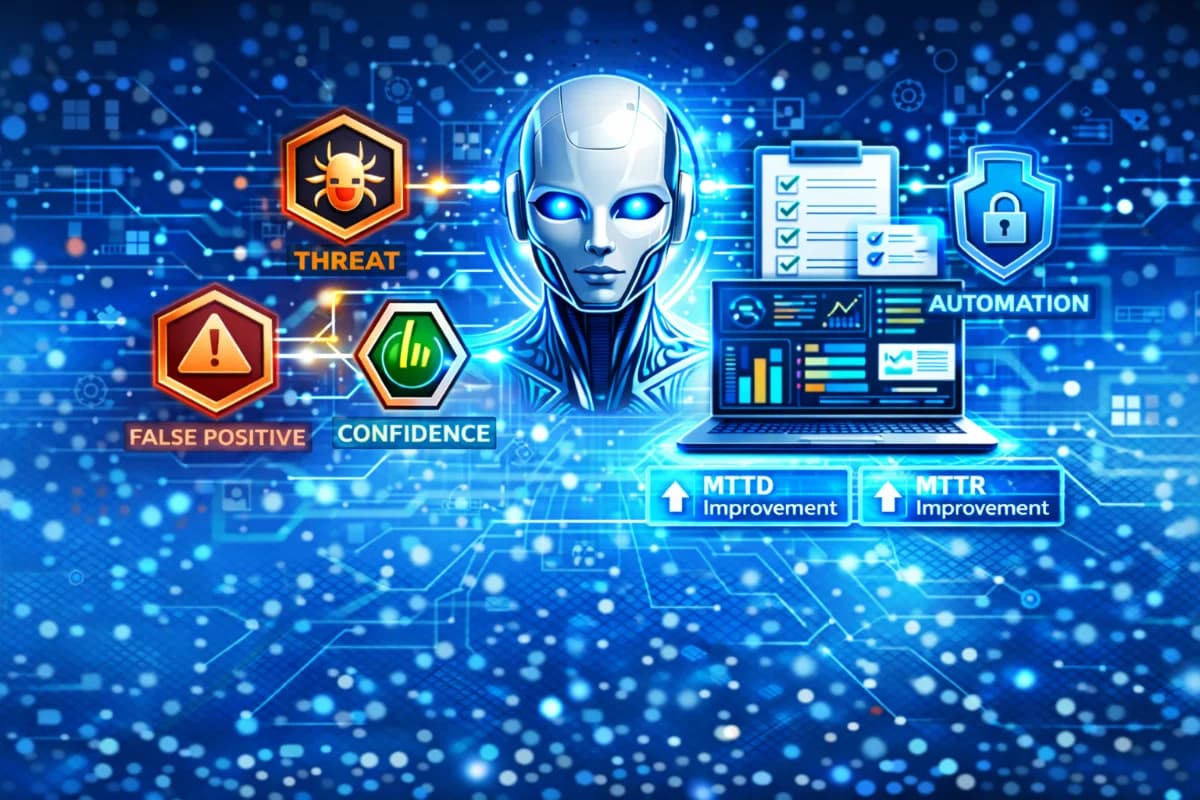
AI threat detection explained: AI driven detection, threat detection automation, false positive reduction, and improving MTTD and MTTR with signals, confidence, and lean team workflows.
AI threat detection sounds like a magic layer that “spots attacks automatically,” but the reality is more useful and more limited. AI based detection can help lean teams catch suspicious patterns faster by correlating signals, ranking confidence, and reducing alert noise. It can also support threat detection automation by collecting evidence, grouping alerts into incidents, and triggering safe response steps. What it cannot do is guarantee correctness without good telemetry, eliminate human judgment in complex incidents, or replace foundational controls like strong sign ins and recovery testing. This article explains how AI threat detection works, what “confidence” really means, how false positive reduction is achieved in practice, and when you should trust AI driven detection enough to automate actions that improve MTTD and MTTR.
Why this topic matters
SMEs are increasingly adopting AI cybersecurity tools because they cannot hire full SOC teams. The real business need is speed and consistency: reduce time to detect and reduce time to respond so incidents do not become outages or customer crises. However, trusting AI blindly can be risky, and distrusting it completely wastes its value. The right approach is to understand what signals AI uses, how confidence is formed, and how to operationalize alerts with guardrails so the team acts quickly without breaking the business.
A realistic example is cloud email compromise. A single “suspicious sign in” alert may be benign, but suspicious sign in plus mailbox rule creation plus unusual downloads in a short window is a strong pattern. AI driven detection can connect those pieces and raise confidence, shrinking MTTD. If the incident narrative is clear, the team can revoke sessions quickly, shrinking MTTR by limiting scope. This is why learning when to trust AI threat detection is a practical operating skill for lean teams, not a theoretical debate.
Key factors and features to consider
What AI driven detection actually does under the hood
AI driven detection generally combines three capabilities: pattern recognition, correlation, and summarization. Pattern recognition flags sequences that match known attack behaviors, such as credential misuse followed by privilege escalation. Correlation links events across systems identity, email, endpoints, cloud apps so one incident is created instead of many isolated alerts. Summarization converts complex telemetry into a plain language story with key evidence, which reduces cognitive load for operators.
For SMEs, the most valuable part is correlation and summarization, not “mystical AI.” When a platform can turn scattered signals into a coherent incident, responders act faster and false positives drop because single noisy events are not escalated alone. This is also where a workflow like ShieldNet Defense can be relevant: it can present incidents in plain language, attach evidence, and recommend safe actions so non specialists can move quickly. The technology matters, but the operational output matters more.
Signals: what AI can detect well, and what it struggles with
AI threat detection performs best when signals are consistent and high quality. Strong signals include unusual login patterns, new device sign ins, suspicious email rule changes, abnormal data access, unusual process behavior on endpoints, and unexpected outbound connections. These signals can be combined into behavioral chains that increase confidence. AI struggles when telemetry is missing, when environments are highly unique without baselines, or when activity is encrypted and not observable without context.
A practical rule is that AI is more reliable at detecting changes and sequences than at labeling single events as “malicious.” One login from a new IP can be normal; a new login plus multiple failed attempts plus immediate permission changes is more meaningful. Lean teams should therefore prefer detection strategies that require multiple supporting signals. This improves false positive reduction and creates incidents that are worth interrupting someone’s day for.
Confidence: when to trust an alert enough to act
Confidence is the platform’s estimate of how likely an alert represents a real incident. It should be based on evidence quantity, signal quality, and the match to known attack patterns. Confidence is not certainty, and SMEs should not treat it as a guarantee. The right way to use confidence is to map it to actions: low confidence triggers evidence collection and monitoring, medium confidence triggers human review and limited containment, and high confidence triggers safe automated actions.
A good system explains why confidence is high, using human readable evidence. For example, “new device login for finance account” plus “mailbox rule created” plus “mass download of attachments” is an explainable chain. If the platform cannot show why it assigned confidence, it will not be trusted. Trust comes from transparency and repeatability, not from AI branding.
False positive reduction: how good systems reduce noise
False positive reduction is achieved through correlation, baselining, and suppression of known benign patterns. Correlation reduces noise by requiring multiple signals before escalating severity. Baselining learns what is normal for roles and devices, so predictable activity like backups or scheduled sync does not generate urgent incidents. Suppression and allowlists prevent repetitive benign alerts from wasting attention. In practice, SMEs should expect a tuning period where baselines stabilize and noisy detections are adjusted.
A practical way to measure false positive reduction is “alert to incident conversion rate”: what percentage of alerts become real incidents worth investigating. If a platform produces many alerts but few incidents, it will create alert fatigue and slow response. Lean teams should demand tools that produce fewer, higher confidence incidents and make it easy to review and tune. This is the operational difference between AI that helps and AI that distracts.
Threat detection automation: what to automate safely
Threat detection automation should start with actions that are low risk and reversible. Examples include collecting evidence, grouping related alerts, tagging severity, opening a ticket with context, quarantining a suspicious email, and revoking a suspicious session. More disruptive actions disabling critical accounts, isolating servers, blocking broad network ranges should require approval until confidence and false positives are well understood. The objective is to shrink time to first containment without creating self inflicted outages.
When automation is applied with guardrails, it improves MTTD and MTTR indirectly. It improves MTTD by making high confidence incidents visible quickly, and it improves MTTR by limiting scope early through safe containment. Lean teams benefit because the first response loop happens quickly even after hours. Over time, these workflows become a predictable operating system rather than a manual scramble.
Detailed comparisons or explanations
When AI based detection is reliable
AI based detection is most reliable for common, high signal attack chains where telemetry is rich and patterns are well understood. Examples include account takeover sequences, ransomware like endpoint behavior, suspicious privilege changes, and unusual data access patterns. In these cases, AI can correlate signals faster than humans and present an incident story that supports quick action. SMEs should trust AI more in these scenarios because the evidence is strong and the outcomes are time sensitive.
Reliability also depends on environment maturity. If you have strong sign in protection, clear identity logs, and consistent endpoint telemetry, AI driven detection can produce stable baselines and fewer false positives. If logs are incomplete or identities are shared, confidence scoring becomes less meaningful. The key is to treat AI as a multiplier of good telemetry and good hygiene, not as a replacement for them.
When AI based detection can mislead
AI can mislead when it sees partial data, when normal business processes look “weird,” or when attackers intentionally mimic normal behavior. For example, a seasonal sales campaign can produce unusual login volumes and data access that looks suspicious without business context. AI may also over rank rare but benign anomalies if baselines are immature. In encrypted environments, network signals can be limited, so AI may infer more than it truly knows unless it has other corroborating telemetry.
SMEs should mitigate this by adding business context, using allowlists for known operations, and keeping humans in the loop for medium confidence incidents. Avoid making irreversible decisions based solely on AI confidence. Instead, use confidence thresholds and staged automation. This approach keeps you safe from automation errors while still benefiting from faster triage and evidence gathering.
Operationalizing AI alerts for lean teams
To operationalize AI alerts, SMEs need a simple playbook mapping confidence to action. High confidence incidents trigger safe automation and immediate notification to the incident owner. Medium confidence incidents trigger human review within a defined time window, with evidence pre attached. Low confidence incidents are logged and monitored, with additional evidence collection enabled. This prevents alert fatigue and preserves speed for the incidents that matter.
A good operational model also includes a weekly tuning cadence. Review false positives, adjust baselines, and add or refine detection chains based on real outcomes. Track MTTD and MTTR trends to ensure the system is improving, not drifting. If using ShieldNet Defense, the platform can support this by producing incident timelines, plain language summaries, and action logs that make tuning and executive reporting easier. The tool helps, but the cadence makes it sustainable.
Best practices and recommendations
- Ensure telemetry quality before judging AI: identity logs, email activity, endpoint signals, and critical cloud events
- Use correlation based detections that require multiple signals to reduce false positives
- Map confidence levels to staged actions: observe, review, contain, and recover
- Automate safe, reversible steps first and keep disruptive actions behind approvals
- Track KPIs monthly: MTTD, MTTR, alert volume, and alert to incident conversion rate
- Run quarterly drills using your top incident chains to validate workflows and response speed
To implement this, start with two high impact incident chains such as account takeover and ransomware suspicion. Define what evidence must be attached automatically and what the first containment action should be. Configure automation to collect evidence and execute safe actions for high confidence incidents, and require human review for medium confidence. Then run a monthly review to tune thresholds and baselines until alert volume is manageable. This is how AI threat detection becomes trustworthy: not by being perfect, but by being consistent and explainable.
- Safe automations to start: evidence collection, incident grouping, severity tagging, session revocation, email quarantine
- Actions to gate with approvals: disabling privileged accounts, isolating critical servers, blocking broad domains
- Evidence to standardize: incident timeline, affected identities, affected devices, data access summary, actions taken
These lists help SMEs implement threat detection automation without risking self inflicted downtime. Safe automations reduce attacker dwell time while remaining reversible. Approval gates protect critical operations while you build trust in confidence scoring. Standardized evidence improves both investigation speed and post incident accountability. Together, these practices make AI driven detection usable for lean teams.
FAQ
Can AI threat detection replace a SOC team?
AI threat detection can reduce the need for a large SOC team by automating correlation, enrichment, and first response steps, but it does not fully replace human judgment. Complex incidents still require investigation, business context, and careful containment decisions. For SMEs, AI is best used to handle routine triage and to surface high confidence incidents quickly. Humans remain essential for edge cases and for approving disruptive actions.
How do I know when to trust AI driven detection?
Trust AI driven detection when it provides transparent evidence, correlates multiple signals into one incident, and has a proven false positive reduction process. Use confidence thresholds to decide actions rather than treating AI as certain. Validate trust through pilots and by tracking MTTD and MTTR improvements over time. If the platform consistently produces clear incident narratives that lead to correct containment, trust can expand gradually.
What KPIs show AI is helping?
The most useful KPIs are reduced MTTD, reduced MTTR, lower alert volume, and improved alert to incident conversion rate. If AI is working, you should see fewer noisy alerts and faster time to first containment for high severity incidents. You should also see more consistent evidence attached to incidents, reducing investigation time. These operational improvements matter more than model accuracy claims.
How should SMEs handle false positives?
SMEs should handle false positives through correlation, baselining, allowlists, and staged automation. Require multiple signals before escalating severity, and tune detections monthly based on real outcomes. Keep medium confidence incidents in human review until baselines stabilize. This approach protects operations while the system learns what is normal for your environment.
How does ShieldNet Defense relate to AI threat detection?
ShieldNet Defense can be positioned as an AI first workflow that emphasizes correlation, plain language incident narratives, evidence timelines, and safe automation. For lean teams, it helps operationalize AI alerts by providing clear “what happened” stories and recommended actions, reducing cognitive load. It also supports reporting and tuning by keeping action logs and evidence consistent. The same trust principles apply: evaluate it on evidence, visibility, false positives, and response outcomes.
Conclusion
AI threat detection works best as a correlation and automation engine: it connects signals into incidents, assigns confidence based on evidence, reduces noise, and triggers safe response steps that improve MTTD and MTTR. It cannot replace good telemetry, foundational controls, or human judgment in complex cases, so SMEs should trust it gradually with staged automation and clear confidence to action mapping. By standardizing evidence, tracking KPIs, and tuning monthly, lean teams can make AI driven detection both trustworthy and operational. If you want a practical next step, pick two incident chains, define safe automations, and use a platform such as ShieldNet Defense to deliver plain language incidents and consistent evidence that supports fast, calm response.
Related Articles

Oct 9, 2026
I replied to a phishing email. Am I at risk?
Replied to a phishing email? Learn what risks you face, what attackers can learn from your reply, and what to do next to protect your account and business.

Oct 8, 2026
Real or Fake? How to verify a sharepoint file invitation
Received a SharePoint file invitation? Learn how to spot fake SharePoint emails, verify shared files safely, and protect your Microsoft 365 account from phishing.

Oct 1, 2026
I paid a fake invoice. What should my business do?
Paid a fake invoice? Learn what your business should do immediately to contact the bank, preserve evidence, secure accounts, investigate the fraud, and reduce further losses.