
Apr 10, 2026
BlogAccess Sprawl: The Hidden Risk Growing Companies Ignore
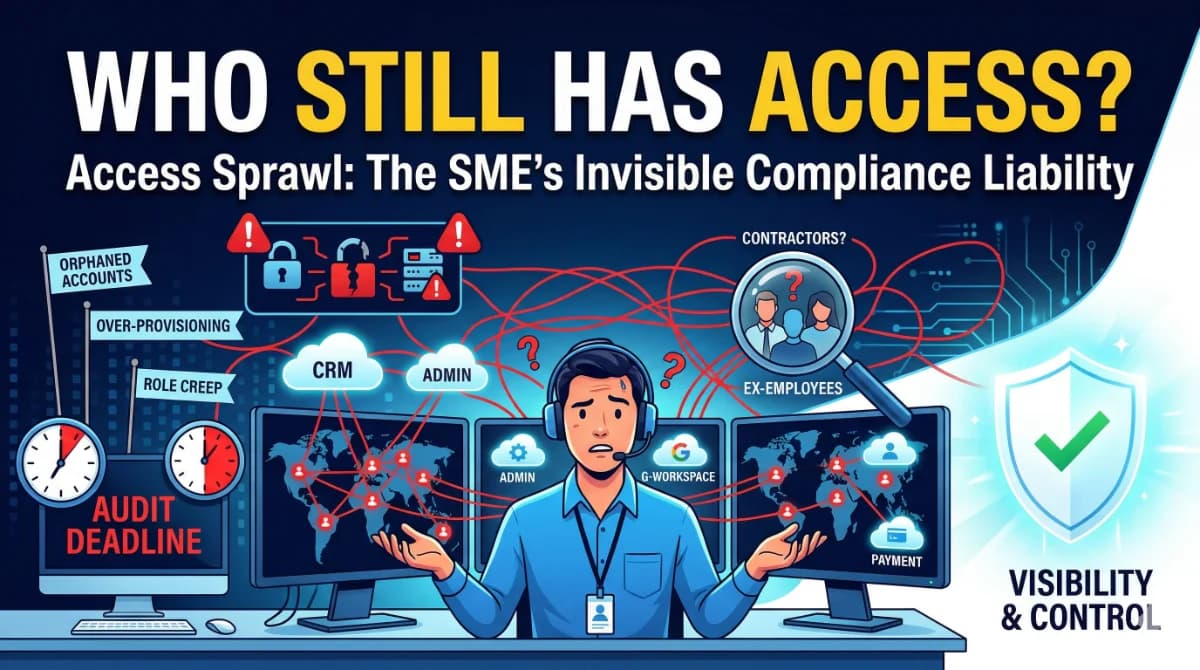
Every compliance audit has the same awkward moment: someone asks who still has access to your financial systems – and no one in the room knows for certain.
Access sprawl is what happens when employee permissions accumulate faster than they are reviewed: contractors who were never offboarded, developers with admin rights they no longer need, and shared accounts that exist across three SaaS tools. Left unchecked, this invisible permission creep becomes your single biggest compliance and security liability – and most SMEs only discover it during a breach or a failed audit.
This article explains what access sprawl is, why it is escalating rapidly, how it exposes growing companies to breaches and compliance failures, and what a practical remediation looks like for teams without dedicated security staff.
What Is Access Sprawl – and Why Is It Getting Worse?
Access sprawl refers to the uncontrolled accumulation of user permissions across systems, applications, and accounts over time. Each time a new SaaS tool is onboarded, a contractor is given a login, or a team member changes roles, access is created. The problem is that access is rarely revoked with the same urgency.
When a user logs in to an SSO provider once in the morning, they may gain access to dozens of different systems simultaneously. A developer's personal access token alone can trigger production workflows through connected integrations – creating a chain of exposure no single person ever consciously approved.
This is not a problem unique to large enterprises. For fast-growing SMEs – fintech companies, SaaS startups, digital agencies – access sprawl accelerates precisely because growth is fast. New team members are onboarded in hours. Contractors come and go. Access is granted to close a deal, hit a deadline, or unblock a sprint – and is almost never reviewed afterward.
The core causes fall into four patterns:
- Orphaned accounts: Former employees and contractors whose access was never revoked
- Role accumulation: Employees who changed departments but retained all previous permissions
- Over-provisioning: New joiners given broad admin access "just in case"
- SaaS fragmentation: Each new tool creating a new identity silo with its own access policy
According to the SANS Institute, authorization sprawl – where users hold redundant or excessive permissions across cloud, SaaS, and hybrid environments – has become a critical vulnerability, creating hidden attack paths that adversaries can exploit without raising immediate alarms. In May 2025, SANS named it one of the top five most dangerous emerging attack techniques of the year.
Why Access Sprawl Is a Compliance Time Bomb
For compliance officers at SMEs, access sprawl is not just a technical problem – it is a direct audit failure waiting to happen.
Frameworks including ISO 27001, SOC 2, GDPR, and PCI DSS all contain access control requirements that presuppose you know who has access to what. Specifically:
- ISO 27001 (A.9) requires formal user access provisioning, periodic access reviews, and removal of access rights upon termination
- GDPR (Article 32) requires appropriate technical measures to ensure data access is restricted to authorized personnel
- PCI DSS (Requirement 7) mandates that access to system components is restricted based on business need-to-know
If your access control records cannot answer the question "who accessed the payment dashboard last Tuesday and why?" – you are not audit-ready. Regulatory frameworks like GDPR, SOC 2, and HIPAA require strict access control and auditability, and untracked permissions make demonstrating compliance nearly impossible.
The financial exposure compounds this. The Verizon 2025 Data Breach Investigations Report, which analyzed over 22,000 security incidents, found that credential abuse accounted for 22% of all confirmed breaches – making it the single most common initial attack vector. When access sprawl leaves over-privileged accounts sitting dormant, those accounts become the cheapest and quietest route an attacker can take.
Human error was a contributing factor in 60% of breaches analyzed in the 2025 DBIR – and third-party involvement in breaches doubled year-over-year, now accounting for 30% of all cases. For an SME that shares system access with partners, freelancers, or managed service providers, both of these vectors are directly tied to unmanaged access permissions.
How Attackers Exploit Access Sprawl – Without Triggering Alerts
One of the most dangerous aspects of access sprawl is that it is nearly invisible to traditional security tools. Anti-malware, firewalls, and even SIEM platforms are designed to flag unusual behavior – but when an attacker is using a legitimately provisioned account, the behavior looks normal.
When attackers use a victim's SSO access, endpoint detection tools see only a standard browser making standard HTTPS connections – normal activity that occurs thousands of times daily. Attackers can access session cookies, OAuth tokens, and browser-stored credentials without triggering any alerts, because strong authentication only protects the initial login, not the session tokens that follow.
This is the attack pattern that SANS Fellow Joshua Wright traced through real-world breaches involving groups like Scattered Spider and LAPSUS$, which targeted organizations including major retailers and financial institutions. The attack starts with acquiring authorized user credentials, which then allow an attacker to pivot from user workstations all the way into network infrastructure – with their primary tool being nothing more than a web browser.
For a growing fintech company in Dubai with developers, contractors, and a remote team all holding Microsoft 365 or Google Workspace access, this is not a theoretical risk. It is the exact environment these attackers target.
Three specific scenarios where access sprawl creates immediate exposure:
- Departed employee accounts: A contractor who worked on your payment integration still has an active Google Workspace login three months later. That account can be phished, credential-stuffed, or purchased on a dark web broker.
- Excessive admin rights: A developer given temporary admin access during a cloud migration was never downgraded. That account, if compromised, has full system access.
- SaaS orphan tokens: An integration your team stopped using still has an active OAuth token connected to your CRM. That token silently grants API access.
What "Controlling Access Sprawl" Actually Looks Like for an SME
Most enterprise-grade IAM guidance assumes you have a dedicated identity team and a $200,000 tooling budget. For an SME compliance officer or IT manager running lean, the practical approach is different.
The goal is not perfection – it is visibility followed by enforcement.
Step 1 – Conduct an access audit Pull a list of every active user account across all systems: Microsoft 365, Google Workspace, your CRM, cloud admin panels, payment processor dashboards. Compare it to your current employee and contractor list. Every account not on that list is an orphan and should be disabled immediately.
Step 2 – Apply the principle of least privilege Every user should have the minimum access required to do their job – nothing more. This means reviewing admin-level accounts specifically and demoting where the privilege is no longer justified. NIST SP 800-53 Control AC-6 defines least privilege as the formal standard for access control across regulated systems.
Step 3 – Enforce identity-based access with continuous verification The most effective countermeasure against access sprawl is shifting from static, password-based access to continuous identity verification – validating not just who is logging in, but whether that device and identity should be trusted for each session, each time.
Step 4 – Implement offboarding as a security process Every employee and contractor departure should trigger a formal access revocation checklist. This includes SSO accounts, individual SaaS logins, API keys, and shared accounts.
Step 5 – Review access quarterly Access control is not a one-time project. Build a quarterly access review into your compliance calendar and document it – this documentation is exactly what ISO 27001 auditors and SOC 2 reviewers will ask to see.
Comparison: Traditional VPN-Based Access vs. Identity-Based Access Control
Managing access sprawl at scale requires a shift in how access itself is granted. Here is how the traditional model compares to modern identity-based approaches:
Capability | Traditional VPN Access | Identity-Based Access (e.g., ShieldNet Access) |
|---|---|---|
Verification method | Password + static IP tunnel | Continuous identity + device verification on every session |
Visibility into access | Limited; logs per-connection, not per-user action | Full session-level visibility – who accessed what and when |
Offboarding speed | Manual VPN credential revocation (often delayed) | Instant access revocation from a central dashboard |
Audit log quality | Network-level logs; difficult to tie to specific user actions | User-level access logs suitable for ISO 27001 / SOC 2 evidence |
SaaS integration | Requires separate configuration per tool | Native integration with Microsoft 365 and Google Workspace |
Contractor/partner access | Requires VPN client install; difficult to manage | Cloud-based, no install required; precise access scoping |
Compliance readiness | Manual effort to compile access evidence for audits | Access logs available on demand for audit export |
ShieldNet Access is built specifically for this use case: a growing SME that needs to know, at any moment, who is in their systems – and to prove it to an auditor. It replaces traditional VPN access with continuous, identity-driven verification. Employees, contractors, and partners are authenticated not just once at login, but persistently across every session. Unauthorized connections are blocked automatically, and risky endpoints are isolated before they can pivot to sensitive systems. Because it is fully cloud-based, there is nothing to install – and access can be revoked instantly from a central dashboard.
→ See how ShieldNet Access works for growing SMEs
FAQ
What is the difference between access sprawl and privilege creep?
These terms are often used interchangeably, but there is a distinction. Privilege creep describes the gradual accumulation of permissions by a single user over time – typically as they change roles. Access sprawl is the broader organizational problem: the total uncontrolled growth of access permissions across all users, accounts, and systems. Privilege creep is one cause of access sprawl.
How does access sprawl affect an ISO 27001 audit?
ISO 27001 Annex A.9 requires organizations to maintain formal access control policies, review user access rights at regular intervals, and revoke access upon employment or contract termination. Auditors will ask for evidence of access reviews. If you cannot produce records showing who has access to what – and that those lists are current – you are likely to receive a non-conformity finding.
Can a small business be targeted specifically because of access sprawl?
Yes. Threat groups like Scattered Spider use authorized credentials to pivot from user workstations into network infrastructure, and their primary tool is simply a browser – meaning that technical sophistication is not required once a valid account is in hand. SMEs are frequently targeted because they have the same SaaS footprint as larger companies but with fewer controls in place. A dormant contractor account is just as exploitable as one at a Fortune 500 company.
How often should SMEs conduct access reviews?
Quarterly is the minimum recommended cadence for most compliance frameworks. ISO 27001 and SOC 2 both require periodic access reviews, and auditors typically expect to see documented evidence of at least one full review cycle per year – with quarterly being the defensible standard. High-risk roles (admin accounts, payment systems, source code repositories) should be reviewed monthly.
Related Articles
Apr 10, 2026
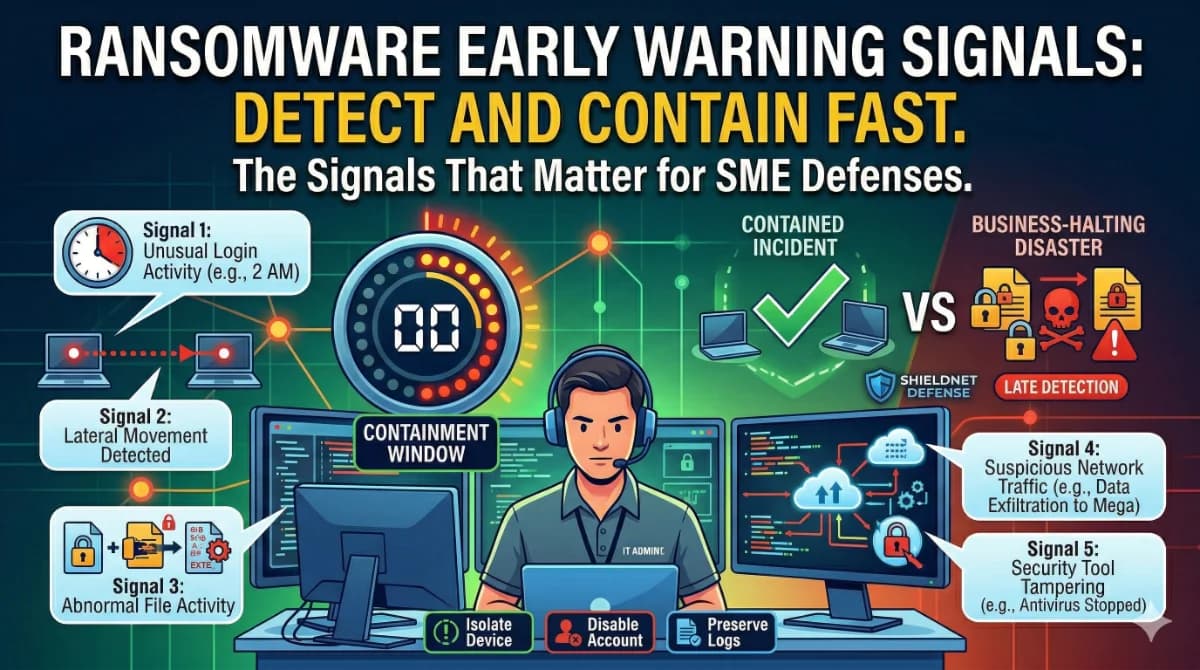
Early Warning Signals: How to Detect and Contain Ransomware Fast
Spot ransomware before files lock. Learn the 5 early warning signals — lateral movement, suspicious encryption, unusual logins — and a fast containment playbook for SMEs.

Apr 10, 2026
ezCloud and ShieldNet 360 officially sign partnership to build a safer digital environment for hotels
On April 10, 2026, ezCloud and ShieldNet 360 officially signed a partnership to help hotels build a safer digital environment.

Apr 9, 2026
How does AI threat detection work in real SOC workflows
How does AI threat detection work for SMEs? Learn AI-driven detection, alert triage automation, false positive reduction, and response orchestration to cut response time.